
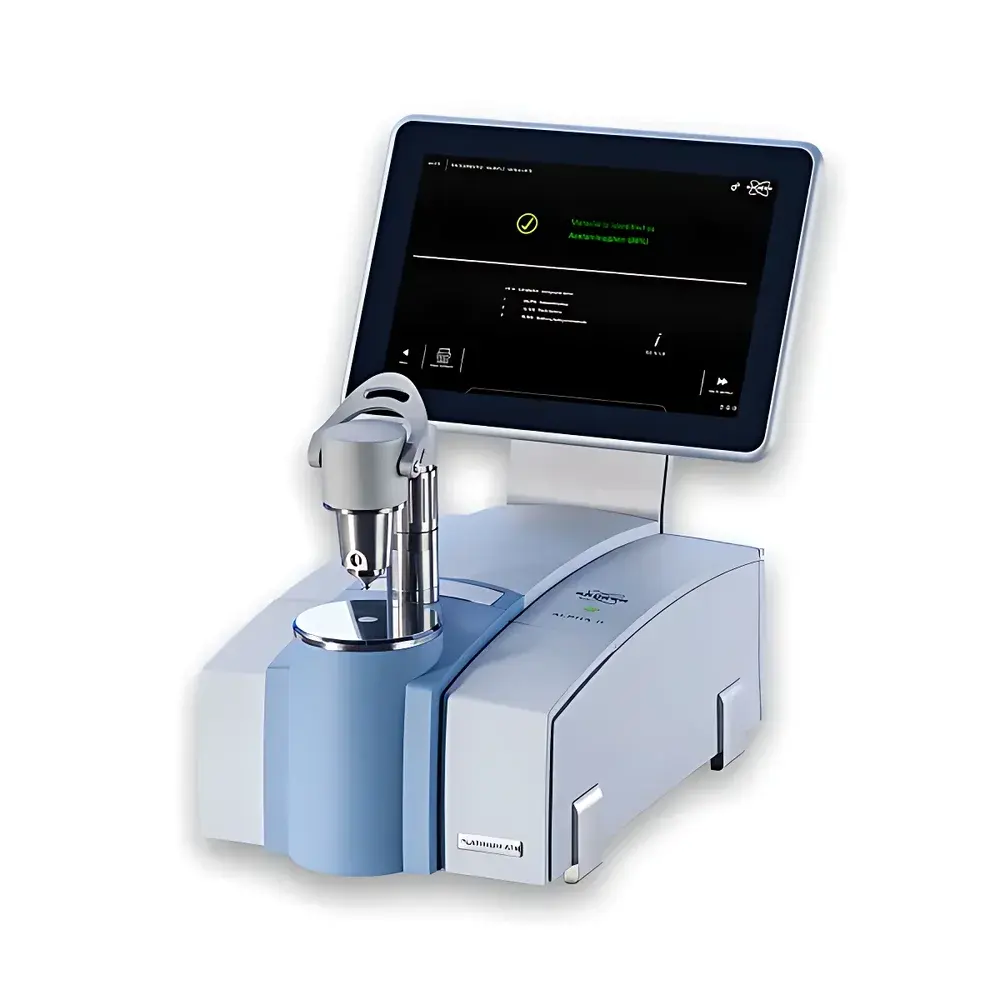
Bruker ALPHA II Fourier Transform Infrared (FT-IR) Spectrometer
| Brand | Bruker |
|---|---|
| Origin | Germany |
| Model | ALPHA II |
| Instrument Type | Laboratory FT-IR Spectrometer |
| Wavenumber Range | 7500–375 cm⁻¹ |
| Spectral Resolution | 0.8 cm⁻¹ |
| Scan Speed | 3 scans/sec |
| Signal-to-Noise Ratio | 50,000:1 |
| Interferometer | RockSolid™ Permanent Alignment Design |
| Light Source | CenterGlow™ High-Efficiency IR Source |
| Laser | Integrated Diode Laser (Long-Term Stability) |
| Optional Features | Integrated Touchscreen PC, Humidity-Resistant Enclosure, Low-Power Operation |
Overview
The Bruker ALPHA II is a compact, high-performance Fourier Transform Infrared (FT-IR) spectrometer engineered for routine and research-grade molecular identification and quantitative analysis in regulated and non-regulated laboratory environments. Based on Michelson interferometry with permanent alignment architecture, the ALPHA II delivers exceptional spectral fidelity through its RockSolid™ interferometer — a monolithic, vibration-insensitive design eliminating the need for periodic realignment and ensuring >10 years of operational stability. Its optical path incorporates a high-radiance CenterGlow™ infrared source (>5 years lifetime) and a temperature-stabilized diode laser for precise wavelength calibration, enabling reproducible wavenumber accuracy across the full spectral range of 7500–375 cm⁻¹. With a native resolution of 0.8 cm⁻¹ and a scan speed of up to 3 spectra per second, the system balances rapid data acquisition with high spectral definition — critical for time-resolved studies, quality control screening, and high-throughput sample workflows.
Key Features
- RockSolid™ interferometer: Fully sealed, alignment-free optical core with no moving mirrors; guarantees long-term spectral reproducibility and eliminates maintenance downtime.
- CenterGlow™ broadband IR source: Optimized thermal emitter delivering high radiant flux and uniform spectral output over its >5-year operational lifetime.
- Integrated diode laser reference: Provides intrinsic wavenumber calibration traceable to fundamental physical constants; supports compliance with ISO 17025 and ASTM E1421.
- Compact footprint (< 30 cm × 30 cm base area): Designed for benchtop integration in space-constrained labs, cleanrooms, or QA/QC environments without sacrificing optical performance.
- Low-power operation (< 35 W typical): Reduces thermal load and energy consumption, supporting sustainability goals and enabling deployment in mobile or off-grid analytical setups.
- Optional integrated touchscreen PC: Pre-installed OPUS spectroscopy software with intuitive graphical interface; supports touch-driven acquisition, processing, and reporting without external peripherals.
- Humidity-resistant configuration: Available with enhanced sealing and desiccant management for reliable operation in tropical or high-humidity laboratories (e.g., pharmaceutical manufacturing sites per WHO TRS 986 Annex 4).
Sample Compatibility & Compliance
The ALPHA II accommodates solid, liquid, and gaseous samples via standardized accessories including diamond ATR (Attenuated Total Reflectance), KBr pellet press, gas cells with pathlengths from 10 cm to 10 m, and liquid transmission cells (CaF₂ or BaF₂ windows). Its modular design allows seamless integration with hyphenated techniques such as TGA-FTIR and GC-FTIR. From a regulatory standpoint, the instrument meets essential requirements for GLP and GMP environments: audit-trail-enabled OPUS software supports 21 CFR Part 11 compliance when configured with electronic signatures and user-role permissions; spectral libraries are validated per USP and EP 2.2.24 guidelines; and hardware design conforms to IEC 61010-1 safety standards for laboratory equipment.
Software & Data Management
OPUS is Bruker’s proprietary, ISO/IEC 17025-aligned spectroscopy platform, offering fully customizable workflows for qualitative identification (library search against >500,000 reference spectra), quantitative modeling (PLS, PCR), and spectral preprocessing (baseline correction, normalization, derivative transformation). All raw interferograms and processed spectra are stored in vendor-neutral, self-documenting OPUS file format (.0, .1, etc.), which embeds metadata including instrument parameters, environmental conditions, operator ID, and timestamp. Data export options include CSV, JCAMP-DX, and SPC formats for LIMS integration. For enterprise deployment, OPUS Connect enables centralized method distribution, remote instrument monitoring, and secure cloud-based spectral repository access — facilitating cross-site collaboration and method harmonization.
Applications
- Pharmaceutical: Raw material identification (RMID), excipient verification, polymorph screening, and cleaning validation swab analysis per FDA Guidance for Industry (2022).
- Polymers & Composites: Additive quantification, degradation assessment, and batch-to-batch consistency testing aligned with ASTM D3418 and ISO 4577.
- Food & Agriculture: Adulteration detection (e.g., honey, olive oil), moisture content estimation, and protein/fat profiling using chemometric models validated per AOAC INTERNATIONAL protocols.
- Academic Research: Reaction monitoring, surface adsorption studies, and thin-film characterization leveraging time-resolved and mapping capabilities.
- Environmental: Microplastic identification in water filtrates and airborne particulate matter using focal plane array (FPA) imaging extensions.
FAQ
Is the ALPHA II compliant with 21 CFR Part 11 for electronic records and signatures?
Yes — when deployed with OPUS software configured for audit trail logging, electronic signature enforcement, and role-based access control, the system satisfies key technical requirements of 21 CFR Part 11.
Can the ALPHA II be used for quantitative analysis out-of-the-box?
Yes — OPUS includes built-in tools for univariate and multivariate calibration (e.g., PLS regression); users can develop, validate, and deploy quantitative methods following ICH Q2(R2) principles.
What is the recommended preventive maintenance schedule?
None required for the interferometer or laser; only periodic cleaning of optical windows and verification of desiccant status (if humidity-resistant version is installed) — typically every 6–12 months depending on ambient conditions.
Does the system support external triggering for process monitoring?
Yes — digital I/O ports enable synchronization with external devices (e.g., reaction controllers, robotic samplers) for time-stamped spectral acquisition in dynamic environments.
How is spectral wavenumber accuracy verified during qualification?
Using NIST-traceable polystyrene film standard (SRM 1921b); Bruker provides IQ/OQ documentation templates aligned with ISO/IEC 17025 and EU GMP Annex 15 requirements.




