
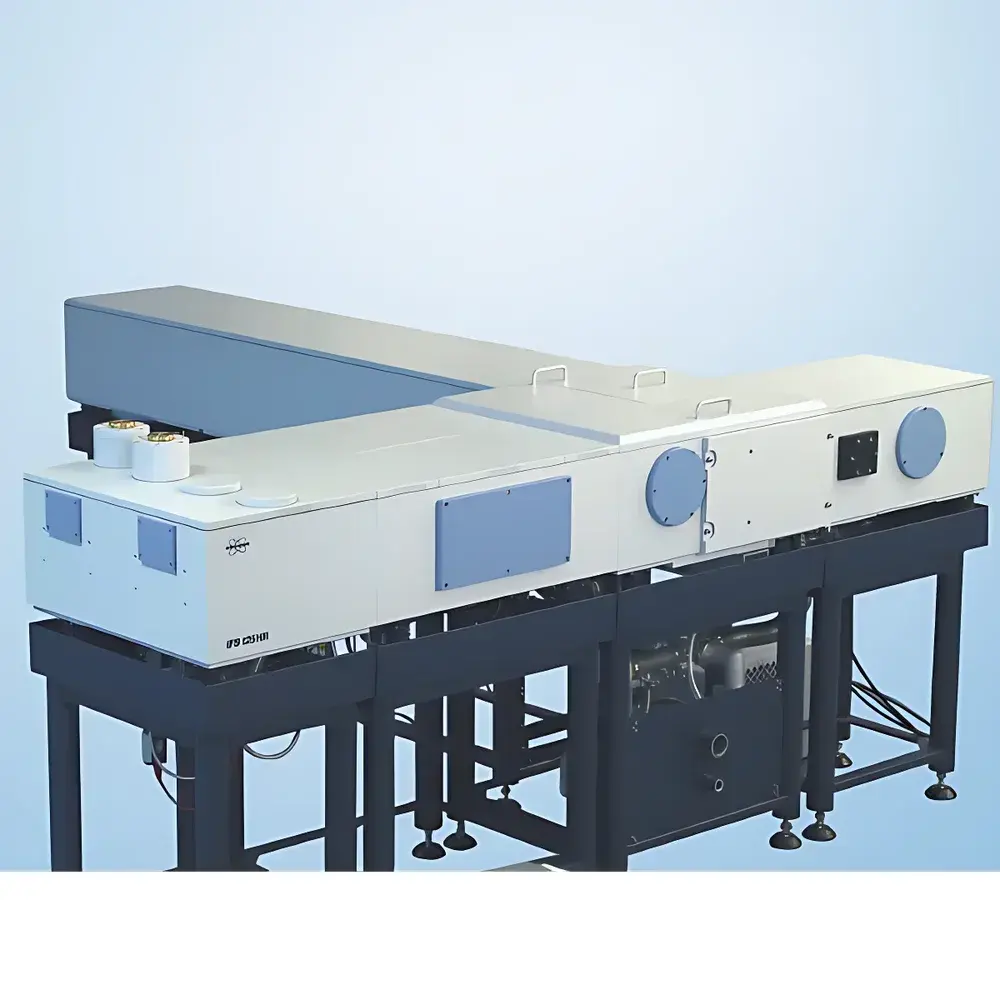
Bruker IFS 125HR High-Resolution Fourier Transform Infrared Spectrometer
| Brand | Bruker |
|---|---|
| Origin | Germany |
| Model | IFS 125HR |
| Instrument Type | Laboratory FTIR Spectrometer |
| Resolution | 0.0009 cm⁻¹ |
| Signal-to-Noise Ratio | >100,000:1 |
| Spectral Range | 5–50,000 cm⁻¹ (Far-IR to UV) |
| Interferometer | Sliding-Bearing Michelson with Hybrid Scan Mechanism |
| Data Acquisition | 24-bit Digitect™ ADC integrated with detector, Ethernet-enabled electronics |
| Vacuum Compatibility | Dual-sample compartment, source/detector exchange without venting |
Overview
The Bruker IFS 125HR is a research-grade high-resolution Fourier transform infrared (FTIR) spectrometer engineered for ultra-precise molecular spectroscopy across an unprecedented spectral range—from 5 cm⁻¹ in the far-infrared to over 50,000 cm⁻¹ in the ultraviolet region. Its core measurement principle relies on time-domain interferometry: a broadband infrared beam is split, recombined after variable path-length delay, and transformed via fast Fourier transform (FFT) into high-fidelity frequency-domain spectra. The instrument achieves its benchmark resolution of 0.0009 cm⁻¹ through a thermally stabilized, vacuum-purged optical bench; a high-precision sliding-bearing Michelson interferometer with hybrid scan architecture; and ultra-low-drift laser referencing (HeNe, 633 nm). This configuration ensures long-term phase stability, minimal instrumental line broadening (<0.009 cm⁻¹), and exceptional reproducibility—critical for isotopic fine-structure analysis, rovibrational line assignment, atmospheric trace-gas monitoring, and fundamental molecular physics studies.
Key Features
- Vacuum-purged optical path (≤10⁻³ mbar) eliminates atmospheric water vapor and CO₂ absorption, enabling artifact-free measurements from far-IR to UV
- Dual independent sample compartments—each configurable with up to four light sources (e.g., globar, SiC, synchrotron beamline coupling, deuterium lamp) and six detectors (MCT, InSb, DTGS, Si, GaP, extended-range InGaAs)
- Hybrid scan interferometer with active mirror position feedback and low-vibration sliding bearings ensures scanning speed stability and sub-nanometer path-length control
- Digitect™ 24-bit analog-to-digital conversion fully integrated at the detector level minimizes electronic noise and preserves dynamic range during rapid data acquisition
- Ethernet-native electronics architecture supports remote operation, synchronized multi-instrument control, and seamless integration into automated laboratory networks
- Modular spectral extension capability: standard mid-IR configuration can be upgraded to near-IR, visible, or UV via interchangeable beamsplitters, sources, and detectors—without realignment or recalibration
Sample Compatibility & Compliance
The IFS 125HR accommodates diverse sample forms—including gases (in multi-pass cells up to 200 m pathlength), liquids (transmission, ATR, photoacoustic), solids (KBr pellets, reflectance, DRIFTS), thin films, and cryogenically cooled single crystals. Its dual-compartment design allows simultaneous reference/sample measurement or differential experiments (e.g., temperature-dependent kinetics, in situ catalysis). All hardware and firmware comply with ISO/IEC 17025 requirements for calibration traceability, and software modules support 21 CFR Part 11-compliant audit trails, electronic signatures, and secure user access levels—enabling deployment in GLP, GMP, and regulated QA/QC environments. Optional NIST-traceable calibration kits (e.g., H₂O vapor lines, rare-earth oxide filters) facilitate routine performance verification per ASTM E1421 and ISO 13777.
Software & Data Management
OPUS spectroscopy software (v8.x or later) provides full instrument control, real-time interferogram inspection, apodization selection, phase correction, and advanced spectral processing—including baseline correction, peak fitting (Voigt, Gaussian, Lorentzian), spectral subtraction, and multivariate analysis (PCA, MCR-ALS). Raw interferograms are stored in Bruker’s proprietary .0 format (lossless compression, metadata-rich), while processed spectra export to ASTM E131, JCAMP-DX, or HDF5 for interoperability with third-party chemometric platforms. Automated batch processing, script-based macro execution (Python API), and RESTful web service interfaces enable integration into LIMS and digital lab infrastructure.
Applications
- Fundamental molecular spectroscopy: rotational-vibrational fine structure analysis of diatomic and polyatomic molecules
- Atmospheric science: high-resolution emission/absorption cross-sections for climate modeling and satellite validation
- Isotope ratio analysis: precise δ¹³C, δ¹⁸O quantification in environmental and geochemical samples
- Condensed-phase dynamics: picosecond-scale vibrational relaxation studies using step-scan mode
- Materials characterization: phonon dispersion mapping in 2D materials and quantum wells
- Pharmaceutical solid-state analysis: polymorph identification and hydrogen-bond network mapping under controlled humidity/temperature
FAQ
What vacuum level is maintained inside the optical bench?
The system operates at ≤10⁻³ mbar, continuously monitored and maintained by a turbomolecular pump with integrated pressure regulation.
Can the IFS 125HR perform step-scan measurements?
Yes—its real-time interferogram digitization and programmable mirror velocity control support step-scan acquisition down to 10 ns time resolution for time-resolved IR studies.
Is external laser synchronization supported?
The instrument features TTL-compatible trigger I/O ports and IEEE-1394 (FireWire) timing interface for synchronization with ultrafast lasers, synchrotron pulses, or THz sources.
How is wavelength accuracy verified?
Calibration uses internal HeNe laser fringe counting combined with periodic validation against NIST-certified spectral line standards (e.g., CO, HF, NH₃ gas cells).
Does OPUS software support automated compliance reporting?
Yes—preconfigured templates generate IQ/OQ/PQ reports aligned with ISO/IEC 17025 and FDA guidance, including instrument performance summaries, calibration history, and user action logs.





