
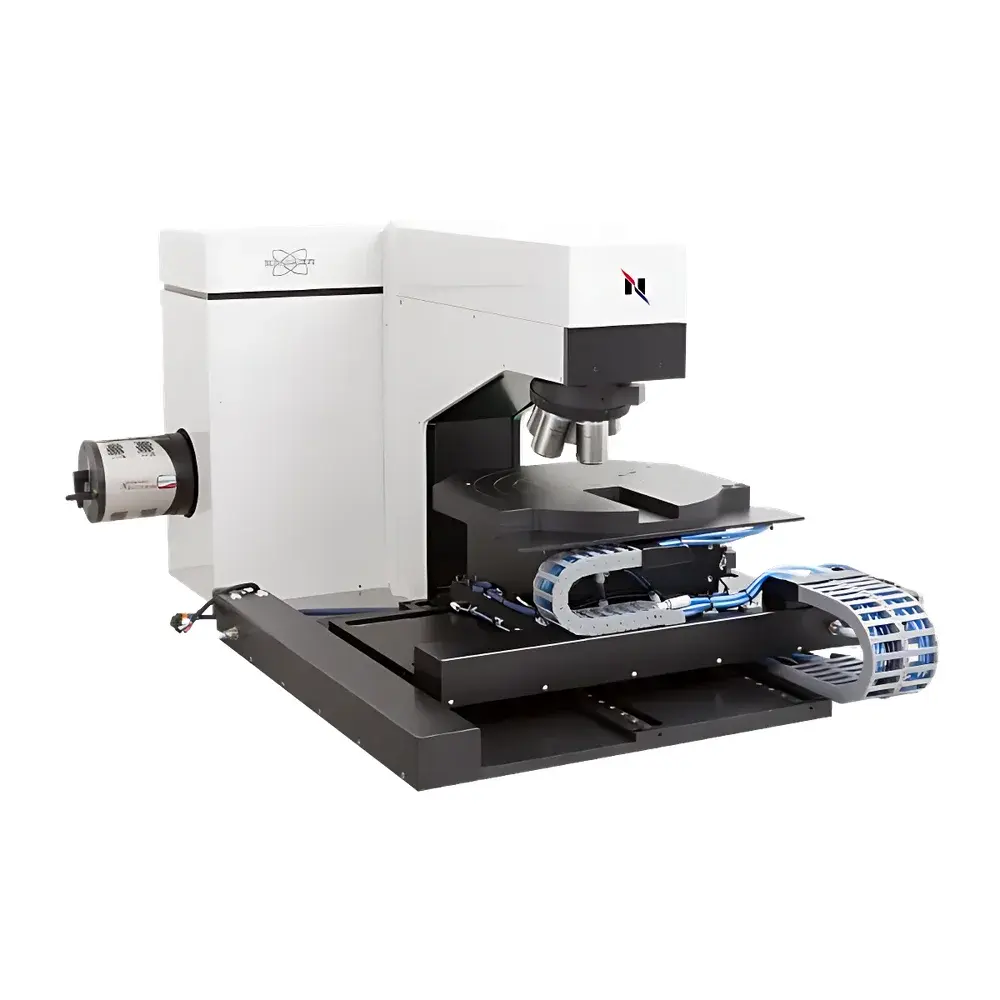
Bruker RAMANdrive Confocal Raman Microscope
| Brand | Bruker |
|---|---|
| Origin | Germany |
| Manufacturer Type | Authorized Distributor |
| Origin Category | Imported |
| Model | RAMANdrive |
| Instrument Type | Confocal Raman Spectrometer (not FT-Raman) |
| Spatial Resolution | 350 nm in X, 500 nm in Y |
| Objective Lenses | 5×, 10×, 20×, 50×, 100×, Darkfield |
| Spectral Resolution | <1.2 cm⁻¹ (grating-dependent) |
| Stage | 300 × 300 × 35 mm XYZ motorized stage |
| Calibration | Auto-calibration using standard lamp and reference sample |
| Alignment | Fully automated optical path alignment |
| Laser Safety | Class I interlocked safety enclosure |
Overview
The Bruker RAMANdrive is a high-performance confocal Raman microscope engineered for nanoscale chemical imaging and quantitative spectroscopic analysis of solid-state materials. Unlike Fourier-transform Raman systems—which rely on interferometry and near-infrared excitation—the RAMANdrive employs point-scanning confocal optics with visible and ultraviolet laser excitation to deliver diffraction-limited spatial resolution and intrinsic depth sectioning capability. Its core architecture integrates a galvanometric mirror-scanned excitation beam, high-numerical-aperture objectives, and a back-illuminated CCD detector optimized for photon efficiency. This configuration enables true confocality with axial (Z) resolution down to 1 µm and lateral (X/Y) resolution approaching 350 nm—well below the classical Abbe limit for visible wavelengths—making it particularly suited for semiconductor metrology, 2D material characterization, and nanomaterial identification where sub-100 nm particle discrimination is required.
Key Features
- Sub-diffraction spatial resolution: 350 nm (X), 500 nm (Y), and 1 µm (Z) achieved via optimized confocal pinhole geometry, high-NA darkfield and standard objectives (5×–100×), and precision laser focus control.
- Multi-wavelength excitation support: Standard configuration includes visible lasers (e.g., 532 nm); optional 325 nm UV laser enables photoluminescence (PL) mapping with shallow penetration depth (~10–50 nm), ideal for surface-sensitive defect and quantum dot analysis in III-nitride semiconductors (e.g., InGaN).
- Fully automated optical alignment and calibration: Integrated standard lamp and certified reference sample enable traceable, repeatable spectral calibration compliant with ISO/IEC 17025 laboratory requirements.
- Motorized XYZ stage (300 × 300 × 35 mm travel range): Supports large-area mosaic mapping, wafer-scale survey scans, and precise repositioning for correlative analysis (e.g., SEM-Raman correlation).
- Class I laser safety enclosure with hardware interlock: Ensures full compliance with IEC 60825-1 and local occupational safety regulations without requiring operator training for laser use.
Sample Compatibility & Compliance
The RAMANdrive accommodates a broad range of solid samples—including polished wafers, thin films, powders mounted on reflective substrates, and freestanding 2D crystals—without vacuum or conductive coating. Its confocal design minimizes fluorescence interference and enables depth-resolved analysis of transparent or semi-transparent materials such as SiC, GaN, sapphire, and diamond. Stress mapping in SiC epitaxial layers is performed via Raman peak shift quantification (e.g., E₂(high) mode at ~796 cm⁻¹), with spatially resolved strain values traceable to NIST-traceable pressure standards. The system supports GLP/GMP-aligned workflows through audit-trail-enabled software logging and optional 21 CFR Part 11 compliance packages.
Software & Data Management
Acquisition and analysis are managed via Bruker’s OPUS software platform, which provides real-time spectral preview, multivariate curve resolution (MCR), hierarchical cluster analysis (HCA), and library search against commercial (e.g., KnowItAll®) and custom-built spectral databases. All raw hyperspectral datasets are stored in HDF5 format with embedded metadata (laser power, objective ID, grating position, stage coordinates), ensuring FAIR (Findable, Accessible, Interoperable, Reusable) data principles. Batch processing scripts can be exported for integration into LIMS or Python-based analytical pipelines.
Applications
- Quantitative stress/strain mapping in wide-bandgap semiconductor wafers (SiC, GaN) for process validation and failure analysis.
- Identification and distribution mapping of sub-100 nm contaminants, residues, or secondary phases in advanced packaging and MEMS fabrication.
- Photoluminescence imaging of InGaN quantum dots under 325 nm excitation to correlate composition gradients with emission wavelength shifts.
- Depth profiling of interfacial reactions in battery electrode cross-sections or thin-film solar cell stacks.
- Non-destructive verification of graphene layer count, doping uniformity, and defect density via G- and 2D-band intensity ratios and linewidth analysis.
FAQ
Is the RAMANdrive an FT-Raman instrument?
No. It is a dispersive confocal Raman microscope utilizing grating-based spectroscopy—not Fourier-transform interferometry. Its design prioritizes spatial resolution and signal-to-noise ratio over broad spectral coverage in a single acquisition.
Can it perform true 3D Raman tomography?
Yes. With its motorized Z-stage and confocal sectioning capability, the system acquires optically sectioned spectra at defined depth intervals, enabling volumetric reconstruction of chemical and mechanical property distributions.
What spectral calibration standards are supported?
The auto-calibration routine uses both a built-in tungsten-halogen lamp for intensity calibration and a silicon reference sample (520.7 cm⁻¹ Raman line) for wavenumber calibration, meeting ISO 17025 traceability requirements.
Does it support correlative microscopy?
Yes. Precise stage coordinate registration allows export of Raman map overlays compatible with SEM, AFM, and optical microscope image files (TIFF, CZI, OME-TIFF formats).
Is remote operation and data review possible?
OPUS software supports secure remote desktop access and web-based spectral viewer modules for collaborative review across geographically distributed teams.





