
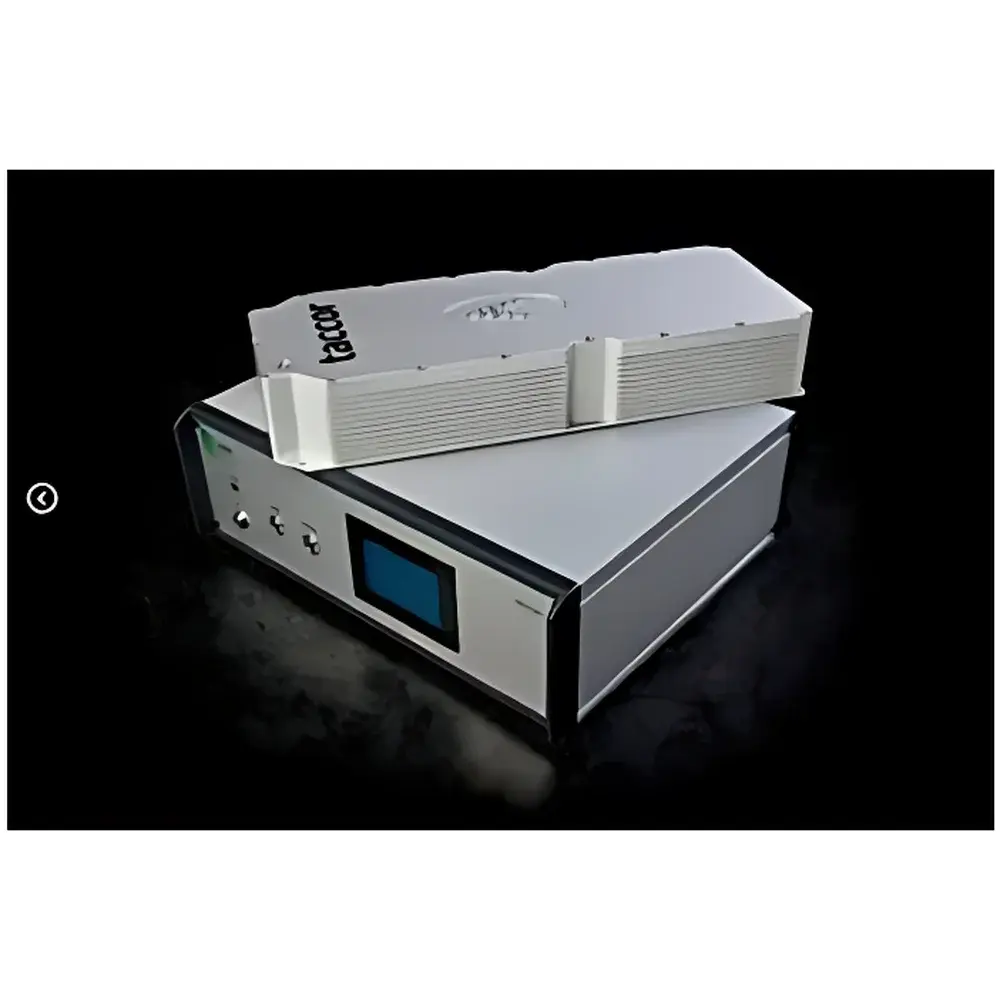
Quantum+GHz Femtosecond Laser System – Taccor Power
| Origin | UK |
|---|---|
| Manufacturer Type | Authorized Distributor |
| Origin Category | Imported |
| Model | Taccor Power |
| Core Technology | Solid-State Mode-Locked Oscillator |
| Repetition Rate | 1 GHz |
| Wavelength Range | ~800 nm (±20 nm) |
| Spectral FWHM | >23 nm |
| Pulse Duration | <30 fs |
| Average Output Power | 800 mW – 1.8 W |
| Beam Diameter | 0.8 mm ± 0.3 mm |
| Beam Divergence | 2.0 mrad ± 0.5 mrad |
| M² | <1.2 (sagittal), <1.2 (tangential) |
| Power Stability | ±1% RMS (24 h) |
| Intensity Noise | <0.1% RMS (1 Hz – 1 MHz) |
| Polarization Ratio | >100:1, Horizontal |
| Operating Temperature | 21 °C ± 5 °C |
| Warm-up Time | ≤10 min |
| Pulse Energy | 0.8 nJ – 1.8 nJ |
| Warranty | 3 years / 9000 operational hours |
Overview
The Quantum+GHz Femtosecond Laser System – Taccor Power is a turnkey, industrial-grade solid-state mode-locked oscillator engineered for high-repetition-rate ultrafast science and precision metrology applications. Operating at a fixed 1 GHz repetition rate, this laser leverages advanced SESAM-based passive mode-locking to deliver sub-30-fs pulses with exceptional amplitude and timing stability. Unlike conventional MHz-repetition-rate oscillators, the 1 GHz architecture provides significantly higher pulse density—enabling improved signal-to-noise ratio in asynchronous optical sampling (ASOPS), enhanced temporal resolution in pump-probe spectroscopy, and reduced photodamage in nonlinear bioimaging. Its broad spectral bandwidth (>23 nm FWHM) supports octave-spanning frequency comb generation when coupled with nonlinear broadening stages, making it suitable for absolute optical frequency metrology traceable to primary cesium standards per ISO/IEC 17025-accredited calibration protocols.
Key Features
- Self-starting, maintenance-free operation with integrated thermal and mechanical stabilization
- Hermetically sealed, alignment-free monolithic cavity—no user-accessible optics or realignment required
- Full remote control via Ethernet (TCP/IP) and USB 2.0; compatible with LabVIEW, Python, and MATLAB APIs
- Factory-installed repetition rate locking to external RF reference (e.g., 1 GHz synthesizer or GPS-disciplined oscillator)
- Optional carrier-envelope phase (CEP) stabilization module available for octave-spanning comb applications
- Complies with IEC 61000-6-3 (EMC emission) and IEC 60825-1:2014 (laser safety Class 4)
- Pre-qualified for GLP/GMP environments: audit-ready firmware logs, timestamped power monitoring, and non-volatile parameter storage
Sample Compatibility & Compliance
The Taccor Power is optimized for integration into vacuum-compatible, vibration-isolated optical tables and OEM instrumentation platforms. Its collimated, diffraction-limited output (M² < 1.2) couples efficiently into single-mode fibers (SMF-28, 780 HP), hollow-core photonic crystal fibers, and nonlinear waveguides. The system meets ISO 10110-3 surface quality specifications for all internal optics and conforms to ASTM E2912–22 for laser-induced damage threshold (LIDT) reporting. All electrical interfaces comply with FDA 21 CFR Part 11 requirements for electronic records and signatures when used in regulated biophotonics workflows. CE marking confirms conformity with EU Machinery Directive 2006/42/EC and Low Voltage Directive 2014/35/EU.
Software & Data Management
The included QuantumControl Suite provides deterministic real-time monitoring of laser parameters—including instantaneous power, pulse energy, repetition rate deviation, and RMS intensity noise—sampled at 10 kHz and logged with microsecond timestamps. Data export supports HDF5 and CSV formats for post-processing in Igor Pro, OriginLab, or custom Python pipelines. Firmware supports secure over-the-air (OTA) updates signed with X.509 certificates. Audit trails record all configuration changes, user logins, and calibration events with SHA-256 hashing—fully compliant with ALCOA+ principles (Attributable, Legible, Contemporaneous, Original, Accurate, Complete, Consistent, Enduring, Available) for regulated laboratories.
Applications
- Biomedical Multiphoton Microscopy: Enables high-speed, low-phototoxicity two-photon excited fluorescence (TPEF) and second-harmonic generation (SHG) imaging at frame rates exceeding 30 fps without pixel dwell time compromise
- Frequency Comb Metrology: Serves as the master oscillator in optical clocks, direct frequency comb spectroscopy (DFCS), and optical arbitrary waveform generation (OAWG) systems
- Ultrafast Pump-Probe Spectroscopy: Delivers sub-30-fs temporal resolution for carrier dynamics studies in 2D materials, perovskites, and quantum dots
- Asynchronous Optical Sampling (ASOPS): Paired with a second free-running oscillator, achieves <100-as timing jitter for THz-TDS and coherent phonon spectroscopy
- Dual-Comb Coherent Anti-Stokes Raman Scattering (DC-CARS): Provides shot-noise-limited vibrational imaging with 10 cm⁻¹ spectral resolution and µs acquisition times
FAQ
Is the Taccor Power compatible with third-party pulse compressors or amplifiers?
Yes—the system features a polarization-maintaining, free-space collimated output with standardized kinematic mounts (SM1-threaded). It has been validated with commercial chirped-pulse amplifiers (CPAs) and grating-based compressors from industry-leading suppliers.
Does the laser support CEP stabilization out of the box?
CEP stabilization is an optional factory-installed upgrade. The base unit includes f–2f interferometer mounting points and low-noise electronics for seamless integration of commercial CEP controllers.
What is the expected lifetime of the SESAM and gain crystal?
Based on accelerated aging tests per MIL-HDBK-217F, the SESAM exhibits >25,000 hours MTBF; the Ti:sapphire crystal shows no measurable degradation after 15,000 hours of continuous operation at rated pump power.
Can the repetition rate be tuned across the GHz range?
The Taccor Power operates at a fixed 1 GHz repetition rate. For tunable repetition rates, consider the Taccor Tune or Gigajet Tune variants, which offer software-controlled adjustment between 500–1000 MHz or 750–850 nm wavelength tuning, respectively.
Is remote diagnostics and predictive maintenance supported?
Yes—embedded health monitoring continuously tracks diode current, cavity temperature gradients, and power supply ripple. Anomalies trigger automated alerts via SMTP or SNMP, enabling proactive service dispatch before performance drift occurs.




