
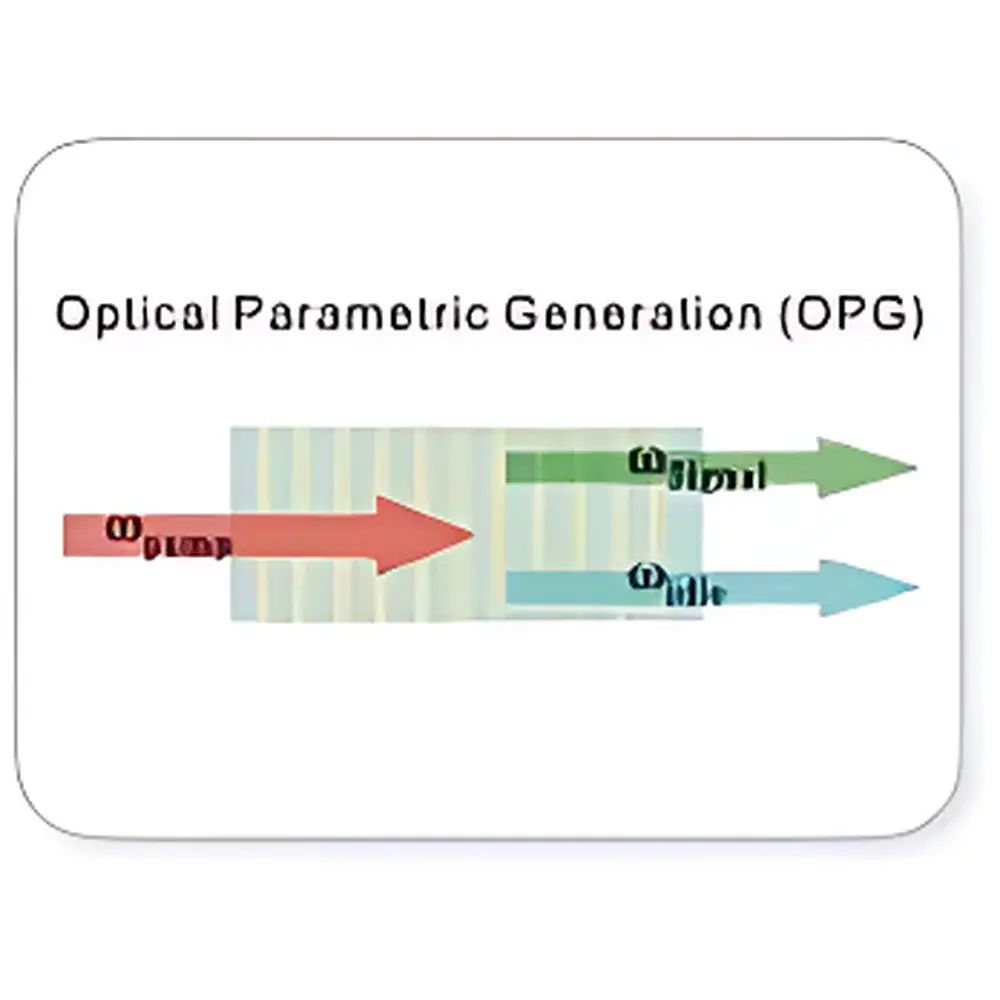
PPLN Crystal for Optical Parametric Generation (OPG)
| Brand | HCP |
|---|---|
| Origin | Taiwan |
| Model | PPLN-OPG |
| Coating | AR-coated |
| Grating Period Options | Single-period, Multi-period, Fan-out |
| Grating Length (X) | 0.3 mm, 0.5 mm, 1.0 mm, 10 mm, 25 mm, 50 mm |
| Crystal Thickness (Z) | 1.0 mm, 2.0 mm, 3.0 mm |
| Tunable Output Wavelength Range | 1395–4433 nm |
Overview
The HCP PPLN-OPG is a periodically poled lithium niobate (PPLN) crystal engineered for optical parametric generation (OPG), serving as the core nonlinear medium in ultrafast and CW-pumped parametric light sources. Based on second-order nonlinear optical processes governed by quasi-phase-matching (QPM), this crystal enables efficient wavelength conversion through difference-frequency generation (DFG), sum-frequency generation (SFG), or optical parametric amplification (OPA). Its precisely fabricated ferroelectric domain grating ensures high conversion efficiency and broad spectral coverage across the near- to mid-infrared (NIR–MIR) range — from 1395 nm to 4433 nm — making it suitable for spectroscopic, metrological, and quantum optics applications requiring tunable coherent radiation.
Key Features
- High-quality, stoichiometric lithium niobate substrate with uniform domain inversion and low propagation loss
- AR-coated surfaces (R < 0.2% per surface) optimized for common pump wavelengths (e.g., 532 nm, 780 nm, 1064 nm, and 1550 nm)
- Multiple grating architectures: single-period (fixed λsignal/λidler), multi-period (broadband tuning), and fan-out (continuous wavelength scanning without mechanical repositioning)
- Precisely controlled poling period accuracy (< ±0.5% tolerance) to ensure phase-matching fidelity and reproducible output spectra
- Available grating lengths from 0.3 mm to 50 mm — enabling trade-offs between gain bandwidth, threshold power, and spatial walk-off compensation
- Crystal thickness options of 1.0 mm, 2.0 mm, and 3.0 mm — selected based on pump intensity, thermal management requirements, and group-velocity matching constraints
- Fully customizable geometry, poling pattern, and coating specifications to match system-level integration needs (e.g., waveguide confinement, cavity alignment, or fiber-coupled packaging)
Sample Compatibility & Compliance
The PPLN-OPG crystal is compatible with standard free-space and fiber-pigtailed OPG/OPO/OPA platforms operating under nanosecond, picosecond, or femtosecond pulse regimes. It supports both Type-0 (e→e + e) and Type-I (e→o + o) QPM configurations depending on crystal cut and polarization orientation. All crystals undergo post-poling annealing and optical inspection per ISO 10110-7 standards for surface quality and bulk homogeneity. While not a finished instrument, the crystal complies with material traceability and documentation requirements aligned with GLP-compliant optical component procurement practices. No RoHS or REACH non-conformities are present; full material safety data is available upon request.
Software & Data Management
As a passive optical component, the PPLN-OPG does not include embedded firmware or control software. However, its performance is fully supported by industry-standard modeling tools including SNLO (ASD Inc.), MATLAB-based QPM simulators, and commercial OPO design suites (e.g., LightTrans VirtualLab Fusion). Users can input exact grating period, length, temperature, and pump parameters to predict phase-matching curves, gain spectra, and conversion efficiency maps. For systems requiring automated wavelength tuning (e.g., fan-out gratings), integration with motorized translation stages and PID-controlled ovens is facilitated via standard analog/digital I/O interfaces. Audit-trail-capable lab notebooks (e.g., LabArchives, Benchling) may be used to log crystal batch numbers, calibration records, and experimental tuning histories in accordance with 21 CFR Part 11 guidelines where applicable.
Applications
- Mid-infrared spectroscopy for gas sensing (e.g., CH4, CO2, NOx, NH3) using tunable idler output between 2.5–4.4 µm
- Ultrafast pulse characterization via cross-correlation frequency-resolved optical gating (XFROG) and spectral phase interferometry (SPIDER)
- Quantum state engineering in spontaneous parametric down-conversion (SPDC) setups for entangled photon pair generation
- Frequency comb extension into the molecular fingerprint region for dual-comb spectroscopy
- Coherent anti-Stokes Raman scattering (CARS) microscopy with synchronized signal and idler beams
- Terahertz generation via difference-frequency mixing in thicker PPLN variants (not included in standard OPG configuration but feasible with custom Z-dimension)
FAQ
What pump wavelengths are compatible with the PPLN-OPG crystal?
Standard configurations support 532 nm (frequency-doubled Nd:YAG), 780 nm (Ti:sapphire), 1064 nm (Nd:YAG), and 1550 nm (Er-fiber) pumps. Custom poling periods can be designed for other fundamental wavelengths upon request.
Is temperature tuning required for wavelength selection?
Yes — for single-period crystals, fine-tuning (±5–10 nm) is achieved via crystal oven control (typically 25–200 °C). Multi-period and fan-out gratings reduce or eliminate the need for thermal scanning.
Can the crystal be mounted in vacuum or UHV environments?
Yes — the crystal is vacuum-compatible when properly housed in OFHC copper or stainless-steel mounts with indium or gold gasket sealing. Outgassing rates meet ASTM E595 specifications.
Do you provide test reports or phase-matching verification data?
Each batch includes a certificate of conformance with measured domain periodicity (via SEM or SHG microscopy), surface flatness (λ/10 @ 633 nm), and coating reflectance spectra. Full SHG efficiency validation data is available as an optional add-on service.
What is the damage threshold for femtosecond pulses?
For 100-fs pulses at 1064 nm, the typical LIDT is ≥ 0.5 J/cm² (tested per ISO 21254-2). Actual threshold depends on beam quality, spot size, and repetition rate — consult application engineering for system-specific evaluation.




