
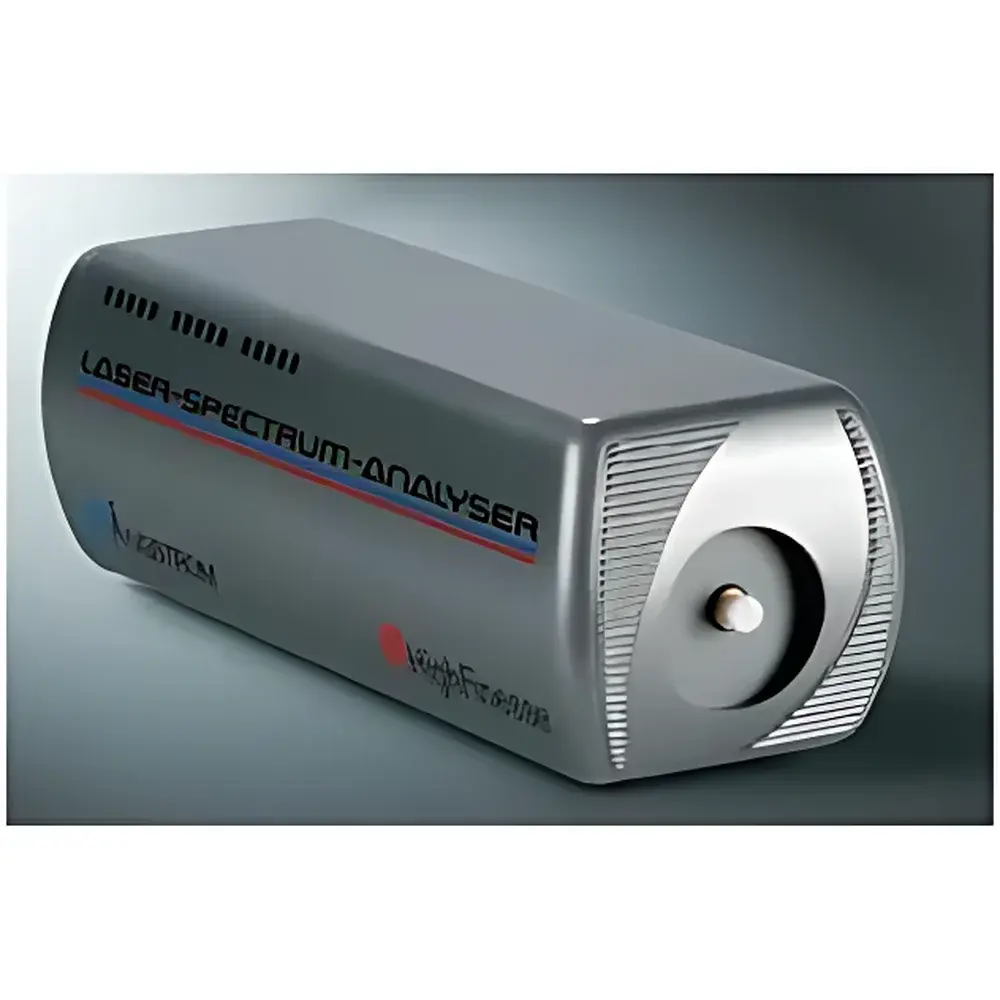
HighFinesse LSA Laser Spectrum Analyzer
| Brand | HighFinesse |
|---|---|
| Origin | Germany |
| Model | LSA |
| Wavelength Range | 350–1100 nm (standard), 200–1100 nm (UV option) |
| Measurement Accuracy | ±5 pm @ 633 nm |
| Sensitivity | 5 nJ @ 633 nm |
| Maximum Spectral Range in High-Resolution Mode | λ/30 |
| Spectral Finesse | 30,000 (single-mode fiber), 15,000 (50 µm multimode fiber) |
| First-Order Calibration Accuracy | ±1 nm |
| Relative Linewidth Measurement Accuracy | ±5 × 10⁻⁶ (single-mode fiber) |
| Repetition Rate | up to 100 Hz |
| Light Source Compatibility | CW and pulsed lasers, gas ion lamps, superluminescent diodes (SLDs), laser diodes (LDs), and light-emitting diodes (LEDs) |
Overview
The HighFinesse LSA Laser Spectrum Analyzer is a high-precision interferometric spectrometer engineered for absolute wavelength calibration, spectral line shape analysis, and narrow-linewidth characterization of coherent and quasi-coherent optical sources. Based on the principle of scanning Fabry–Pérot interferometry, the LSA delivers sub-picometer resolution without reliance on external wavelength references—enabling traceable, self-calibrating spectral measurements in laboratory and industrial metrology environments. Its core architecture features a thermally stabilized, air-spaced etalon with piezoelectric tuning, allowing continuous, linearized spectral scans across the visible to near-infrared spectrum. Designed for applications demanding rigorous spectral fidelity—including laser stabilization, cavity mode analysis, and frequency comb characterization—the LSA operates with intrinsic reproducibility and long-term drift stability compliant with ISO/IEC 17025 metrological requirements.
Key Features
- Interferometric resolution down to 5 pm at 633 nm—enabling discrimination of closely spaced longitudinal modes in single-frequency lasers.
- Two operational configurations: standard (350–1100 nm) and extended UV-enhanced (200–1100 nm) optics, optimized for broadband deep-UV throughput and reduced solarization effects.
- Dynamic sensitivity of 5 nJ per pulse at 633 nm, supporting low-energy pulsed sources including nanosecond Q-switched microchip lasers and femtosecond oscillator outputs (with appropriate attenuation).
- Configurable input coupling: single-mode fiber (SMF-28) for maximum finesse (30,000) or 50 µm core multimode fiber for enhanced alignment tolerance and higher power handling.
- Real-time acquisition at up to 100 Hz scan repetition rate—facilitating closed-loop feedback control integration in active laser stabilization systems.
- Onboard wavelength calibration using built-in HeNe reference line (632.8165 nm), traceable to NIST standards, with automated recalibration routines executed prior to each measurement sequence.
Sample Compatibility & Compliance
The LSA accommodates both continuous-wave (CW) and time-gated pulsed optical sources, with integrated trigger synchronization for pulse-to-scan alignment. It supports spectral analysis of multi-line emitters (e.g., argon-ion, krypton-ion, and HeNe lasers), broadband incoherent sources (SLDs, LEDs), and narrowband tunable oscillators. All optical paths comply with IEC 61000-4-3 (EMC immunity) and IEC 60825-1:2014 (laser safety classification interface). Data integrity protocols align with FDA 21 CFR Part 11 requirements when operated with HighFinesse’s optional validated software suite (LSA Control v4.x), including electronic signatures, audit trails, and user role-based access control. The system meets ISO 17025 clause 5.9 for measurement uncertainty reporting and supports GLP-compliant documentation workflows.
Software & Data Management
The LSA is controlled via HighFinesse’s native LSA Control application (Windows 10/11, 64-bit), which provides real-time spectral visualization, peak search with Gaussian/Lorentzian fitting, full-width-at-half-maximum (FWHM) extraction, and beat-note analysis for dual-laser heterodyne verification. Raw interferogram data (16-bit, 2048-point) and calibrated spectra (wavelength vs. intensity) are exportable in HDF5, CSV, and SPC formats. API support (DLL and Python bindings) enables integration into LabVIEW, MATLAB, and Python-based automation frameworks for high-throughput QC testing. All measurement metadata—including environmental temperature, etalon voltage history, and calibration timestamp—is embedded in file headers for full traceability.
Applications
- Verification of wavelength accuracy and mode-hop-free tuning range in external cavity diode lasers (ECDLs) and distributed feedback (DFB) lasers.
- Linewidth quantification of ultra-stable lasers used in optical atomic clocks and gravitational wave interferometry (e.g., LIGO-type pre-stabilized lasers).
- Spectral purity assessment of fiber amplifiers and master oscillator power amplifier (MOPA) systems under varying pump conditions.
- Characterization of spectral narrowing dynamics during cavity dumping or injection seeding in pulsed solid-state lasers.
- Calibration validation of wavemeters and optical spectrum analyzers (OSAs) against primary interferometric standards.
- Quantitative analysis of spontaneous emission profiles in semiconductor optical amplifiers (SOAs) and amplified spontaneous emission (ASE) noise suppression efficiency.
FAQ
What is the minimum measurable linewidth with the LSA?
The practical lower limit depends on source coherence and signal-to-noise ratio; for a stable CW laser at 633 nm with >1 mW power and optimal SMF coupling, sub-MHz equivalent linewidths (corresponding to <10 pm FWHM) can be resolved with statistical confidence.
Can the LSA measure broadband LED spectra with high dynamic range?
Yes—its linear response over 5 decades of intensity and adaptive gain control allow simultaneous capture of dominant peaks and weak sidebands; however, spectral smoothing and deconvolution algorithms are recommended for accurate radiant flux density reconstruction.
Is vacuum operation supported for UV measurements below 200 nm?
No—the LSA’s UV-extended configuration uses fused silica optics and MgF₂ coatings but remains an air-path instrument; for vacuum-compatible VUV spectroscopy (<200 nm), alternative grating-based systems are recommended.
How often does the internal HeNe reference require recalibration?
The HeNe reference is factory-aligned and drift-compensated via thermal monitoring; HighFinesse recommends annual verification against an NIST-traceable wavelength standard in accredited metrology labs.
Does the LSA support external triggering for synchronized pulsed measurements?
Yes—TTL-compatible trigger input accepts rising-edge signals with programmable delay (0–10 ms, 10 ns resolution) to align interferometric sampling with laser pulse arrival time.




