
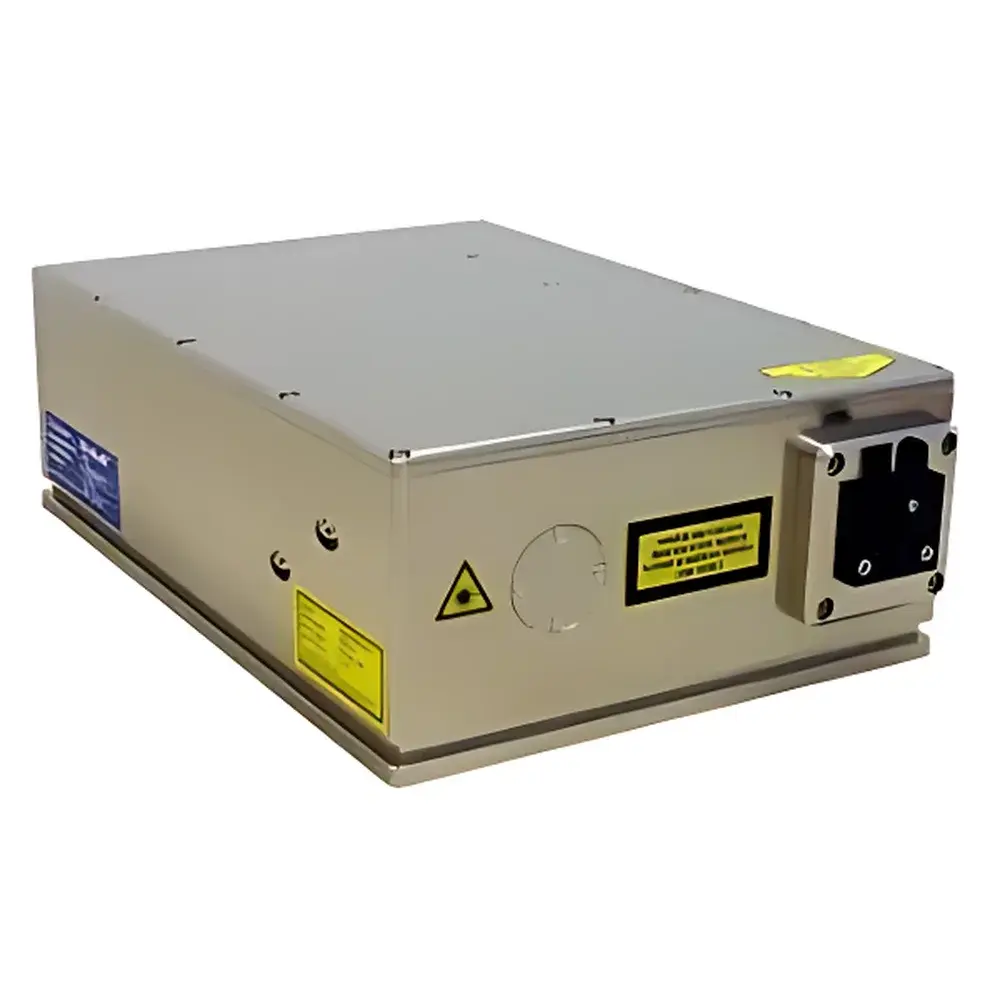
Crystal Laser FQCW 266-100 UV Continuous-Wave Laser System
| Brand | CrystaLaser |
|---|---|
| Origin | Germany |
| Model | FQCW 266-100 |
| Wavelength | 266 nm |
| Operation Mode | Continuous Wave (CW) |
| Output Power | 100 mW (typ.) |
| Beam Quality | TEM₀₀, M² < 1.1 |
| Power Stability | < ±0.5% RMS over 8 h |
| Noise | < 0.3% RMS (10 Hz–10 MHz) |
| Coherence Length | > 10 m |
| Polarization | Linear, > 100:1 |
| Warm-up Time | < 5 min |
| Cooling | Air-cooled |
| Control Interface | Analog (0–5 V) & Digital (RS232/USB) |
| Compliance | CE, RoHS, FDA CDRH Class IIIb |
Overview
The Crystal Laser FQCW 266-100 is a compact, air-cooled, continuous-wave (CW) ultraviolet laser system engineered for high-stability, low-noise operation at 266 nm. Based on intracavity frequency quadrupling of a diode-pumped Nd:YAG or Nd:YVO₄ fundamental source, this laser delivers true CW emission—distinct from quasi-CW or modulated outputs—enabling applications requiring long coherence length, narrow spectral linewidth, and exceptional amplitude stability. Its monolithic, hermetically sealed resonator architecture ensures robustness against environmental drift and mechanical perturbation, making it suitable for integration into OEM instrumentation, laboratory-grade metrology platforms, and regulated industrial environments. Unlike pulsed 266 nm sources (e.g., Q-switched Nd:YAG harmonics), the FQCW 266-100 provides uninterrupted photon flux ideal for time-resolved fluorescence lifetime measurements, interference-based alignment systems, and steady-state photochemical excitation.
Key Features
- True continuous-wave output at 266 nm with TEM₀₀ spatial mode (M² < 1.1) and diffraction-limited beam propagation
- Closed-loop power regulation enabling precise analog (0–5 V) and digital (RS232/USB) control of output intensity from 10% to 100% of rated power
- Ultra-low amplitude noise (< 0.3% RMS, 10 Hz–10 MHz bandwidth), critical for heterodyne detection and quantum optics experiments
- Coherence length exceeding 10 meters—validated via Michelson interferometry—supporting high-resolution interferometric sensing and holographic recording
- Integrated thermal management and passive stabilization ensure < ±0.5% RMS power stability over 8-hour continuous operation
- Compliant with IEC 60825-1:2014 and FDA 21 CFR Part 1040.10 (Class IIIb laser product), including interlock-ready safety circuitry and key-controlled enable interface
Sample Compatibility & Compliance
The FQCW 266-100 is compatible with standard optical mounts (e.g., SM1-threaded collimators, kinematic mirror mounts) and integrates seamlessly into vacuum-compatible enclosures when equipped with optional fused silica Brewster windows. Its 266 nm output couples efficiently into silica-core single-mode fibers (e.g., UV-grade SM600) and excites deep-UV fluorescence in biological fluorophores (e.g., tryptophan, NADH) and semiconductor defect states (e.g., silicon vacancy centers). The system meets ISO 13406-2 for laser-induced damage threshold (LIDT) certification on coated optics and conforms to ASTM E275 for UV source characterization methodology. For GMP/GLP-regulated workflows—including wafer inspection and pharmaceutical photostability testing—the laser supports audit-trail-capable power logging via its USB interface and adheres to EU Directive 2014/30/EU (EMC) and 2011/65/EU (RoHS).
Software & Data Management
Crystal Laser provides the proprietary CLControl Suite (v3.2+), a cross-platform application (Windows/macOS/Linux) supporting real-time power monitoring, scheduled power ramping, and automated calibration sequence execution. All operational parameters—including setpoint history, temperature logs, and error codes—are timestamped and exportable in CSV/JSON format compliant with 21 CFR Part 11 requirements when deployed with validated electronic signature modules. The RS232 and USB interfaces support SCPI command syntax, enabling native integration into LabVIEW™, Python (PySerial), MATLAB®, and EPICS-based control frameworks. Firmware updates preserve configuration integrity and include cryptographic signature verification to prevent unauthorized modification.
Applications
- Photolithography & Mask Alignment: Stable 266 nm illumination for sub-micron feature definition in mask aligners and direct-write systems
- Interferometric Metrology: Long-coherence-length source for displacement measurement in Fabry–Pérot cavities and gravitational wave detector prototypes
- Raman & Resonance Fluorescence Spectroscopy: Excitation of UV-resonant vibrational modes in polymers, proteins, and 2D materials (e.g., h-BN)
- Semiconductor Inspection: Non-contact surface defect mapping via UV scattering contrast enhancement on Si, GaN, and sapphire wafers
- Time-Correlated Single Photon Counting (TCSPC): Low-jitter CW excitation source for fluorescence lifetime imaging (FLIM) in confocal and multiphoton microscopes
- OEM Integration: Drop-in replacement for nitrogen lasers in MALDI ion sources and portable LIDAR transceivers where size, weight, and wall-plug efficiency are constrained
FAQ
Is the FQCW 266-100 suitable for use in cleanroom environments?
Yes—the unit features particle-free internal optics, anodized aluminum housing, and zero outgassing elastomers, meeting ISO Class 5 particulate limits when operated within specified ambient temperature (15–30 °C) and humidity (30–60% RH) ranges.
Can output power be modulated at kHz frequencies?
No—this is a strictly CW source; for analog modulation, external AOMs or EOMs must be used. The internal power control loop operates at < 10 Hz bandwidth and is intended for slow-setpoint adjustment only.
What is the typical lifetime of the nonlinear crystal assembly?
Under nominal operating conditions and proper thermal management, the BBO or CLBO frequency-conversion crystal exhibits > 10,000 hours MTBF, as verified per Telcordia GR-468-CORE reliability testing protocols.
Does the system support remote diagnostics via network interface?
Not natively—the RS232/USB interface requires host PC connection; however, third-party Ethernet-to-serial gateways (e.g., Lantronix XDirect) enable TCP/IP access when deployed in controlled lab networks.
Are beam pointing stability specifications available?
Yes—angular drift is specified as < 3 µrad/°C over the operating temperature range, measured via quadrant photodiode tracking per ISO 11146-1 Annex B.






