
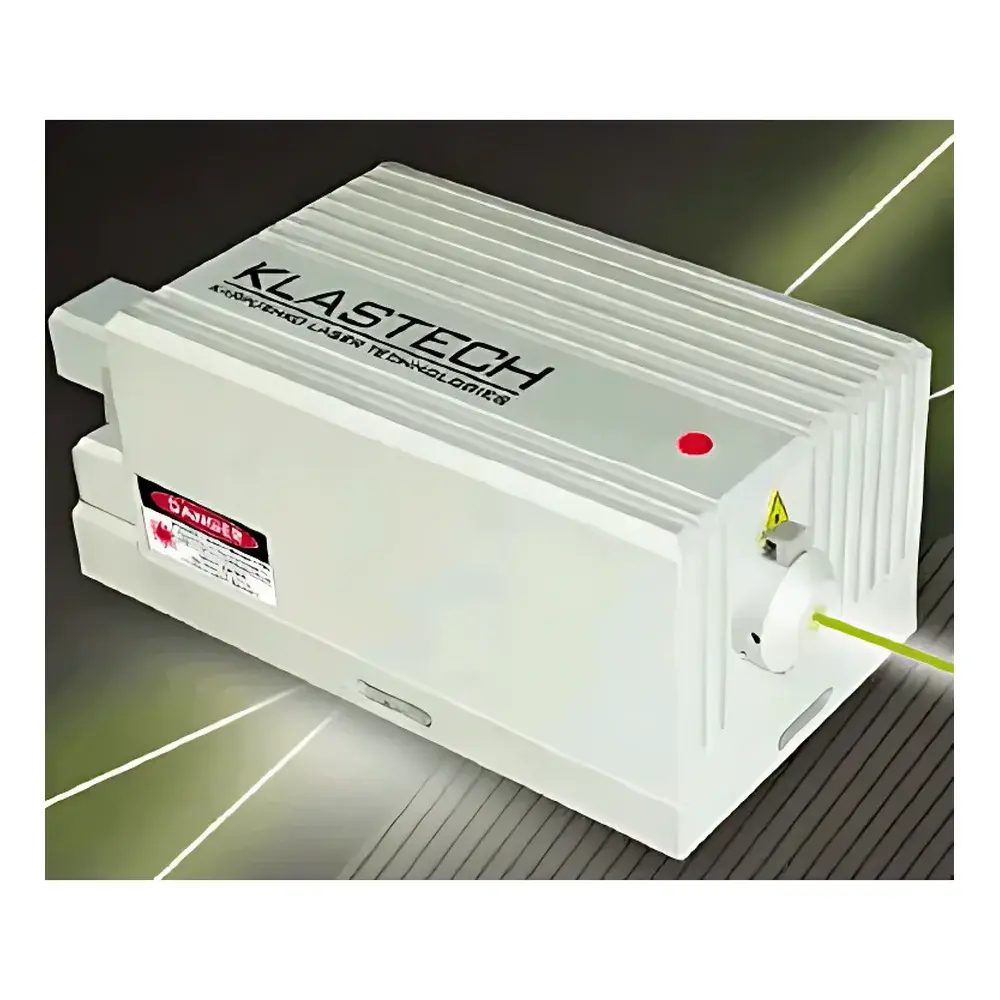
Symphony® 532nm DPSS High-Power Continuous-Wave Laser System
| Wavelength | 532 nm |
|---|---|
| Output Power (CW) | 1000 mW |
| Beam Diameter | 0.7 mm ±0.2 mm (@ 10 mm, 1/e²) |
| Beam Mode | TEM₀₀, M² < 1.05 |
| Divergence | <1 mrad (½ angle) |
| Beam Pointing Stability | ≤10 μrad / °C |
| Longitudinal Mode | Single Longitudinal Mode (SLM), Linewidth <1 MHz |
| Polarization | Vertical, Extinction Ratio ≥100:1 |
| Intensity Noise (p-p) | ≤2% (10 Hz–10 MHz) |
| Intensity Noise (rms) | ≤0.3% (10 Hz–10 MHz) |
| Power Stability | ≤2% over 4 hours |
| Operating Temperature | 15–35 °C |
| Storage Temperature | 10–50 °C |
| Laser Head Dimensions | 186 × 139 × 96 mm |
| Laser Head Weight | 2540 g |
| Power Supply Dimensions | 225 × 246 × 110 mm |
| Power Supply Weight | 2960 g |
Overview
The Symphony® 532nm DPSS High-Power Continuous-Wave Laser System is a solid-state, diode-pumped laser engineered for demanding scientific and industrial applications requiring high spectral purity, exceptional beam quality, and long-term amplitude stability. Based on intracavity frequency-doubling of a Nd:YVO₄ or Nd:YAG crystal, this system delivers stable 532 nm green light with true single longitudinal mode (SLM) operation—critical for interferometric precision, coherent detection, and nonlinear optical pumping. Its TEM₀₀ output, M² 150 m), narrow linewidth (<1 MHz), and low relative intensity noise (RIN), enabling reproducible measurements across extended acquisition windows.
Key Features
- True single longitudinal mode (SLM) emission with linewidth 150 m—essential for heterodyne detection and cavity-enhanced spectroscopy
- TEM₀₀ Gaussian beam profile with M² < 1.05 and beam diameter 0.7 mm ±0.2 mm (1/e² at 10 mm), optimized for high-efficiency coupling into optical cavities and fiber-based systems
- Vertical linear polarization with extinction ratio ≥100:1, supporting polarization-sensitive experiments such as ellipsometry and electro-optic modulation
- Beam pointing stability ≤10 μrad/°C, minimizing thermal drift during multi-hour acquisitions in vibration-isolated environments
- Low-intensity noise performance: ≤0.3% rms (10 Hz–10 MHz) and ≤2% p-p, meeting specifications for quantitative phase imaging and photon correlation spectroscopy
- Integrated thermal management and active power regulation ensure ≤2% power drift over 4 hours—validated under GLP-compliant operational protocols
Sample Compatibility & Compliance
The Symphony® 532nm laser is compatible with standard optomechanical mounts (e.g., Thorlabs KM100, Newport UMB-1), kinematic mirror mounts, and OEM integration interfaces including TTL modulation input and analog power control (0–5 V). It operates within Class 3B laser safety limits per IEC 60825-1:2014 and complies with FDA 21 CFR Part 1040.10/1040.11 for US market deployment. The system supports audit-ready operation in regulated environments: firmware logs timestamped power calibration events, and all user-accessible settings are traceable via internal non-volatile memory—aligning with ISO/IEC 17025 documentation requirements for accredited testing laboratories.
Software & Data Management
While the Symphony® 532nm operates as a stand-alone instrument with front-panel controls, optional USB- and RS-232–enabled interface modules enable remote parameter configuration and real-time monitoring of output power, temperature, and interlock status. Integration with LabVIEW™, MATLAB®, and Python (via PySerial or vendor SDK) allows synchronization with data acquisition hardware (e.g., National Instruments DAQ cards) and automated calibration routines. All logged parameters adhere to FAIR data principles—machine-readable timestamps, SI-traceable units, and metadata-enriched export (CSV, HDF5)—facilitating compliance with electronic lab notebook (ELN) systems used in pharmaceutical QC and academic research repositories.
Applications
- Holographic interferometry and digital holography for micro-deformation analysis in MEMS and composite material testing
- Laser Doppler vibrometry (LDV) for non-contact modal analysis of aerospace components and micro-electromechanical systems
- Particle image velocimetry (PIV) and laser sheet illumination in fluid dynamics research, leveraging high brightness and low divergence
- Pumping of Ti:Sapphire oscillators in ultrafast laser systems requiring narrowband, diffraction-limited 532 nm excitation
- Forensic document examination and latent fingerprint enhancement using coherent green illumination for fluorescence excitation and contrast optimization
- Calibration of spectroradiometers and CCD/CMOS quantum efficiency mapping systems where spectral accuracy and spatial uniformity are critical
FAQ
Is the Symphony® 532nm laser compliant with FDA 21 CFR Part 1040.10 for medical device integration?
Yes—the system carries full Class 3B certification and includes integrated key-switch interlock, emission indicator, and beam shutter functionality required for OEM integration into diagnostic or analytical instruments subject to FDA review.
Can the laser be operated in external modulation mode for pulsed applications?
The standard configuration supports TTL-compatible blanking (up to 100 kHz) and analog power control (0–5 V, 0–100%); custom firmware variants support gated CW operation synchronized to external triggers with <100 ns jitter.
What cooling method is used, and does it require chilled water?
The laser employs thermoelectric (TEC) cooling with intelligent feedback control; no external chiller or tap water connection is required—operation is fully self-contained within the specified 15–35 °C ambient range.
Does the system include beam profiling or power meter calibration certificates?
A NIST-traceable power meter calibration certificate (ISO/IEC 17025 accredited) is provided with each unit; optional beam profiler integration (e.g., Ophir NanoScan) is supported via standardized mechanical and electrical interfaces.
How is long-term wavelength stability maintained over temperature fluctuations?
The resonator incorporates athermal design principles and active cavity length stabilization via piezoelectric transducer feedback, ensuring wavelength drift <±1 pm over the full operating temperature range.




