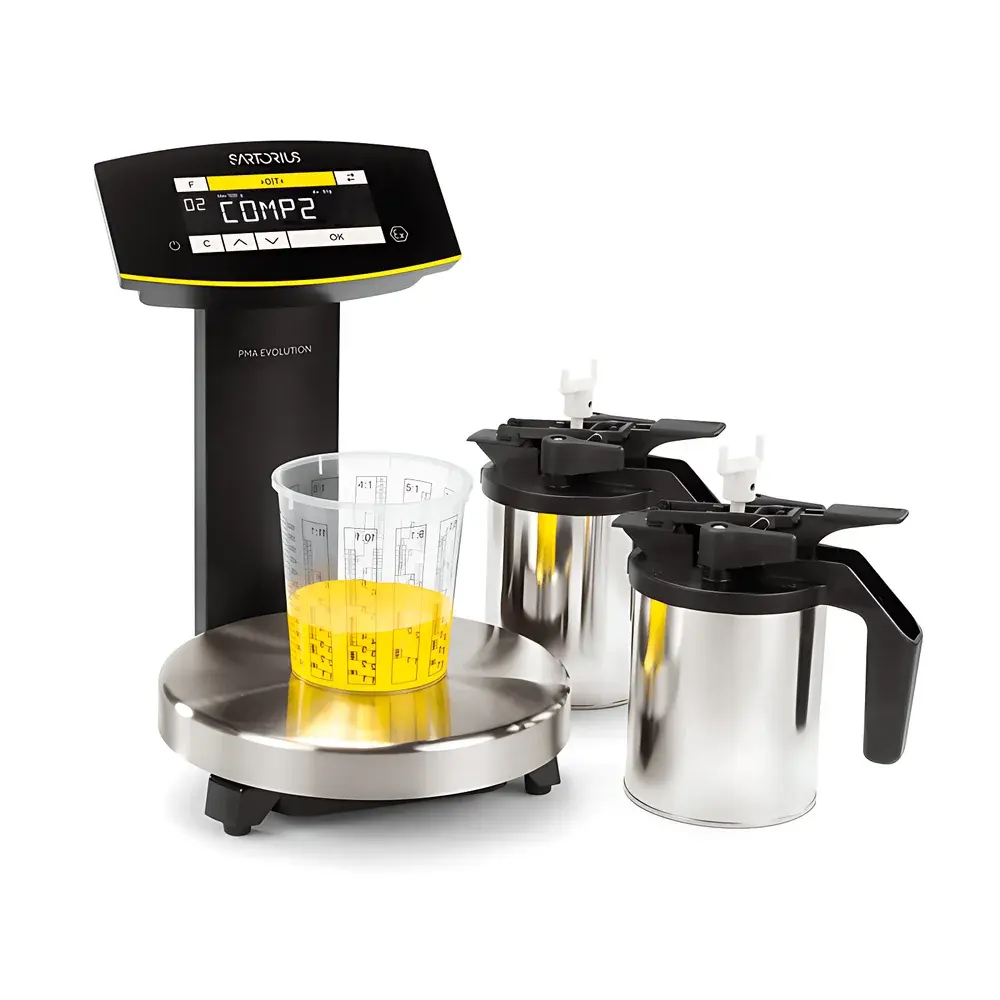
Sartorius PMA Vision Intrinsically Safe Paint Mixing Scale
| Brand | Sartorius |
|---|---|
| Origin | Germany |
| Model | PMA Vision |
| Certification | ATEX/IECEx Zone 1/21 Certified |
| Weighing Capacity | Up to 6.5 kg (configurable) |
| Readability | 0.01 g |
| Display | Tempered Glass Touchscreen with Optional Protective Cover |
| Connectivity | Ethernet, Wi-Fi, Bluetooth |
| Operating System | Embedded Linux with Real-Time Task Scheduler |
| Compliance | EN 60079-0, EN 60079-11, ISO 8502-9, ASTM D3924, USP <41> |
Overview
The Sartorius PMA Vision Intrinsically Safe Paint Mixing Scale is an engineered solution for precision color formulation and batch dispensing in hazardous environments—specifically designed for paint, coatings, and ink manufacturing facilities where flammable solvents, vapors, or combustible dusts are present. Built upon intrinsically safe (IS) electronics architecture compliant with ATEX Directive 2014/34/EU and IECEx standards for Zone 1 (gas) and Zone 21 (dust), the PMA Vision eliminates ignition risk without compromising measurement integrity. Unlike conventional bench scales requiring external PCs for recipe execution, the PMA Vision integrates a dedicated paint-mixing firmware module directly into its embedded control system. This enables autonomous, offline execution of multi-step formulation sequences—including ingredient sequencing, tolerance-based weight verification, real-time deviation alerts, and audit-ready event logging—without dependency on host computers or network availability during active dispensing.
Key Features
- Intrinsically safe design certified to ATEX II 2G Ex ib IIB T4 Gb and IECEx Ex ib IIB T4 Gb for use in Zone 1 gas atmospheres; additionally rated for Zone 21 combustible dust environments per EN 60079-31.
- Integrated paint-mixing engine supporting up to 99-ingredient formulations with programmable sequence logic, dynamic tolerance bands (±0.05–5.0% configurable per component), and auto-queue management for concurrent job processing.
- Tempered glass touchscreen interface with IP65-rated front panel and optional polycarbonate protective cover for resistance to solvent splashes, abrasion, and frequent cleaning with industrial-grade disinfectants.
- Multi-protocol connectivity stack: Gigabit Ethernet (TCP/IP), IEEE 802.11ac Wi-Fi, and Bluetooth 5.0 LE—enabling seamless integration with enterprise color management systems (e.g., Datacolor MATCH, X-Rite Color iMatch), MES platforms, and ERP modules such as SAP ECC or S/4HANA.
- Onboard data storage (8 GB eMMC) retains ≥100,000 formulation records with full timestamping, operator ID, calibration history, and digital signature support for 21 CFR Part 11 compliance when paired with validated software configuration.
Sample Compatibility & Compliance
The PMA Vision accommodates standard paint mixing vessels (up to Ø250 mm base diameter) and supports direct mounting on stainless-steel workbenches or explosion-proof mounting frames. Its load cell architecture is optimized for low-drift performance under thermal fluctuations typical in production environments (operating range: 5–40 °C, ≤80% RH non-condensing). All materials in contact with process surfaces conform to FDA 21 CFR 177.2600 for indirect food-contact applications and EU Regulation (EC) No. 1935/2004. The device meets electromagnetic compatibility requirements per EN 61326-1 (industrial environment) and functional safety criteria aligned with IEC 61508 SIL 2 for safety-related weighing functions. It is validated for routine use under GLP and GMP frameworks, including full traceability of calibration events against accredited national standards (DAkkS or UKAS).
Software & Data Management
The embedded operating system runs a deterministic real-time scheduler ensuring sub-100 ms response latency for weight-triggered actions. Firmware updates are delivered via signed OTA packages with SHA-256 verification. Data export supports CSV, XML, and OPC UA protocols for interoperability with LIMS and cloud-based analytics platforms. Audit trails capture all critical user actions—including recipe upload, weight confirmation, override authorization, and calibration initiation—with immutable timestamps and role-based access control (RBAC). When deployed in regulated environments, the system supports electronic signatures per 21 CFR Part 11 through integration with third-party identity providers (e.g., Microsoft Azure AD) and hardware token authentication.
Applications
The PMA Vision serves as the central weighing node in closed-loop color formulation workflows across automotive OEM paint shops, architectural coating plants, industrial maintenance depots, and aerospace MRO facilities. It enables precise gravimetric dispensing of base pigments, resins, solvents, and additives while maintaining full compliance with VOC reporting mandates (EU Directive 2004/42/EC, EPA Method 24). Its mobility-ready architecture allows operators to initiate jobs from tablets or smartphones using responsive web interfaces—reducing floor-space constraints and enabling decentralized workflow orchestration across multi-site operations. Integration with automated warehouse systems permits real-time inventory reconciliation and just-in-time material staging based on actual consumption data.
FAQ
Does the PMA Vision require continuous network connectivity to execute recipes?
No. Once downloaded, recipes are stored locally and executed autonomously by the onboard controller—even during network outages.
Can it interface with legacy color formulation software?
Yes, via standardized RESTful APIs and OPC UA server functionality; Sartorius provides documented integration kits for major vendors including BYK-Gardner, HunterLab, and Datacolor.
Is calibration traceable to national metrology institutes?
Yes—internal calibration routines reference internal mass standards certified to ISO/IEC 17025 by DAkkS-accredited laboratories; external calibration certificates include uncertainty budgets per EURAMET cg-18.
What maintenance intervals are recommended for IS certification validity?
Periodic verification of intrinsic safety barriers and enclosure integrity must be performed annually by an IECEx-certified service provider; full functional validation is recommended every 6 months in high-utilization settings.