
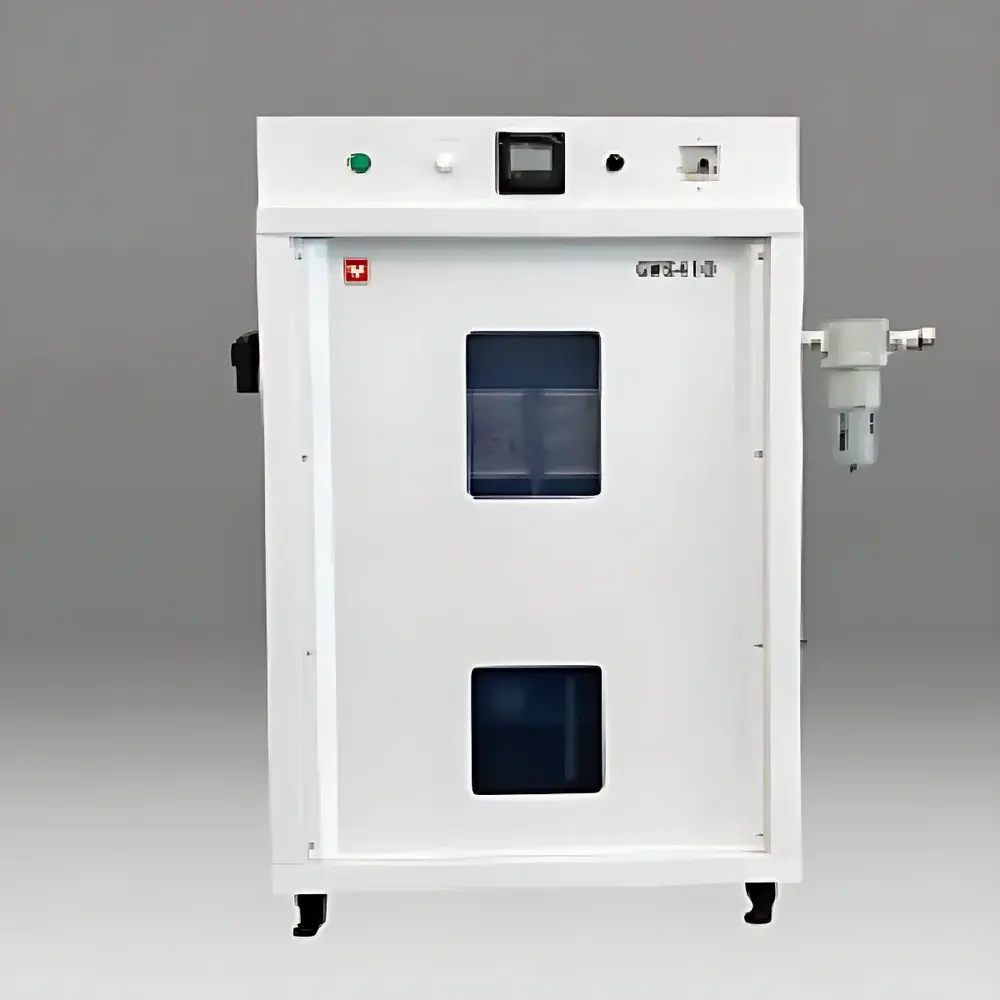
Yamato GWS410 Organic Solvent Scrubbing System
| Brand | Yamato |
|---|---|
| Origin | Japan |
| Model | GWS410 |
| Maximum Throughput | 1500 mL/h |
| Operating Temperature Range | 40–240 °C |
| Cleaning Liquid | Water or Alkaline Aqueous Solution |
| Scrubber Fill Medium | Pall Rings |
| Circulation Pump | Small Magnetic Drive Pump (Max Flow: 15 L/min, Max Head: 8 m) |
| Reservoir Capacity | 35 L |
| Power Supply | AC 200 V, 0.35 A |
| Dimensions (W×D×H) | 800 × 500 × 1230 mm |
| Weight | Approx. 80 kg |
| Safety Features | Earth Leakage Circuit Breaker |
| Sample Compatibility | Vapor-phase organic solvents and acidic/alkaline process off-gases |
Overview
The Yamato GWS410 Organic Solvent Scrubbing System is a purpose-engineered gas-cleaning unit designed for integration with laboratory-scale spray dryers and other thermal processing equipment that generate volatile organic solvent vapors or corrosive exhaust streams. Unlike conventional condensation or adsorption-based abatement methods, the GWS410 employs a continuous counter-current scrubbing principle based on aqueous-phase absorption—leveraging physical dissolution, acid-base neutralization, and particulate impaction within a structured packed-bed column. It operates at ambient pressure and does not require refrigeration, vacuum, or consumable adsorbents. The system is intended for use in controlled laboratory environments where operator safety, material compatibility, and regulatory traceability are critical—particularly during R&D of pharmaceutical formulations, polymer dispersions, or functional food powders processed via organic-solvent-based spray drying (e.g., acetone, ethanol, dichloromethane, or ethyl acetate systems).
Key Features
- Robust stainless-steel and corrosion-resistant polymer construction ensures long-term reliability when handling aggressive solvent vapors and alkaline wash solutions.
- Dual-stage cleaning mechanism: high-efficiency Pall ring packing provides large interfacial area for mass transfer, while fine droplet water/alkali spray enhances contact time and absorption kinetics.
- Integrated magnetic-drive recirculation pump eliminates shaft seals—reducing leakage risk and maintenance frequency in continuous operation.
- Real-time operational monitoring via accessible pH measurement of the scrubber reservoir; optional integration with digital pH meters supports GLP-compliant logging.
- Modular design enables straightforward coupling to Yamato GAS411C exhaust management units or third-party dryer exhaust ducts using standard 100–150 mm diameter flanges.
- Compliance-ready architecture: electrical components meet IEC 61000-6-2/6-4 immunity/emission standards; grounding and leakage protection conform to JIS C 8374 and IEC 61000-1-2.
Sample Compatibility & Compliance
The GWS410 is validated for vapor-phase removal of low-to-moderate volatility organic solvents (e.g., methanol, ethanol, isopropanol, acetone, THF, and ethyl acetate) as well as acidic byproducts (e.g., HCl, acetic acid) generated during thermal processing. It is not intended for halogenated hydrocarbons with poor water solubility (e.g., chloroform, carbon tetrachloride) or highly non-polar solvents (e.g., hexane, toluene) without supplemental pretreatment. The system complies with Japanese Industrial Standards (JIS Z 8401) for laboratory fume control performance and aligns with ISO 14644-1 Class 8 cleanroom-compatible exhaust treatment practices. When operated with documented pH monitoring and scheduled media replacement, it supports audit trails required under GLP (OECD 1998) and internal QA protocols for solvent residue control.
Software & Data Management
The GWS410 is a standalone electromechanical system with no embedded firmware or proprietary software. All operational parameters—including reservoir pH, liquid level, and pump runtime—are monitored manually or via externally connected industrial-grade sensors (e.g., Mettler Toledo InPro 3250, Hanna HI98107). Users may integrate analog 4–20 mA outputs from compatible transmitters into existing LIMS or SCADA platforms for centralized logging. While the unit itself does not store data, its mechanical simplicity and absence of microprocessors facilitate full 21 CFR Part 11 compliance when paired with validated electronic record systems—particularly for pharmaceutical development workflows requiring attributable, legible, and contemporaneous entries.
Applications
- Abatement of solvent vapors from lab-scale spray dryers (e.g., Yamato ADL311, SD-1000 series) during formulation development of heat-sensitive APIs.
- Neutralization of acidic off-gases generated during lyophilization cycle ramp-down or solvent exchange steps.
- Pre-treatment of exhaust streams prior to activated carbon filtration or catalytic oxidation—extending downstream media life and reducing regeneration frequency.
- Environmental health & safety (EHS) mitigation in university research labs conducting nanoparticle synthesis via solvothermal spray pyrolysis.
- Process validation support: consistent scrubbing efficiency enables reproducible residual solvent quantification per USP and ICH Q3C(R8) guidelines.
FAQ
Can the GWS410 be used with chlorinated solvents such as dichloromethane?
Limited efficacy is expected due to low water solubility and slow hydrolysis kinetics; supplemental condensation or carbon adsorption is recommended upstream.
Is the system compatible with automated pH dosing?
Yes—standard ¼” NPT ports allow connection to peristaltic dosing pumps and programmable controllers for closed-loop alkali replenishment.
What maintenance intervals are recommended for the Pall ring packing?
Visual inspection every 200 operating hours; replacement advised after 1,000 hours or if pressure drop across the column increases by >25% from baseline.
Does the GWS410 meet CE or UL certification requirements?
It carries PSE marking for Japan; CE/UL certification requires system-level evaluation including installation environment, ductwork, and interlocked dryer controls.
Can the reservoir be upgraded to include conductivity or TOC monitoring?
Yes—the 35 L polypropylene tank features auxiliary ports and mounting brackets for third-party inline analyzers compliant with ASTM D5903 and ISO 8573-7.



