
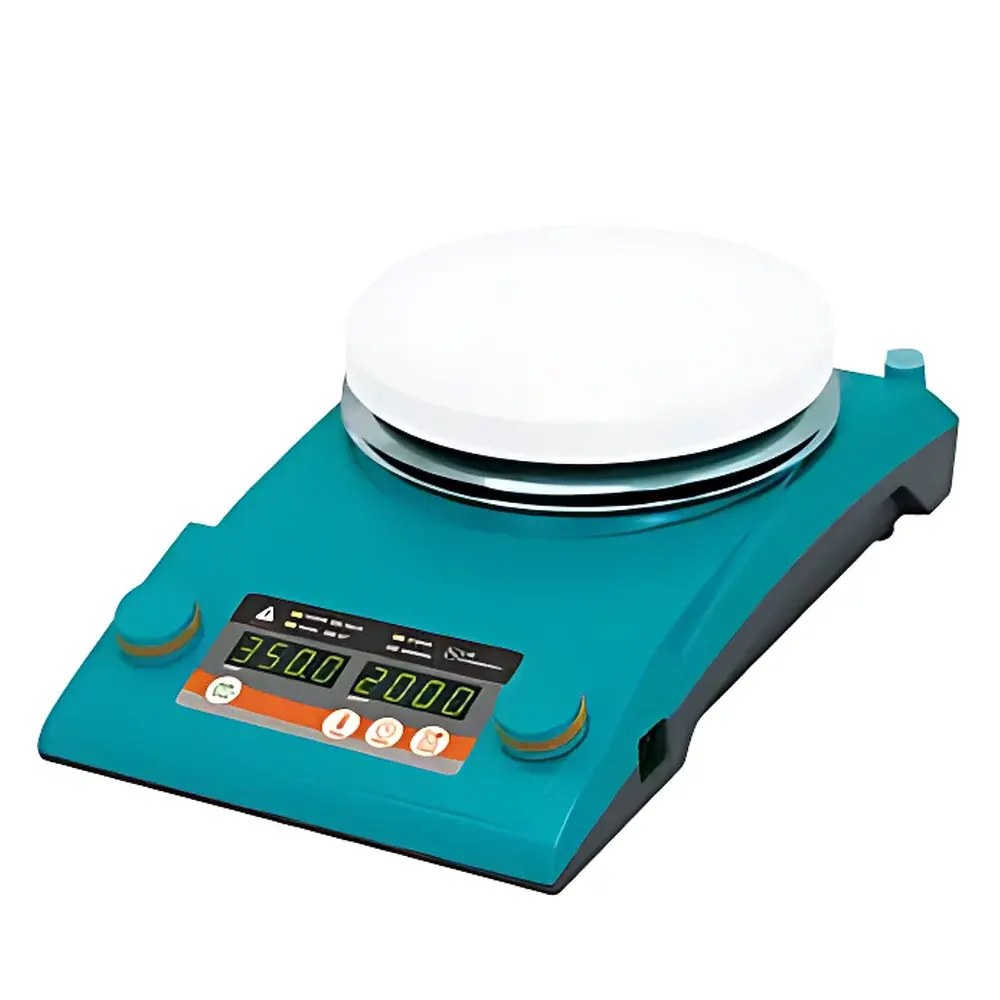
JEIO TECH TS-Series High-Performance Heating Magnetic Stirrers (TS-14S, TS-17S, TS-18Q)
| Brand | JEIO TECH |
|---|---|
| Origin | South Korea |
| Instrument Type | Heating Magnetic Stirrer |
| Max. Stirring Volume | 20 L |
| Speed Range | 30–2,000 rpm |
| Temperature Range | Ambient to 350 °C |
| Heating Power | 600 W (TS-14S), 800 W (TS-17S/TS-18Q) |
| Control System | PID Feedback Controller with LED Display (0.1 °C resolution) |
| Safety Features | Overtemperature Protection (plate, housing, PCB), Current Overload Protection, Dual-Mode Timer (delay start / temperature-triggered start), External PT100 Sensor Support (250 °C or 350 °C options) |
| Compliance | CSA-certified (except TS-18Q), RoHS-compliant (except TS-17S and TS-18Q) |
| Power Supply | 120 V / 60 Hz (5.0–6.7 A) or 230 V / 50–60 Hz (3.0–4.0 A) |
Overview
The JEIO TECH TS-Series Heating Magnetic Stirrers are engineered for precision thermal and mechanical control in demanding laboratory environments. Designed around a robust Couette-flow principle, these instruments combine high-efficiency induction heating with digitally regulated magnetic coupling to deliver consistent agitation across diverse viscosities—from low-viscosity aqueous solutions to highly viscous polymer melts and molten salts. The integrated aluminum-ceramic-coated hotplate ensures rapid thermal response and uniform heat distribution, while the brushless DC motor provides stable torque delivery up to 2,000 rpm—even during cold-start conditions or under high-load viscosity transitions. Each model (TS-14S, TS-17S, TS-18Q) is calibrated for traceable temperature accuracy and reproducible rotational speed control, supporting applications requiring strict adherence to ASTM E29, ISO/IEC 17025, and GLP documentation standards.
Key Features
- PID feedback temperature control with 0.1 °C resolution and programmable ramp profiles (Optimal, Fast, Slow, User-defined, and Spot modes)
- Adjustable heating rate (0–100% power output) for precise thermal profiling and avoidance of sample degradation
- Dual-mode timer: time-based activation or temperature-triggered start/stop—enabling automated reaction initiation at target setpoints
- Independent heater ON/OFF toggle and real-time external temperature monitoring via optional PT100 probe (SN-8-4 connector; max. 250 °C or 350 °C variants)
- Overtemperature protection system with dedicated plate-status LED indicator and configurable upper/lower thermal limits
- Stall-resistant magnetic drive architecture with optimized magnet geometry, enabling reliable coupling of stir bars up to 8 mm × 40 mm—even in high-viscosity media
- Instant stop functionality and smooth startup protocol prevent vortex disruption and minimize splashing during critical mixing phases
Sample Compatibility & Compliance
The TS-Series accommodates a wide range of vessel geometries and materials—including borosilicate glass, stainless steel, and PTFE-lined reactors—up to 20 L capacity (water-equivalent). Its flat, ceramic-coated aluminum top plate supports both round-bottom and flat-bottom containers with optimal thermal contact. All models meet CSA C22.2 No. 1010.1 safety requirements (excluding TS-18Q), and RoHS Directive 2011/65/EU compliance applies to TS-14S (RoHS exemptions apply to TS-17S and TS-18Q per Annex III). The system supports audit-ready operation under FDA 21 CFR Part 11 when paired with validated third-party data logging software and electronic signature workflows.
Software & Data Management
While the TS-Series operates as a standalone instrument with local LED interface, it is fully compatible with external data acquisition systems via analog voltage output (0–10 V) for temperature and speed signals. Optional RS-232 or USB-to-serial adapters enable integration into LabVIEW, MATLAB, or custom SCADA platforms for automated batch recording, trend analysis, and electronic lab notebook (ELN) synchronization. All parameter changes—including setpoint adjustments, timer configurations, and safety limit modifications—are timestamped and stored in non-volatile memory, satisfying GLP/GMP traceability requirements for method validation and equipment qualification (IQ/OQ/PQ).
Applications
These stirrers serve core functions across analytical chemistry, materials science, pharmaceutical development, and quality control laboratories. Typical use cases include: dissolution testing per USP , catalyst slurry homogenization in heterogeneous catalysis research, solvent evaporation control during rotary evaporation pre-concentration, polymerization reaction staging under inert atmosphere, and thermal stability assessment of APIs and excipients. The TS-18Q’s square heating surface and enhanced 800 W power rating make it particularly suitable for high-mass-volume synthesis and extended-duration reflux setups where thermal inertia must be actively managed.
FAQ
What external temperature sensors are supported?
The TS-Series accepts PT100 resistance thermometers with SN-8-4 connectors; two variants are available—AAA34501 (250 °C max) and AAA34502 (350 °C max)—both offering ±0.3 °C accuracy within their respective ranges.
Can the stirrer operate without an external sensor?
Yes—the built-in plate sensor enables closed-loop temperature control, though external sensing is recommended for process-critical applications requiring media-specific thermal feedback.
Is firmware upgrade capability available?
Firmware updates are performed by authorized JEIO TECH service centers using proprietary diagnostic tools; no user-accessible update interface is provided to maintain regulatory integrity.
What stir bar geometries are recommended for high-viscosity mixing?
Octagonal and elliptical stir bars (e.g., BCW16xx series) provide superior torque transfer in viscous media; cylindrical bars (BCW11xx) are preferred for low-turbulence, laminar-flow applications.
Does the unit support continuous operation at maximum temperature and speed?
Continuous operation at 350 °C and 2,000 rpm is permissible only with adequate ventilation and load-dependent duty cycles; JEIO TECH recommends ≤8 hours/day at full-rated conditions to ensure long-term thermal stability of internal components.



