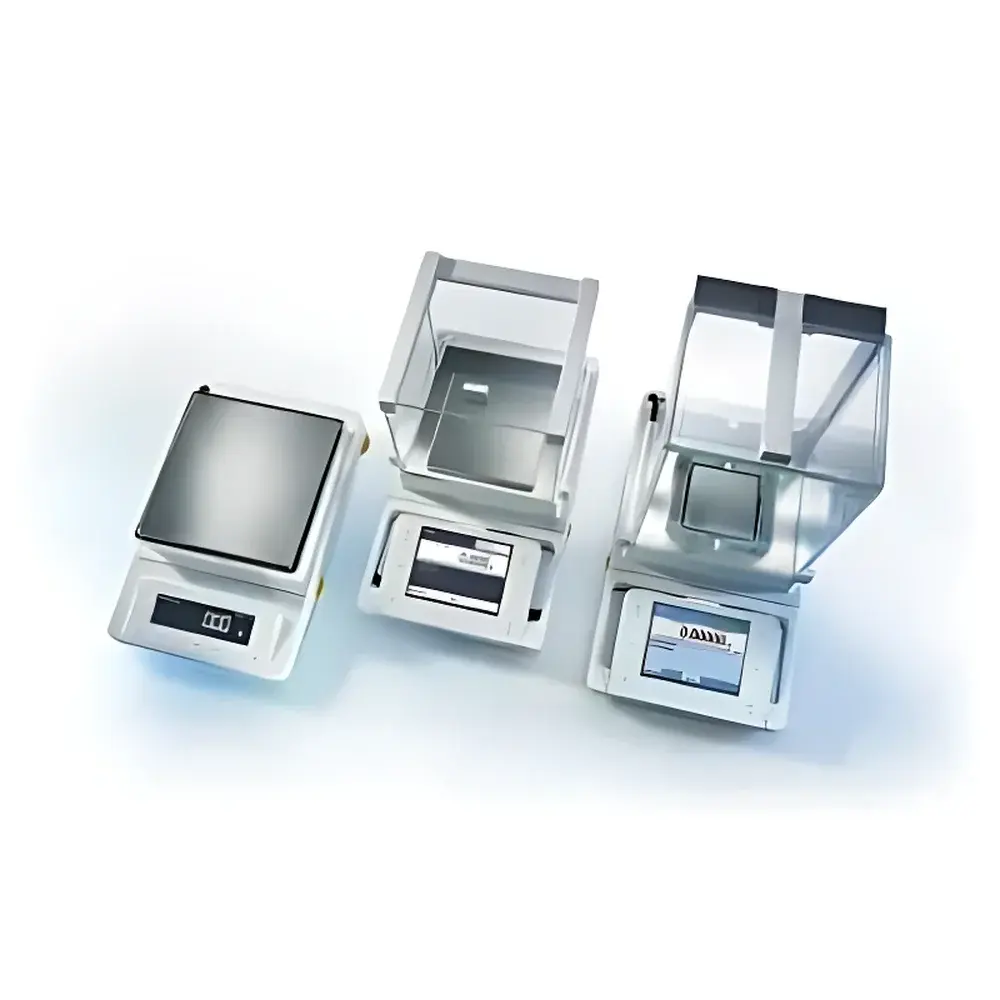
Sartorius Cubis® High-Performance Analytical Balance (Discontinued, Superseded by Cubis II Series)
| Brand | Sartorius |
|---|---|
| Origin | Germany |
| Instrument Type | Analytical Balance |
| Maximum Capacity | 2–5 g (ultramicro/micro modules), up to 70 kg (with optional high-capacity modules) |
| Readability | 0.1 µg (10⁻⁷ g) |
| Repeatability | ≤ ±0.001 mg |
| Calibration | Fully Automatic Internal Calibration (isoCAL®) |
| Compliance | ISO/IEC 17025, USP <41>, ASTM E898, FDA 21 CFR Part 11 (via Q-Apps), GLP/GMP-ready |
Overview
The Sartorius Cubis® High-Performance Analytical Balance was engineered for laboratories demanding traceable, regulatory-compliant mass measurement at the highest metrological tier. Designed and manufactured in Germany, this discontinued but historically significant platform operated on electromagnetic force compensation (EMFC) principle — delivering exceptional stability, thermal drift resistance, and long-term repeatability under dynamic environmental conditions. Though superseded by the Cubis II series, the Cubis® remains a reference benchmark for modular precision weighing systems in regulated environments including pharmaceutical QC/QA labs, contract research organizations (CROs), and reference material certification facilities. Its architecture supported full traceability through integrated isoCAL® — an automated, temperature-compensated internal calibration system compliant with ISO 9001, ISO/IEC 17025, and pharmacopoeial requirements (e.g., USP and EP 2.1.3). The balance’s foundational design philosophy centered on metrological integrity, user-defined workflow integration, and audit-ready data governance — not merely weight acquisition.
Key Features
- Fully modular hardware architecture: independent selection and interchange of weighing module, display/control unit, and draft shield — enabling configuration-specific optimization without compromise on performance.
- Ultra-high resolution weighing modules: including ultramicro (0.0001 mg readability, up to 6 g capacity) and micro (0.001 mg readability, up to 6 g capacity) variants — validated for gravimetric analysis of active pharmaceutical ingredients (APIs), reference standards, and nanomaterial dispersions.
- Three display/control options: MSA (high-resolution color TFT touchscreen with Q-App runtime environment), MSU (monochrome graphical display with tactile keypad), and MSE (high-contrast LCD with guided menu navigation) — each supporting role-based access control and configurable user permissions.
- isoCAL® technology: fully automatic, motor-driven internal calibration with real-time temperature monitoring and drift compensation — eliminating manual calibration artifacts and ensuring continuous compliance between scheduled verifications.
- Electrostatically optimized draft shields: DF (manual stainless steel for filter weighing), DM (motorized for ultramicro applications), DI/DA (motorized with integrated ionizers for static-sensitive samples), DU/DE/DR (manual variants with graded readability support) — all featuring conductive glass coatings and low-friction, silent-motion mechanisms.
Sample Compatibility & Compliance
The Cubis® platform accommodated diverse sample types — from hygroscopic powders and volatile solvents to electrostatic-prone polymers and ultra-low-mass filters — via application-tailored draft shield configurations and environmental compensation algorithms. Its mechanical design met IP54 ingress protection standards for dust and splash resistance. Regulatory alignment extended across global frameworks: validation documentation packages supported IQ/OQ/PQ execution per GAMP 5; raw data export formats (CSV, XML) were structured for seamless ingestion into LIMS and ELN systems; and Q-Apps enabled SOP-driven workflows compliant with FDA 21 CFR Part 11 (electronic signatures, audit trails, data integrity controls). All firmware and calibration records adhered to ALCOA+ principles (Attributable, Legible, Contemporaneous, Original, Accurate, Complete, Consistent, Enduring, Available).
Software & Data Management
Q-Apps — Sartorius’ proprietary, browser-based application framework — allowed users to deploy validated, parameterized weighing protocols without local software installation or IT intervention. Preconfigured Q-Apps included “Loss-on-Drying,” “Dispensing,” “Density Determination,” and “Filter Weighing” — each enforcing mandatory field entries, range checks, and automatic metadata tagging (operator ID, timestamp, environmental conditions). Raw measurement data, calibration logs, and event histories were stored in encrypted internal memory with immutable timestamps. Export interfaces supported USB mass storage, RS-232, Ethernet (TCP/IP), and optional Wi-Fi — all configurable with TLS 1.2 encryption and LDAP/Active Directory integration for enterprise authentication.
Applications
- Pharmaceutical quality control: assay verification of APIs, excipient blending uniformity testing, and residual solvent quantification via gravimetric loss-on-drying.
- Reference material certification: preparation of certified reference materials (CRMs) requiring sub-10 µg uncertainty budgets per ISO Guide 35.
- Environmental analysis: gravimetric determination of particulate matter (PM₂.₅/PM₁₀) on quartz fiber filters per EPA Method 201A and ISO 12103-1.
- Materials science: density measurement of advanced ceramics and metal alloys using Archimedean immersion techniques.
- Academic research: precise formulation of catalyst precursors, nanocomposite dispersions, and isotopic tracer solutions where mass uncertainty directly impacts stoichiometric fidelity.
FAQ
Is the Cubis® still supported by Sartorius?
Yes — although discontinued and replaced by the Cubis II series, Sartorius continues to provide spare parts, service contracts, and calibration support for Cubis® instruments under its legacy product maintenance program.
Can Q-Apps be customized for proprietary workflows?
Yes — Sartorius offers Q-App development services under NDA, enabling creation of validated, audit-ready applications aligned with internal SOPs and regulatory submission requirements.
What is the uncertainty contribution of isoCAL® during routine operation?
isoCAL® contributes less than 0.05% of full-scale uncertainty at 23 °C ±1 °C, verified per EURAMET cg-18 guidelines and documented in the instrument’s type approval certificate.
Does the Cubis® meet USP repeatability requirements for analytical balances?
Yes — all ultramicro and micro modules (0.0001 mg and 0.001 mg readability) satisfy USP repeatability criteria (standard deviation ≤ 0.1 RSD at 5% and 100% load) when operated within specified environmental tolerances.
How is data integrity ensured during electronic record transfer?
All exported files include embedded digital signatures, SHA-256 hash values, and timestamped audit trails — meeting ALCOA+ and 21 CFR Part 11 §11.10(d) requirements for electronic records.