
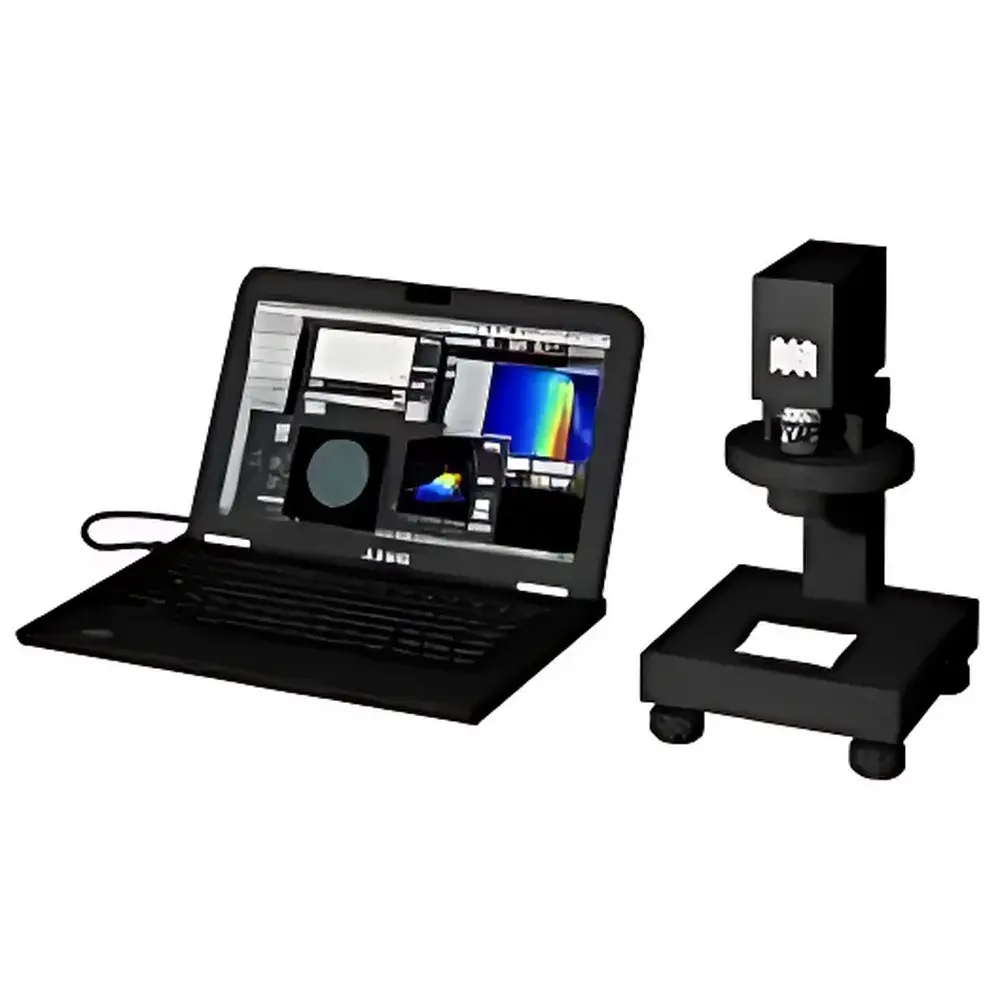
Photonic Lattice WPA-100-S Polarizing Stress Analyzer for Lens Birefringence Measurement
| Brand | Photonic Lattice |
|---|---|
| Origin | Japan |
| Model | WPA-100-S |
| Measurement Range | 0–4000 nm |
| Repeatability | <1.0 nm |
| Pixel Resolution | 384 × 288 (≈110,000 pixels) |
| Measurement Wavelengths | 523 nm, 543 nm, 575 nm |
| Field of View | 11.6 × 15.8 mm |
| Dimensions | 200 × 275 × 309.5 mm |
| Weight | 9 kg (unit), 4 kg (power supply) |
| Power Supply | AC 100–240 V, 50/60 Hz |
| Software | WPA-View (dedicated for WPA-100-S) |
Overview
The Photonic Lattice WPA-100-S Polarizing Stress Analyzer is a high-precision, compact optical instrument engineered for quantitative two-dimensional mapping of stress-induced birefringence in transparent optical components—particularly small-diameter lenses used in mobile phone cameras, AR/VR optics, and precision imaging systems. It operates on the principle of multi-wavelength polarimetric phase difference imaging, leveraging wavelength-dependent retardation measurements at 523 nm, 543 nm, and 575 nm to reconstruct absolute retardation values across a dynamic range of 0–4000 nm with sub-nanometer repeatability (<1.0 nm). Unlike conventional single-wavelength compensators or manual Senarmont setups, the WPA-100-S integrates a custom-designed polarization image sensor with real-time computational algorithms to extract full-field retardation magnitude and fast-axis orientation without mechanical rotation or user calibration. This enables non-contact, non-destructive evaluation of internal residual stress distribution—directly correlated to refractive index anisotropy—and its impact on modulation transfer function (MTF) degradation in high-resolution lens assemblies.
Key Features
- Multi-wavelength retardation reconstruction: Simultaneous acquisition at three discrete visible wavelengths enables robust phase-unwrapping and accurate quantification of retardation up to 4000 nm—critical for evaluating thick or highly stressed polymer and glass lens elements.
- Dedicated small-lens metrology platform: Optimized field of view (11.6 × 15.8 mm) and spatial resolution (384 × 288 pixels ≈ 110 k pixels) support rapid, automated inspection of lenses with diameters down to φ10 mm—fully aligned with JEITA and ISO 10110-5 requirements for micro-optic quality control.
- Automated pass/fail classification: Built-in threshold logic within WPA-View software allows configurable criteria for retardation magnitude, fast/slow axis uniformity, and regional gradient analysis—enabling integration into inline QC workflows compliant with IATF 16949 and ISO 9001.
- Fast-axis and slow-axis vector mapping: Full Stokes parameter derivation yields spatially resolved orientation data, supporting root-cause analysis of molding-induced stress asymmetry or coating-induced birefringence.
- CSV export and ROI automation: All 2D retardation maps, axis orientation fields, and statistical summaries (mean, std dev, max/min) are exportable in CSV format; region-of-interest selection supports batch processing of lens arrays or multi-element modules.
Sample Compatibility & Compliance
The WPA-100-S is validated for use with optically transparent materials including optical-grade polycarbonate (PC), cyclic olefin copolymer (COC), acrylic (PMMA), BK7, fused silica, and hybrid molded-glass lenses. Its measurement methodology conforms to principles outlined in ISO 11146-2 (laser beam profiling), ASTM F2633 (retardation measurement of ophthalmic lenses), and JIS Z 8767 (polarization-based stress evaluation). While not a certified metrology standard itself, the system’s traceable repeatability (<1.0 nm) and wavelength-stabilized LED sources support GLP-aligned documentation protocols—including audit trails, user access logs, and version-controlled measurement configurations—making it suitable for regulated R&D environments operating under FDA 21 CFR Part 11–compliant data governance frameworks.
Software & Data Management
WPA-View is a Windows-based native application designed exclusively for the WPA-100-S. It provides real-time visualization of retardation heatmaps, vector field overlays, cross-sectional line profiles, and statistical histograms. The software implements automatic background subtraction using reference-free null calibration, eliminating dependency on zero-stress reference samples. All measurement sessions are timestamped and stored with metadata (operator ID, sample ID, environmental conditions if logged externally). Export options include CSV (for post-processing in MATLAB, Python, or JMP), PNG/TIFF (8- and 16-bit), and XML-based configuration files. WPA-View supports secure user role management (administrator/operator/viewer) and optional encryption for sensitive production datasets.
Applications
- Mobile camera module manufacturing: In-line verification of injection-molded plastic lens birefringence prior to assembly—ensuring MTF stability across temperature cycling and mechanical shock.
- AR waveguide substrate qualification: Mapping stress gradients in large-area planar substrates that induce polarization-dependent diffraction efficiency loss.
- Optical adhesive bondline assessment: Detecting localized birefringence at glass-polymer interfaces caused by CTE mismatch or UV-cure shrinkage.
- R&D of low-stress optical polymers: Comparative screening of new resin formulations under controlled thermal and mechanical loading conditions.
- Failure analysis labs: Correlating birefringence hotspots with observed astigmatism, ghosting, or color fringing in end-user device complaints.
FAQ
What is the maximum measurable retardation value, and how is accuracy maintained at high ranges?
The WPA-100-S achieves a full-scale range of 0–4000 nm via multi-wavelength phase unwrapping. Accuracy remains stable across the range due to algorithmic redundancy—each pixel’s retardation is solved simultaneously from three independent wavelength equations, minimizing ambiguity in integer-order fringe counting.
Can the system measure lenses smaller than φ10 mm?
Yes—the WPA-100-S supports optional macro-lens attachments and stage adapters for lenses down to φ3 mm; resolution scales inversely with magnification, maintaining >0.5 µm effective pixel pitch at highest zoom.
Is calibration required before each measurement session?
No routine recalibration is needed. The system performs an internal reference check at power-on using stabilized LED sources and factory-characterized sensor response curves. A full calibration certificate (NIST-traceable) is provided with initial delivery and recommended annually.
Does WPA-View support automated reporting for ISO/IEC 17025-compliant labs?
Yes—custom report templates can be defined with embedded logos, measurement uncertainty statements, and electronic signatures; exported PDFs include embedded metadata compliant with ISO/IEC 17025 clause 7.8.2 requirements for result reporting.
How does the WPA-100-S handle non-uniform illumination or surface reflections?
The polarization image sensor incorporates hardware-level polarization crosstalk compensation and dynamic range optimization per channel. Surface reflections are suppressed via synchronized circular polarization gating and software-based specular artifact masking during post-processing.



