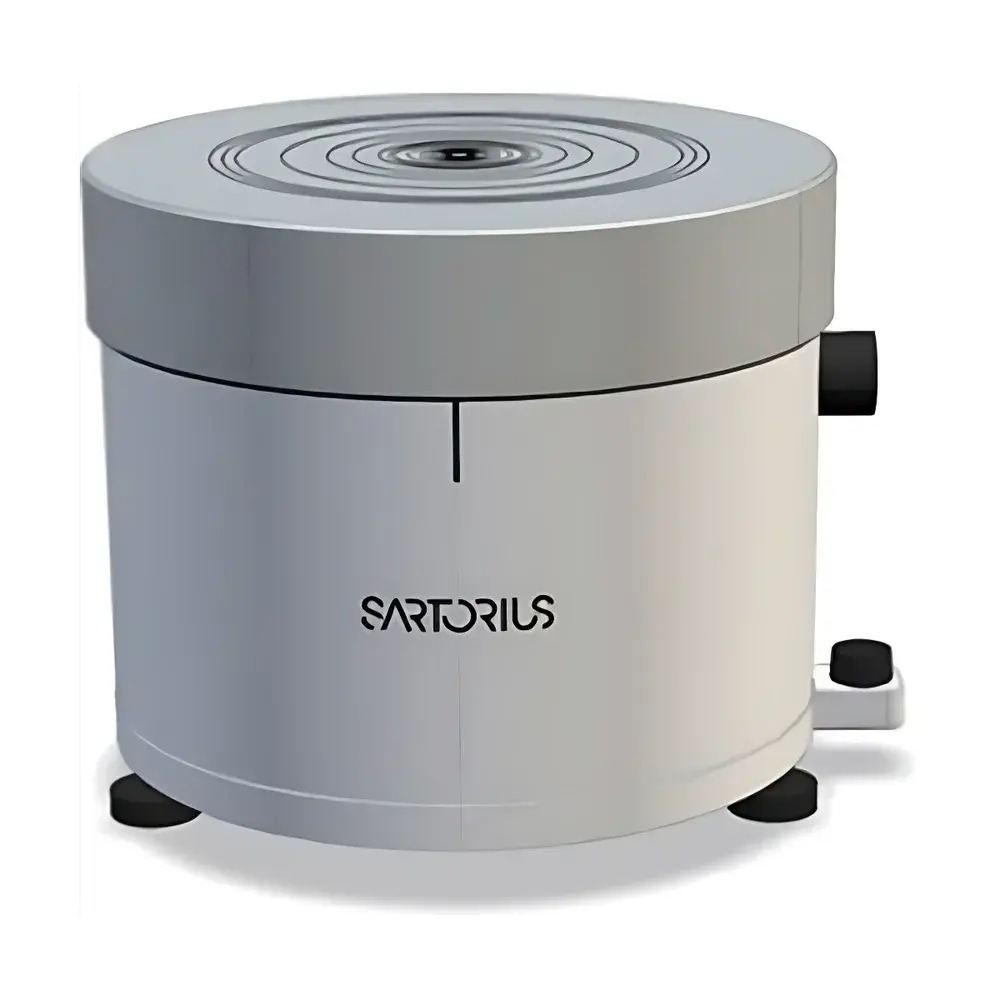
Sartorius YSZ03C Magnetic Susceptibility Meter
| Brand | Sartorius |
|---|---|
| Origin | Germany |
| Model | YSZ03C |
| Readability | 1 µg |
| Applicable Weight Classes (OIML R111) | E1, E2, F1, F2, M1 |
| Maximum Capacity | 50 kg |
| Measurement Principle | Gravimetric force interaction between permanent magnet (NdFeB, dipole moment ≈ 0.1 A·m²) and test weight |
| Compliance | OIML R111-1 Edition 2022 |
Overview
The Sartorius YSZ03C Magnetic Susceptibility Meter is a metrologically traceable, gravimetric instrument engineered for the precise determination of magnetic susceptibility and magnetization intensity of precision mass standards. It operates in full compliance with OIML Recommendation R111-1 (Edition 2022), the internationally recognized standard governing the magnetic characterization of weights classified as E1, E2, F1, F2, and M1. Unlike electromagnetic or induction-based methods, the YSZ03C employs a high-resolution analytical balance to quantify the vertical force component arising from the interaction between a calibrated permanent magnet—integrated within the instrument—and the test weight under controlled geometric conditions. This gravimetric approach eliminates reliance on material-specific calibration factors and ensures direct traceability to SI units via force measurement. The system’s core architecture features an internal NdFeB permanent magnet mounted on a precision mechanical flip mechanism, enabling rapid polarity reversal to isolate and cancel systematic magnetic field asymmetries. Its compact, self-contained design integrates the magnet, actuation system, weighing cell, and environmental shielding into a single monolithic unit—minimizing external field interference and operator-induced variability.
Key Features
- Gravimetric measurement principle fully aligned with OIML R111-1 Annex C requirements for magnetic testing of high-accuracy weights
- Integrated NdFeB permanent magnet with nominal dipole moment of 0.1 A·m², mechanically reversible for differential force analysis
- High-resolution weighing module with 1 µg readability, optimized for low-force detection in the sub-milligram range
- Fixed, repeatable geometry between magnet pole face and weight center-of-mass—ensuring reproducible measurement conditions per OIML R111-1 Section 7.4
- Compact benchtop form factor with internal magnetic shielding; no external magnet handling or alignment required
- Designed for use in temperature-stabilized metrology laboratories (20 ± 2 °C recommended) with low-vibration mounting
Sample Compatibility & Compliance
The YSZ03C is validated for use with cylindrical, hexagonal, and parallelepiped-shaped weights conforming to OIML R111 dimensional tolerances for classes E1 through M1. It supports weights up to 50 kg, with measurement validity maintained across the full mass range when appropriate support fixtures and centering jigs are employed. All measurement procedures follow the step-by-step protocol defined in OIML R111-1 Clause 7.4.2, including mandatory zero-point verification before and after polarity reversal, ambient field compensation, and distance-dependent correction application. The instrument satisfies the metrological requirements for laboratories operating under ISO/IEC 17025:2017, and its measurement uncertainty budget is documented in accordance with EURAMET cg-18 (Guidelines on Magnetic Characterization of Weights). It is routinely deployed in national metrology institutes (NMIs), accredited calibration laboratories, and primary mass standard maintenance facilities where traceability to CIPM MRA signatory NMIs is mandatory.
Software & Data Management
The YSZ03C operates in conjunction with Sartorius’ dedicated metrology software suite, which provides guided workflow execution, automated calculation of magnetic susceptibility (χ) and magnetization (M) according to R111-1 Annex C equations, and real-time uncertainty propagation. Raw force data, magnet position state, environmental parameters (temperature, barometric pressure), and user-defined weight geometry inputs are logged with timestamped, audit-trail-enabled records. Software outputs comply with GLP and GMP documentation requirements, supporting electronic signatures, version-controlled report templates, and export to CSV or PDF formats compatible with LIMS integration. Data integrity is ensured via built-in 21 CFR Part 11-compliant controls—including user access levels, electronic signature enforcement, and immutable audit logs of all measurement events and parameter modifications.
Applications
- Verification of magnetic properties for E1–M1 weights prior to calibration or certification in accordance with OIML R111-1
- Periodic magnetic stability monitoring of reference standards used in mass metrology laboratories
- Root-cause analysis of anomalous weighing deviations attributable to magnetic interactions in ultra-precision balances
- Supporting ISO 17025 accreditation audits by providing documented, standardized magnetic test evidence
- Validation of weight cleaning and demagnetization procedures following surface contamination or mechanical shock events
- Research applications involving magnetic property correlation with alloy composition, heat treatment history, or surface passivation quality
FAQ
Does the YSZ03C require external calibration magnets or reference weights?
No. The integrated NdFeB magnet is factory-characterized and thermally stabilized; no user calibration or external reference magnets are required.
Can the YSZ03C measure weights larger than 50 kg?
No. The 50 kg maximum capacity is strictly enforced by mechanical design and force sensor limits; exceeding this may compromise measurement integrity and void metrological validity.
Is the instrument suitable for field use or only laboratory environments?
It is designed exclusively for controlled metrology laboratories meeting ISO/IEC 17025 environmental specifications—vibration isolation, temperature stability (20 ± 2 °C), and low-EMI conditions are mandatory.
How does the YSZ03C handle temperature drift during extended measurements?
The system incorporates active thermal stabilization of the magnet assembly and real-time temperature compensation algorithms embedded in the firmware.
What documentation is provided to support ISO/IEC 17025 compliance?
A full metrological validation report, uncertainty budget per EURAMET cg-18, software validation summary, and traceable certificate of conformity to OIML R111-1 are supplied with each unit.