
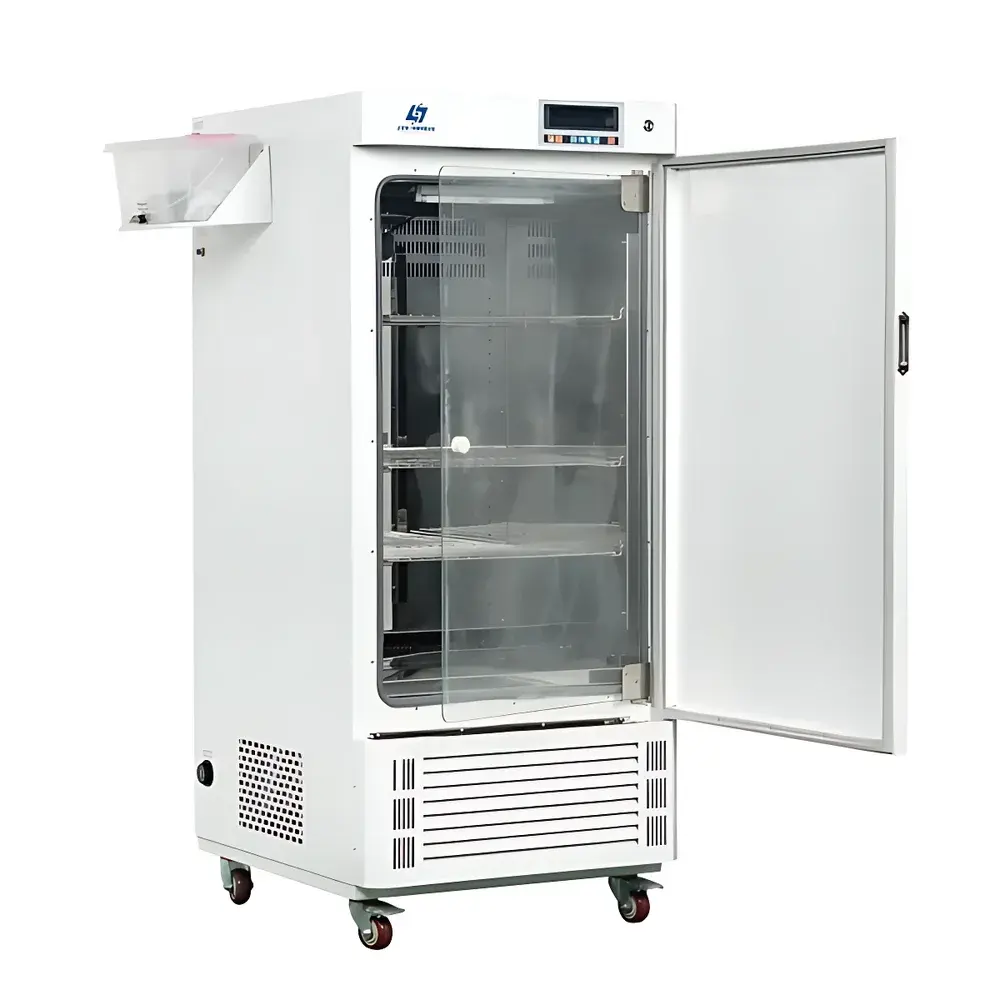
Yoyi LHS-500HC Large-Scale Temperature and Humidity Controlled Chamber
| Brand | Yoyi |
|---|---|
| Origin | Shanghai, China |
| Manufacturer Type | Direct Manufacturer |
| Product Category | Domestic |
| Model | LHS-500HC |
| Instrument Type | Upright |
| Temperature Range | 0–60 °C |
| Humidity Range | 40–95 %RH |
| Temperature Fluctuation | ±1 °C |
| Humidity Deviation | ±3 %RH |
| Humidity Fluctuation | ±1 %RH |
| Interior Dimensions (W×D×H) | 800×700×900 mm |
Overview
The Yoyi LHS-500HC is a high-reliability upright temperature and humidity controlled chamber engineered for precise environmental simulation in research, quality control, and product validation laboratories. Designed according to the fundamental principles of psychrometric control and forced-air thermal convection, it maintains stable, repeatable conditions across its 500 L working volume—critical for accelerated aging, stability testing, microbial cultivation, and material performance evaluation under defined climatic stress. Its operational envelope spans 0–60 °C and 40–95 %RH, enabling compliance with key regulatory test protocols including ICH Q1A(R3) for pharmaceutical stability, ISO 188 for rubber aging, and ASTM D4332 for conditioning of plastics prior to testing. The chamber’s dual-layer insulated door with sealed observation window minimizes thermal leakage during visual monitoring, while its mirror-finish stainless-steel interior (304 grade) ensures corrosion resistance, ease of decontamination, and long-term dimensional stability.
Key Features
- Microprocessor-based PID control system with intuitive large LCD interface supporting up to 99 programmable cycles, each comprising 30 segments (max. 99 h 59 min per segment) for complex multi-step environmental profiles.
- Optimized air circulation architecture featuring rear-mounted centrifugal blower and symmetrical ducted airflow path, delivering uniform temperature distribution (±1 °C uniformity) and rapid recovery after door opening.
- Self-designed electric heating tube humidification system with integrated stainless-steel water reservoir and auto-refill detection; paired with high-accuracy capacitive humidity sensor (calibrated traceable to NIST standards) to achieve ±3 %RH deviation over full operating range.
- Eco-friendly refrigeration circuit utilizing R134a/R406a blended refrigerant, compliant with Montreal Protocol requirements and optimized for energy efficiency (typical power consumption: 2.4 kW at 25 °C/60 %RH steady state).
- Modular internal structure with three-position adjustable stainless-steel shelves (standard configuration: two shelves included); corner radii ≥R25 mm for seamless cleaning and reduced microbial retention.
- Four-point leveling system with dual-mode mobility: swivel casters with brake locks for repositioning, plus independent adjustable leveling feet for permanent installation and vibration isolation.
Sample Compatibility & Compliance
The LHS-500HC accommodates diverse sample formats—including Petri dishes, vials, trays, electronic assemblies, polymer specimens, and packaged goods—without compromising environmental fidelity. Its interior volume (800×700×900 mm) supports stacked or staggered loading configurations while maintaining required airflow clearance. All materials in contact with the chamber environment meet USP Class VI biocompatibility criteria where applicable. The unit conforms to GB/T 10586–2006 (Technical Requirements for Damp Heat Test Chambers), GB/T 2424.6–2006 (Performance Verification of Temperature/Humidity Chambers), and GJB/J 3827–1999 (Calibration Procedures for Standard Environmental Chambers). Optional accessories—including RS485 communication interface (Modbus RTU protocol), embedded thermal printer, and external test port kits (25 mm/50 mm diameter)—enable integration into GLP/GMP-compliant workflows with full audit trail capability.
Software & Data Management
The embedded controller logs real-time temperature and humidity values at user-defined intervals (1–60 min), storing up to 30 days of data internally. When equipped with the optional RS485 interface and配套 PC software (Yoyi EnviroLog v3.2), users gain access to remote monitoring, automated report generation (PDF/CSV), and electronic signature support aligned with FDA 21 CFR Part 11 requirements. Data integrity safeguards include password-protected parameter modification, time-stamped event logging (door openings, alarm triggers, setpoint changes), and non-volatile memory backup. Calibration records—including sensor offset adjustments and verification timestamps—are retained separately and exportable for regulatory submissions.
Applications
- Pharmaceutical stability studies per ICH guidelines (long-term, intermediate, and accelerated conditions)
- Biological incubation for cell culture, fungal growth, and BOD analysis (with optional BOD socket)
- Accelerated weathering and moisture absorption testing of polymers, composites, and adhesives
- Pre-conditioning of electronic components prior to thermal shock or functional testing
- Textile and leather hygroscopic behavior assessment under controlled RH gradients
- Food packaging permeability and shelf-life modeling under variable humidity regimes
FAQ
What is the maximum allowable ambient temperature for safe operation?
The chamber is rated for use in environments ≤30 °C and ≤80 %RH (non-condensing), as specified in GB/T 10586–2006.
Does the LHS-500HC support continuous unattended operation?
Yes—equipped with over-temperature and over-humidity cut-off protection, automatic compressor restart delay, and battery-backed clock/calendar for uninterrupted cycle execution.
Can humidity be maintained below 40 %RH?
No—the minimum controllable humidity is 40 %RH; for low-RH applications (e.g., dry storage), a desiccant-based or refrigerated dehumidification system is recommended.
Is third-party calibration certification available?
Yes—Yoyi provides optional UKAS-accredited calibration certificates (traceable to national standards) upon request, covering both temperature and humidity sensors across the full operating range.
What maintenance intervals are recommended?
Monthly inspection of water tank cleanliness and condensate drain line; quarterly verification of door seal integrity and sensor response time; annual full-system performance validation per ISO/IEC 17025 procedures.



