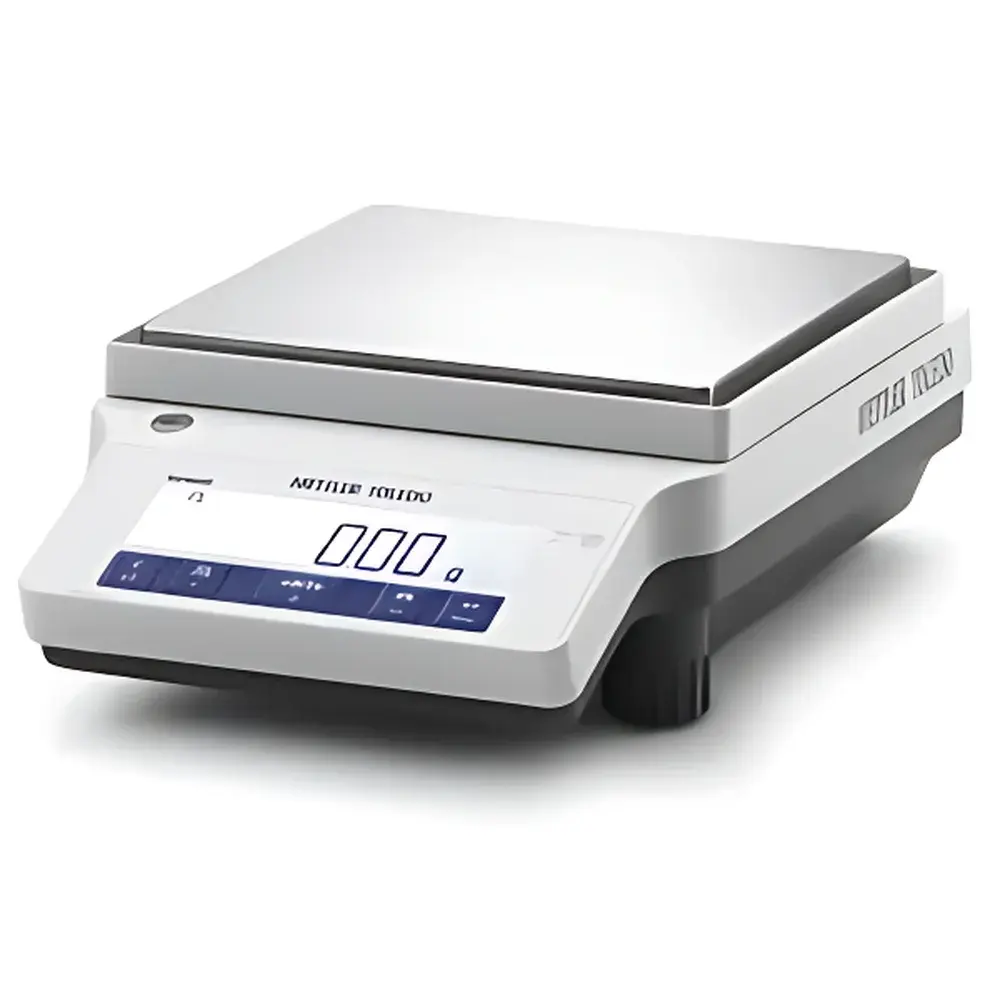
METTLER TOLEDO ME1002 Precision Balance with Internal Calibration
| Brand | METTLER TOLEDO |
|---|---|
| Origin | Shanghai, China |
| Model | ME1002/02 |
| Maximum Capacity | 1200 g |
| Readability | 0.01 g |
| Repeatability (typ.) | 0.007 g |
| Minimum Weight (USP, 0.1% tolerance, typ.) | 14 g |
| Stabilization Time | 1 s |
| Pan Dimensions (W × D) | 180 mm × 180 mm |
| External Dimensions (H × W × D) | 100 mm × 200 mm × 319 mm |
| Housing | Die-cast aluminum and ABS |
| Calibration | Internal, one-button operation |
| Interface | RS232 (integrated), optional Bluetooth |
| Display | Backlit LCD |
Overview
The METTLER TOLEDO ME1002 Precision Balance is an entry-level analytical-grade instrument engineered for consistent, traceable mass measurement in routine laboratory, quality control, and educational environments. Based on electromagnetic force compensation (EMFC) technology, the ME1002 delivers high reproducibility and long-term stability without mechanical levers or knife-edges. Its 1200 g maximum capacity and 0.01 g readability meet the performance requirements of ISO/IEC 17025-compliant weighing tasks where moderate resolution suffices—such as sample preparation, formulation checks, and inventory reconciliation. Designed for daily operational robustness, the balance integrates a die-cast aluminum base and stainless steel weighing pan to resist mechanical stress, thermal drift, and chemical exposure typical in general lab workflows.
Key Features
- Internal calibration system with built-in reference mass: Enables rapid, operator-independent verification and adjustment at any time via single-button activation—eliminating dependency on external weights and reducing calibration downtime.
- Robust mechanical architecture: Features overload protection up to 150% of nominal capacity, reinforced pan support, and vibration-damping foot design to maintain accuracy under variable floor conditions.
- Intuitive user interface: High-contrast backlit LCD display ensures legibility under diverse ambient lighting; function keys are logically grouped for rapid access to tare, unit conversion, and application modes.
- Stable 1-second stabilization time: Optimized damping algorithm minimizes settling delay without compromising sensitivity—critical for high-throughput batch processing.
- Comprehensive connectivity: Integrated RS232 port supports direct data transmission to PCs, printers, or LIMS; optional Bluetooth module enables wireless integration into networked lab environments compliant with FDA 21 CFR Part 11 audit trail requirements when paired with validated software.
Sample Compatibility & Compliance
The ME1002 accommodates samples up to 180 mm × 180 mm on its flat, corrosion-resistant stainless steel pan—suitable for powders, granules, vials, petri dishes, and small containers. Its minimum weight of 14 g (at USP 0.1% tolerance, k = 2) defines the lower limit for pharmacopeial compliance in non-sterile dosage form testing. While the instrument itself is not CE-marked for medical device use nor certified to OIML R76, it conforms to EN 45501 for non-automatic weighing instruments and meets the environmental and EMC criteria specified in IEC 61326-1. For GLP/GMP environments, the balance supports documented calibration records and can be integrated into electronic lab notebooks (ELN) via ASCII-compatible output protocols.
Software & Data Management
Data export follows standard ASCII format over RS232, enabling seamless ingestion into Excel, LabWare, or custom SQL-based databases. The balance supports automatic timestamping and user ID input (via optional keyboard or barcode scanner), facilitating traceability per ISO/IEC 17025 clause 7.7. When used with METTLER TOLEDO’s LabX Lite software (sold separately), users gain configurable report templates, real-time statistical process control (SPC) charts, and automated pass/fail evaluation against predefined limits. All data transfers retain full metadata—including date/time stamp, net/gross/tare values, and calibration status—supporting audit readiness for regulatory inspections.
Applications
- Pharmaceutical QC labs: Weighing active pharmaceutical ingredients (APIs) and excipients during tablet formulation, where repeatability ≤ 0.007 g satisfies USP repeatability criteria for Class II balances.
- Academic teaching laboratories: Supporting undergraduate chemistry and biology courses requiring reliable mass determination without advanced functionality or elevated cost.
- Food and beverage QA: Monitoring ingredient batches, checking package fill weights, and verifying label claims per FDA 21 CFR 101.105.
- Materials science prep labs: Measuring polymer pellets, catalysts, or ceramic precursors prior to thermal analysis or sintering cycles.
- Environmental testing facilities: Preparing soil or water samples for digestion and subsequent ICP-MS or AAS analysis.
FAQ
Does the ME1002 comply with USP requirements for repeatability and minimum weight?
Yes—the typical repeatability of 0.007 g and minimum weight of 14 g (at 0.1% tolerance, k = 2) satisfy USP criteria for Class II balances used in non-sterile pharmaceutical applications.
Is external calibration required if internal calibration is performed daily?
Internal calibration verifies linearity and zero point but does not replace periodic external verification using traceable standards; ISO/IEC 17025 recommends external checks at defined intervals based on risk assessment and usage frequency.
Can the balance be connected to a modern Windows 11 PC without a legacy serial port?
Yes—using a certified USB-to-RS232 adapter with signed drivers, or via optional Bluetooth module with compatible METTLER TOLEDO communication software.
What is the warranty coverage for the ME1002 in international markets?
METTLER TOLEDO provides a standard 2-year limited warranty covering parts and labor for manufacturing defects, subject to local distributor terms and proper installation per operating manual guidelines.
Is the ME1002 suitable for use in fume hoods or humid environments?
It is rated for indoor laboratory use (IP31 per IEC 60529); prolonged exposure to condensation, corrosive vapors, or particulate-laden airflow may compromise longevity and is not recommended without environmental shielding or enclosure validation.