
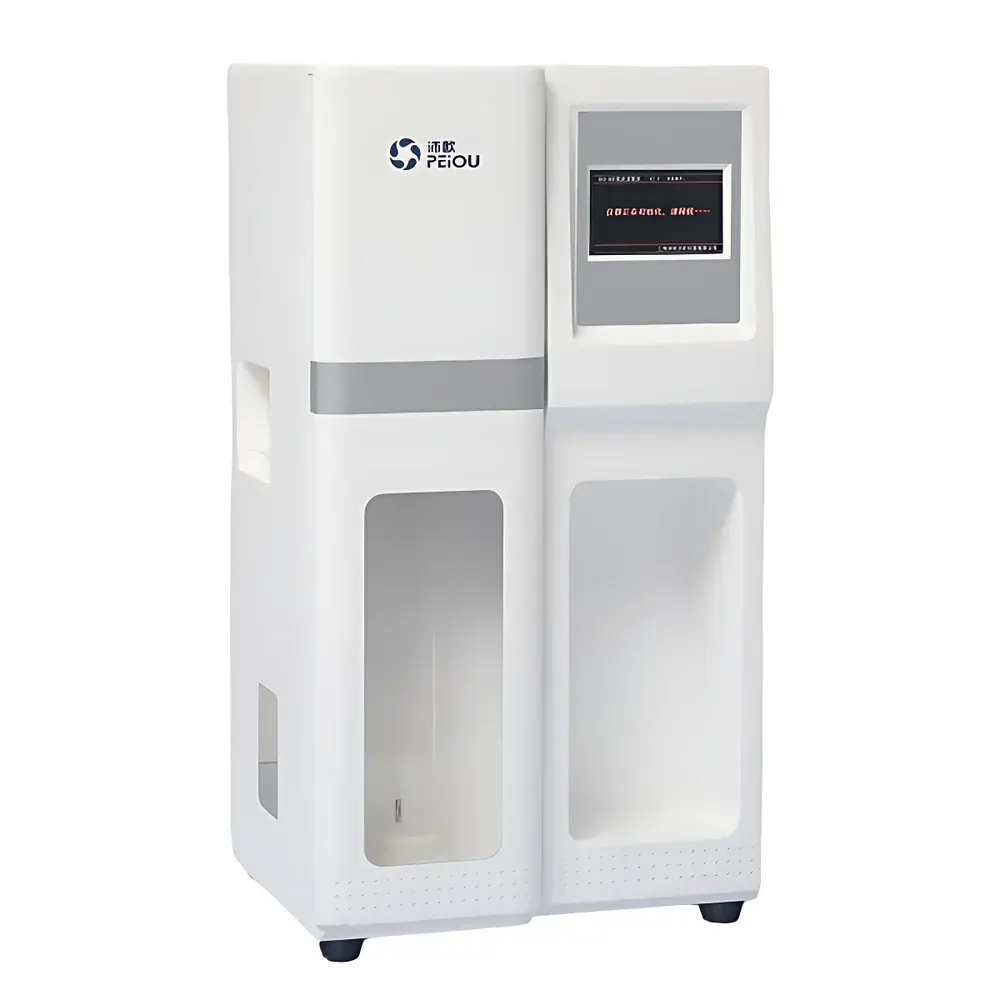
Peiou SKD-200 Automated Kjeldahl Nitrogen Determinator
| Brand | Peiou |
|---|---|
| Origin | Shanghai, China |
| Model | SKD-200 |
| Instrument Type | Automated Kjeldahl Nitrogen Determinator |
| Automation Level | Fully Automated |
| Nitrogen Determination Range | 0.1–240 mg N |
| Sample Weight Capacity | ≤6 g (solid) / ≤16 mL (liquid) |
| Recovery Rate | >99.5% |
| Repeatability | RSD ≤0.5% |
| Distillation Time | 1–99 min |
| Distillation Flow Rate | 15–30 mL/min (adjustable) |
| Distillation Power | 1500 W (adjustable) |
| Delay Time | 0–1800 s |
| Pre-stored Methods | 999 |
| Cooling Water Requirement | ≥1.5 L/min (inlet water temperature ≤20 °C), water pressure ≥0.15 MPa |
| Dimensions (L×W×H) | 370×300×680 mm |
Overview
The Peiou SKD-200 Automated Kjeldahl Nitrogen Determinator is an integrated, fully automated system engineered for precise and reproducible total nitrogen quantification in accordance with standardized Kjeldahl methodology (ISO 8968-1, AOAC 984.13, ASTM D1142, and USP <467>). It implements classical wet digestion followed by alkaline distillation and titrimetric or colorimetric detection—enabling reliable nitrogen analysis across diverse matrices including foodstuffs, feed, fertilizers, environmental samples, and pharmaceutical excipients. The instrument employs a microprocessor-controlled sequence that autonomously executes digestion product transfer, reagent dosing (NaOH, boric acid, diluent), steam distillation, condensate collection, and post-run cleaning—eliminating manual intervention while maintaining full process traceability. Its dual-level liquid sensing architecture prevents dry-heating incidents, and segmented alkali addition ensures controlled exothermic reaction kinetics, minimizing sample splashing and improving analytical robustness.
Key Features
- Fully automated workflow: sequential, programmable addition of NaOH, boric acid, and dilution solution—each delivered via corrosion-resistant solenoid valves and chemically inert tubing.
- Adjustable distillation power (up to 1500 W) and flow rate (15–30 mL/min) to optimize recovery for both low- and high-nitrogen samples—critical for heterogeneous agricultural or biological materials.
- Integrated delay function (0–1800 s) supports extended digestion hold times required for complex fertilizer or soil matrix analysis per ISO 5983-1.
- ABS engineering plastic chassis—molded as a single unit—provides inherent resistance to sulfuric acid fumes and thermal stress during prolonged operation.
- Independent circuitry, fluidics, and gas pathways reduce cross-contamination risk; external reagent reservoirs simplify maintenance and minimize internal exposure to aggressive reagents.
- Dual-mode operation: seamless switching between fully automated and manual override modes, with real-time status display of all active steps (e.g., alkali injection phase, condensate volume, elapsed distillation time).
- 999 method storage capacity enables laboratory-wide SOP deployment—including preset parameters for preheating, rinsing cycles, reagent volumes, and distillation duration—supporting GLP-compliant audit trails when paired with validated data logging software.
Sample Compatibility & Compliance
The SKD-200 accommodates solid samples up to 6 g and liquid samples up to 16 mL, compatible with standard Kjeldahl digestion tubes (e.g., 100–300 mL borosilicate glass). Its design meets functional safety requirements for Class II laboratory equipment under IEC 61010-1. The system supports regulatory workflows aligned with FDA 21 CFR Part 11 (when used with compliant data acquisition software), EU Regulation (EC) No 882/2004 on official controls, and ISO/IEC 17025:2017 clause 7.2.2 (method validation). All wetted components—including seals, diaphragms, and pump heads—are constructed from PTFE, EPDM, or FKM elastomers rated for continuous exposure to 40% NaOH and saturated boric acid solutions at elevated temperatures.
Software & Data Management
Operation is managed through a 7-inch capacitive touch LCD interface with intuitive icon-driven navigation and multilingual support (English, Spanish, French, Chinese). Each run logs timestamped metadata—including method ID, sample ID, reagent batch numbers (if entered), distillation duration, power profile, and final condensate volume—to internal flash memory. Export options include USB-stored CSV files compatible with LIMS integration. When connected to Peiou’s optional PC-based LabLink software, the SKD-200 supports electronic signature capture, user access levels (admin/operator), audit trail generation (per ALCOA+ principles), and automatic report generation conforming to ISO 14253-1 uncertainty frameworks.
Applications
The SKD-200 delivers consistent performance in routine QC laboratories requiring high-throughput nitrogen determination: protein content estimation in dairy and cereal products (via N × 6.38 factor), crude protein analysis in animal feed per AOAC 984.13, total Kjeldahl nitrogen (TKN) in wastewater per EPA Method 351.2, nitrogen balance studies in clinical nutrition research, and ammonium-nitrogen verification in industrial catalysts. Its adjustable distillation kinetics and high recovery (>99.5%) make it particularly suitable for challenging samples such as humic-rich soils, high-fat meats, and viscous fermentation broths where incomplete liberation or ammonia loss is common.
FAQ
Does the SKD-200 require external cooling water chiller units?
No—ambient tap water meeting specified flow rate (≥1.5 L/min) and temperature (≤20 °C) is sufficient. Recirculating chillers are optional for facilities with unstable municipal supply.
Can the instrument be validated for GMP environments?
Yes—its programmable method storage, electronic logbook, and hardware-level interlocks support IQ/OQ/PQ protocols. Full validation documentation packages are available upon request.
What maintenance intervals are recommended for long-term reliability?
Valve seals and pump tubing are rated for ≥3 years of continuous use under normal operating conditions; annual calibration verification against certified N standards (e.g., NH₄Cl reference material) is advised.
Is remote monitoring or network connectivity supported?
The base unit does not include Ethernet/Wi-Fi, but RS-232 and USB host interfaces enable connection to centralized lab networks via third-party middleware or Peiou’s LabLink gateway.
How is carryover between runs prevented?
Automated post-distillation rinse cycles—using deionized water and configurable volume/timing—ensure complete removal of residual condensate and reagents from the distillation chamber and condenser path.





