
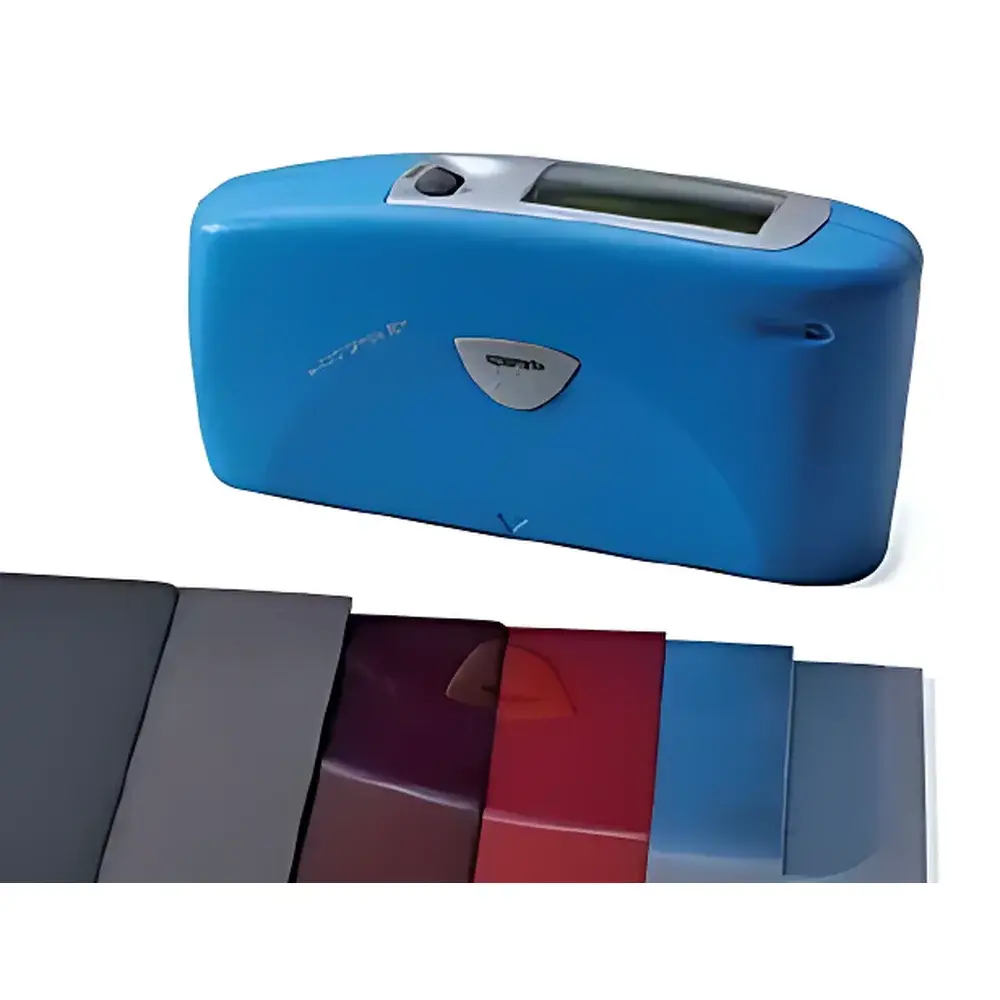
BYK-Gardner Micro-TRI-Gloss 4567 Portable 45° Gloss Meter
| Brand | BYK-Gardner |
|---|---|
| Origin | Germany |
| Model | BYK-Micro-TRI-Gloss 4567 |
| Type | Automatic |
| Transmission Range | 0–100% |
| Transmission Repeatability | ±0.2% |
| Measurement Angle | 45° |
| Measuring Spot Size | 9 × 13 mm |
| Compliant Standards | ASTM D2457, ISO 2813, JIS Z8741, TAPPI T 480, DIN 67530 |
Overview
The BYK-Gardner Micro-TRI-Gloss 4567 is a precision-engineered, handheld gloss meter designed specifically for 45° specular gloss measurement in applications where standard 20°/60°/85° geometries are insufficient—particularly in ceramics, rigid and flexible plastics, transparent and opaque films, and coated substrates requiring industry-specific angular alignment. Based on the principle of specular reflectance at a defined incident angle (45°), the instrument quantifies surface reflectivity as gloss units (GU) relative to a polished black glass reference standard (100 GU). Its optical architecture conforms to CIE and ISO definitions of gloss, ensuring metrological traceability and inter-laboratory comparability. Unlike general-purpose gloss meters, the 4567 variant is calibrated and validated for high-reproducibility assessment of mid-to-low gloss surfaces (10–180 GU) under controlled illumination (CIE Illuminant D65) and detector spectral response matching the human photopic luminosity function. The device operates without external power supply—powered by internal rechargeable Li-ion batteries—and delivers stable readings across ambient temperatures from 10°C to 40°C with <0.1 GU thermal drift per °C.
Key Features
- Single-angle 45° configuration optimized for ceramics, plastic films, and laminated substrates per ASTM C346, ASTM D2457, and JIS Z8741
- Compact ergonomic housing (128 × 65 × 32 mm) with tactile rubberized grip and intuitive rotary wheel navigation
- High-resolution color TFT display (320 × 240 px) with adjustable brightness and anti-glare coating for field use
- Integrated automatic diagnostic system: real-time verification of calibration status, standard tile cleanliness, and optical path integrity
- Measuring aperture: 9 × 13 mm — engineered to balance spatial resolution and signal-to-noise ratio for heterogeneous or textured surfaces
- Extended dynamic range: 10–180 GU with repeatability of ±0.1 GU (0–20 GU), ±0.2 GU (20–100 GU), and ±0.2% (100–180 GU)
- Onboard statistical mode: calculates mean, standard deviation, min/max, and range across ≥3 user-defined positions per sample
- IP54-rated enclosure for dust and splash resistance during shop-floor or QC lab deployment
Sample Compatibility & Compliance
The Micro-TRI-Gloss 4567 accommodates flat, curved, and moderately textured surfaces—including glazed ceramic tiles, extruded PVC sheets, biaxially oriented polypropylene (BOPP) films, anodized aluminum panels, and solvent-cast acrylic coatings. It supports both magnetic and non-magnetic substrate mounting via optional probe adapters (not included). All measurements comply with ISO/IEC 17025-accredited calibration protocols using NIST-traceable reference standards. Instrument validation documentation satisfies GLP and GMP audit requirements, including full traceability of calibration history, uncertainty budgets (<0.35 GU expanded uncertainty, k=2), and environmental monitoring logs. Regulatory alignment includes ASTM D2457 (plastics), ASTM C346 (ceramics), TAPPI T 480 (paperboard), and DIN 67530 (general gloss methodology).
Software & Data Management
Data export and remote configuration are enabled via BYK’s SmartLab Gloss software (Windows-compatible, v5.2+), which supports FDA 21 CFR Part 11-compliant electronic records through role-based user authentication, audit trail logging, and digital signature integration. SmartLab Gloss enables batch project management, trend analysis over time-series measurements, automated PDF report generation (with embedded metadata: operator ID, timestamp, location, instrument SN), and Excel-compatible CSV export. Firmware updates, custom calibration curve loading, and instrument diagnostics can be performed directly through the software interface. All measurement data include embedded EXIF-style metadata: GPS coordinates (if enabled), ambient illuminance (lux), temperature/humidity (via optional sensor), and operator-defined sample IDs.
Applications
- Ceramic manufacturing: Quantitative evaluation of glaze uniformity and acid-resistance testing via gloss loss (%) after chemical exposure per ASTM C346
- Flexible packaging R&D: In-line gloss profiling of metallized PET films and laminated pouches during gravure or flexo printing validation
- Automotive interior trim: Consistency control of low-gloss thermoplastic olefin (TPO) dashboards and door panels where 45° minimizes directional bias from micro-texturing
- Paper & board quality assurance: Gloss mapping of coated paper grades (e.g., cast-coated, matte-finish) per TAPPI T 480 and ISO 8254-3
- Medical device packaging: Verification of seal integrity and surface finish stability on Tyvek®-laminated trays via longitudinal gloss tracking
- Academic materials science: Correlation studies between surface roughness (Ra), refractive index, and 45° gloss response in polymer nanocomposites
FAQ
What standards does the BYK-Micro-TRI-Gloss 4567 comply with?
ASTM D2457, ASTM C346, ISO 2813, JIS Z8741, TAPPI T 480, and DIN 67530.
Can this instrument measure curved surfaces?
Yes—within radius limits of ≥25 mm; optional curvature compensation kits are available for radii down to 10 mm.
Is the 45° geometry suitable for automotive paint evaluation?
No—automotive OEMs require 20°/60°/85° per ISO 2813; the 4567 is intended for ceramics, films, and specialty substrates.
How often must the instrument be recalibrated?
Annual factory recalibration is recommended; onboard diagnostics alert users when calibration drift exceeds ±0.3 GU.
Does it support GLP/GMP documentation requirements?
Yes—SmartLab Gloss provides full 21 CFR Part 11 compliance, including electronic signatures, audit trails, and secure data archiving.




