
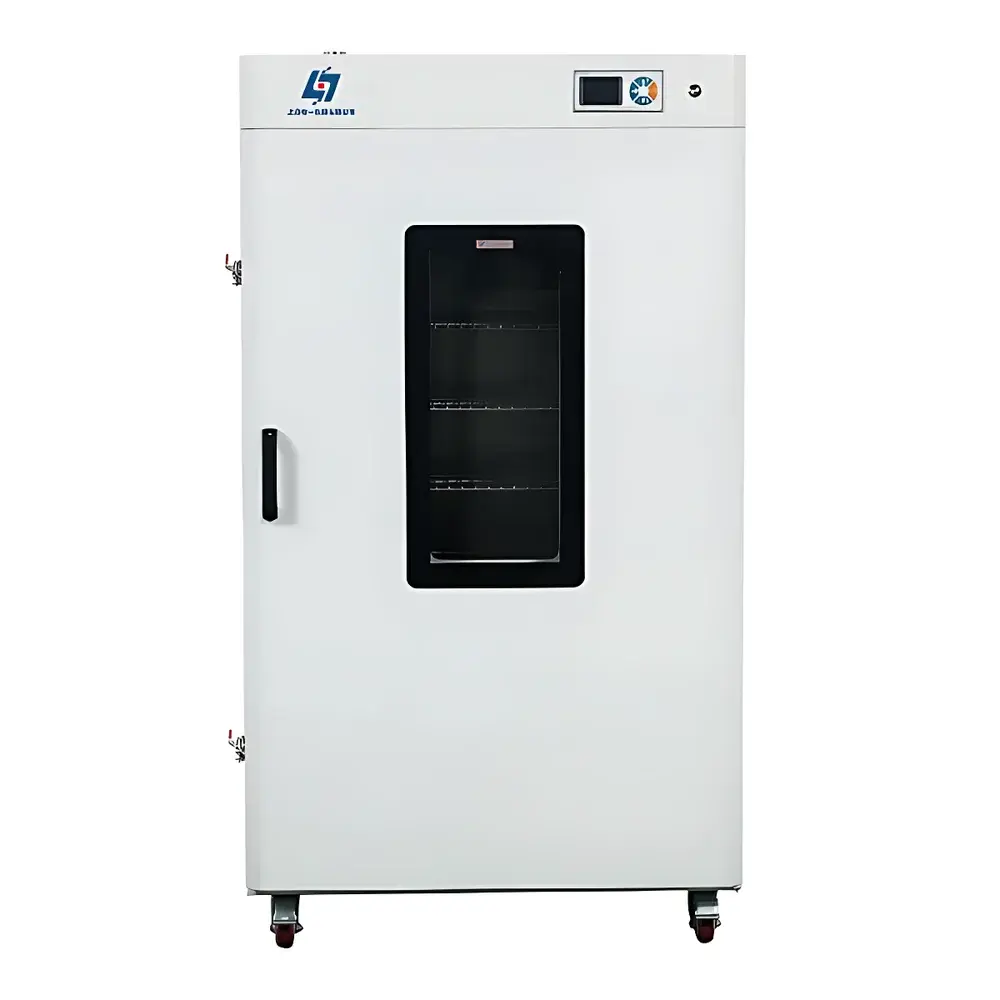
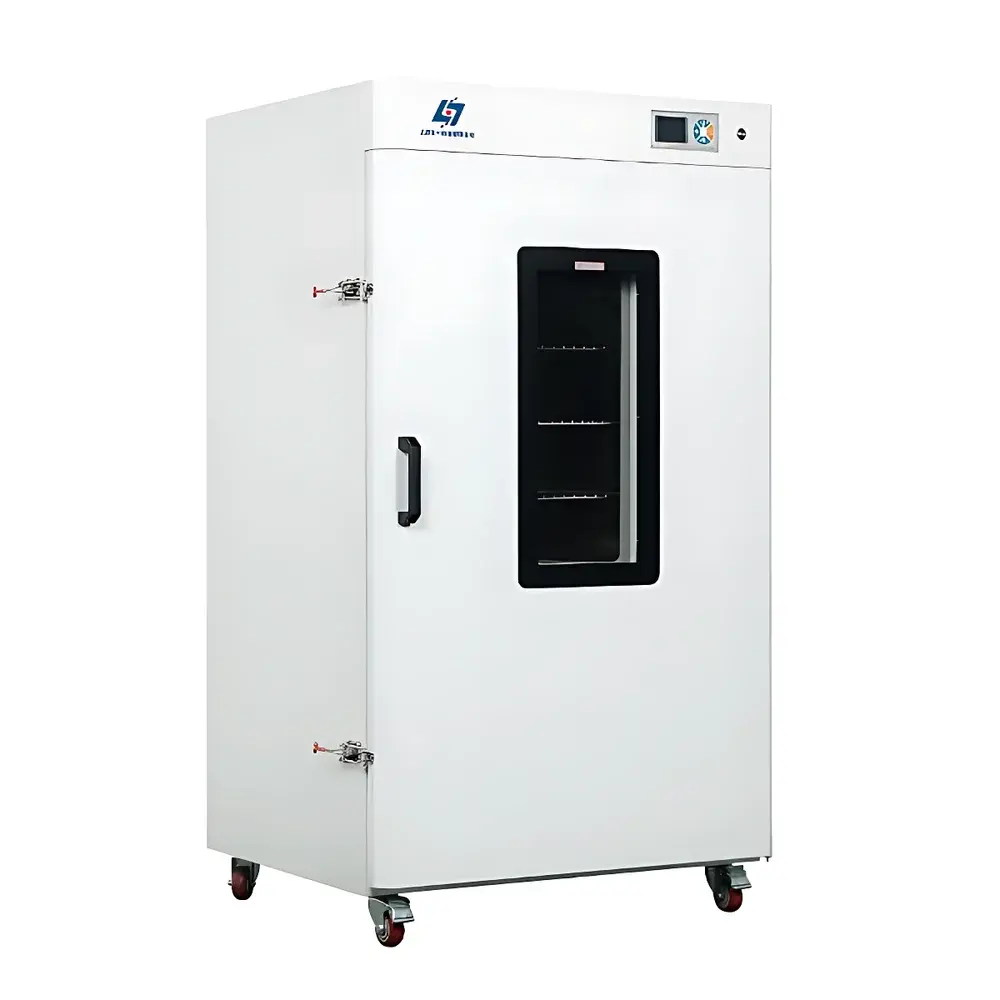
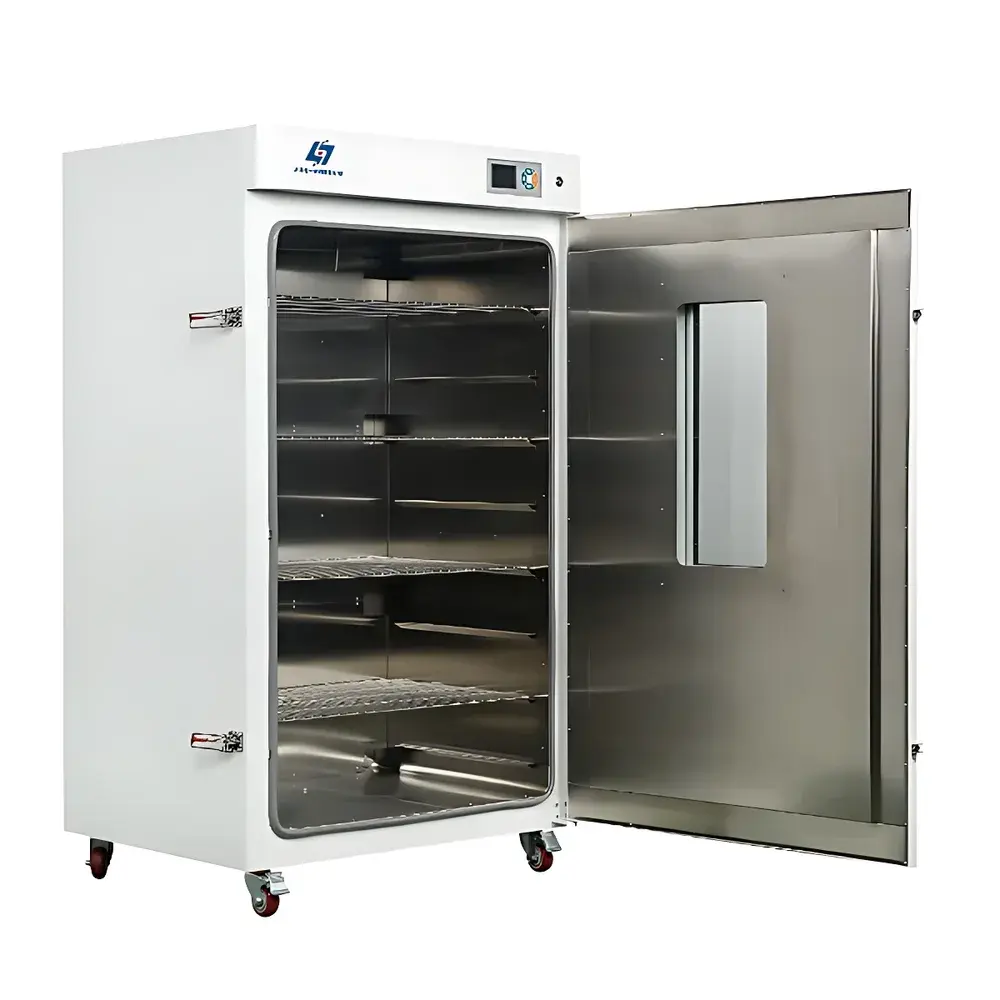
Yoyilab DHG-9620A Vertical Forced-Air Constant-Temperature Drying Oven (620 L Capacity)
| Brand | Yoyilab |
|---|---|
| Origin | Shanghai, China |
| Manufacturer Type | Direct Manufacturer |
| Instrument Type | General-Purpose Drying Oven |
| Model | DHG-9620A |
| Temperature Range | RT+10 °C to 250 °C |
| Temperature Uniformity | ±2.5% at 100 °C |
| Temperature Fluctuation | ±1 °C |
| Temperature Resolution | 0.1 °C |
| External Dimensions | 980 × 750 × 1750 mm |
| Internal Chamber Dimensions | 800 × 640 × 1300 mm |
| Chamber Material | Mirror-Finish Stainless Steel (SUS304) |
| Power Supply | AC 380 V, 50 Hz |
| Input Power | 4000 W |
| Working Environment | 5–40 °C ambient, ≤80% RH |
| Compliance | GB/T 30435–2013 |
Overview
The Yoyilab DHG-9620A is a vertically oriented, forced-air circulating drying oven engineered for precision thermal processing in research laboratories, quality control facilities, and industrial R&D environments. It operates on the principle of convection-based heat transfer, utilizing a rear-mounted centrifugal blower and optimized air duct architecture to ensure uniform airflow distribution across the entire 620 L working chamber. Designed in strict accordance with GB/T 30435–2013 (“Electrical Heating Constant-Temperature Drying Ovens — Technical Requirements and Test Methods”), the unit delivers stable thermal performance under continuous operation, supporting applications ranging from moisture removal and polymer curing to pre-sterilization conditioning and accelerated aging studies. Its robust structural design—featuring cold-rolled steel exterior with electrostatic epoxy coating and a seamless mirror-finish stainless-steel interior—ensures long-term corrosion resistance and ease of cleaning, critical for GMP-aligned workflows in pharmaceutical, food, and biotechnology settings.
Key Features
- Microprocessor-based intelligent temperature controller with dual PID algorithms, enabling precise setpoint regulation (±0.1 °C resolution) and real-time deviation monitoring.
- Multi-function LCD interface displaying simultaneous readouts of set temperature, actual chamber temperature, elapsed time, and remaining hold duration—eliminating manual parameter cross-referencing.
- Dual-layer tempered glass observation window with large viewing area, allowing non-intrusive visual verification of sample status without compromising thermal integrity.
- High-efficiency horizontal air circulation system with adjustable rear intake and exhaust ports, facilitating automatic moisture expulsion and minimizing manual venting interventions.
- Independent over-temperature protection circuit (optional), compliant with IEC 61000-4-2 ESD immunity standards, which cuts power autonomously upon exceeding user-defined safety thresholds.
- Hot-seal silicone gasket on door frame ensures consistent thermal sealing across operating range; gasket material rated for continuous exposure up to 250 °C.
- Four independently adjustable stainless-steel shelves (standard configuration), accommodating heterogeneous load geometries while maintaining laminar flow profiles.
Sample Compatibility & Compliance
The DHG-9620A accommodates a broad spectrum of sample types—including petri dishes, aluminum weighing pans, glass desiccators, ceramic crucibles, and polymer film reels—without airflow obstruction or thermal shadowing. Its chamber geometry supports both batch and semi-continuous throughput modes, making it suitable for ASTM D1654 (corrosion testing), ISO 5725 (precision validation), and USP (sterile processing support). The unit meets electromagnetic compatibility requirements per GB/T 18268.1–2010 (IEC 61326-1) and conforms to electrical safety standards outlined in GB 4793.1–2007 (IEC 61010-1). Optional RS485 communication enables integration into centralized lab management systems compliant with FDA 21 CFR Part 11 for electronic record integrity and audit trail generation.
Software & Data Management
While the base model operates via embedded firmware, optional RS485 interface (with Modbus RTU protocol support) allows bidirectional data exchange with external SCADA platforms or LIMS. When paired with supplied PC software, users can configure multi-step temperature ramps, export timestamped CSV logs (including min/max/avg values per minute), and generate PDF reports traceable to GLP/GMP documentation requirements. Optional embedded thermal printer provides hard-copy output of cycle parameters and real-time temperature curves—fully compliant with Annex 11 (EU GMP) data retention mandates. All optional accessories—including programmable controllers, inert gas inlet kits with calibrated rotameters, and 25 mm/50 mm test port adapters—are CE-marked and supplied with calibration certificates traceable to NIM (National Institute of Metrology, China).
Applications
- Moisture content determination per AOAC 950.46 and ISO 712 in food, feed, and agricultural commodities.
- Curing of epoxy resins, silicone elastomers, and powder coatings under controlled convection conditions.
- Pre-conditioning of test specimens prior to tensile, impact, or dielectric testing (ASTM D638, D256, D149).
- Thermal stabilization of reference standards and calibration weights before metrological use.
- Baking of printed circuit board assemblies post-soldering to eliminate residual flux volatiles (IPC-J-STD-001).
- Accelerated stability testing of pharmaceutical intermediates per ICH Q1A(R2) guidelines.
FAQ
What is the maximum allowable load volume for optimal temperature uniformity?
For compliance with ±2.5% uniformity specification (tested at 100 °C per GB/T 30435–2013), loading should not exceed 70% of internal chamber volume (i.e., ≤434 L net space), with minimum 50 mm clearance between samples and chamber walls.
Can this oven be validated for IQ/OQ/PQ protocols?
Yes—the unit’s documented thermal mapping profile, factory calibration certificate (NIST-traceable Pt100 sensor), and configurable alarm logging support full qualification under ISO/IEC 17025 and ASTM E2500 frameworks.
Is inert gas purging compatible with standard operation?
An optional inert gas inlet kit (with 0–10 L/min float-type flowmeter) enables nitrogen or argon blanketing during oxidation-sensitive processes; gas interface integrates seamlessly with existing exhaust ducting.
Does the controller support ramp-and-soak programming?
Standard firmware supports single-setpoint hold only; multi-segment programming requires the optional programmable temperature controller (part #PTC-DHG), sold separately.
What maintenance intervals are recommended for sustained accuracy?
Annual verification of temperature sensor drift and blower motor performance is advised; door gasket replacement every 24 months under daily 8-hour operation ensures seal integrity at elevated temperatures.



