
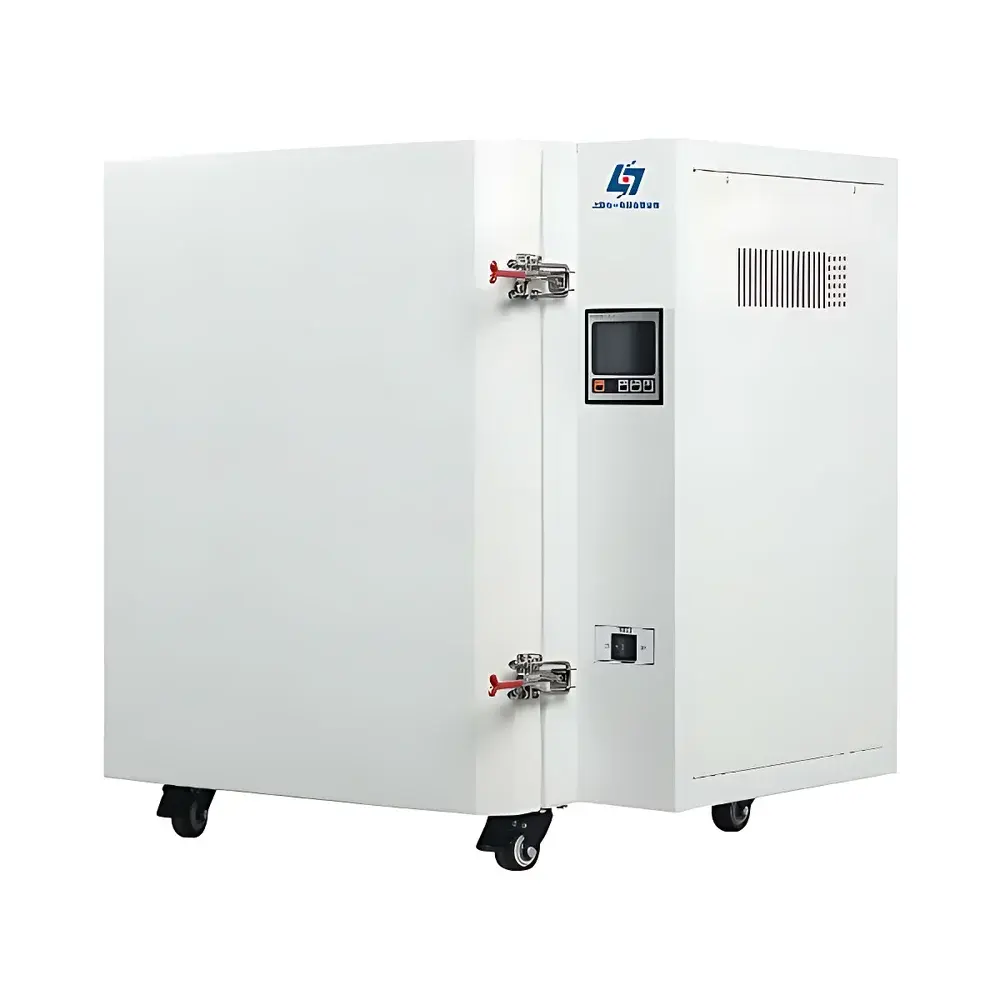
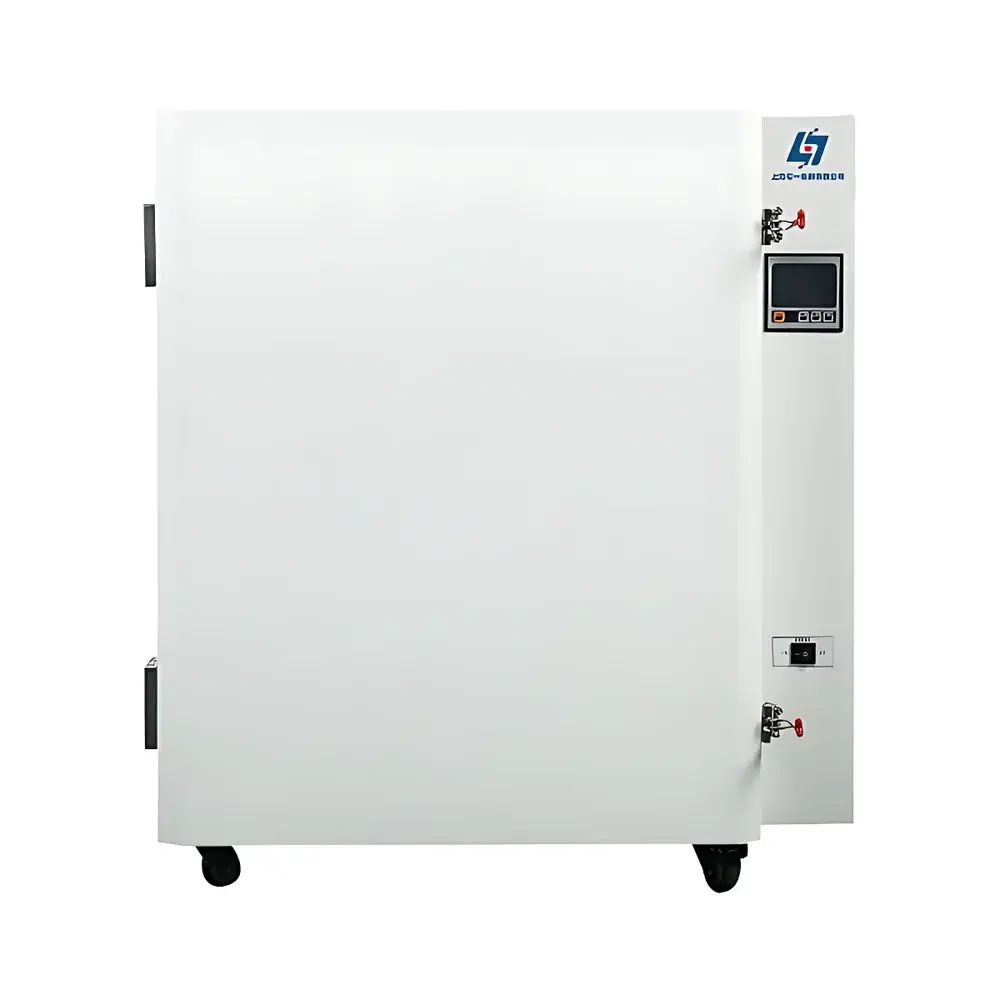
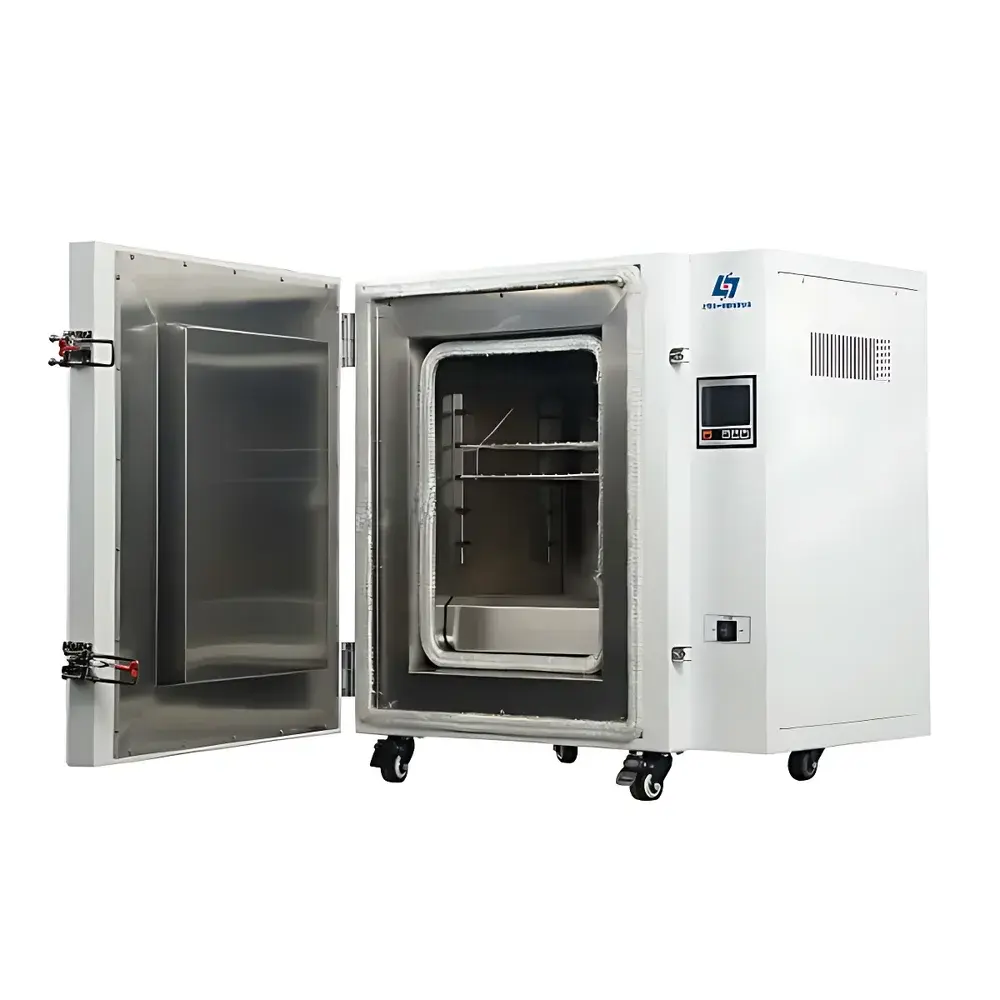
Yoyi DGG-78 Programmable High-Temperature Forced-Air Drying Oven (400 °C Max)
| Brand | Yoyi |
|---|---|
| Origin | Shanghai, China |
| Manufacturer | Yes |
| Product Type | High-Temperature Oven |
| Model | DGG-78 |
| Temperature Range | RT+20 °C to 400 °C |
| Temperature Uniformity | ±2.5% (at 100 °C) |
| Temperature Fluctuation | ±2.0 °C |
| Temperature Resolution | ±1 °C |
| Internal Chamber Dimensions (W×D×H) | 400 mm × 400 mm × 450 mm |
| External Dimensions (W×D×H) | 770 mm × 580 mm × 800 mm |
| Chamber Volume | 70 L |
| Chamber Material | Mirror-Finish Stainless Steel |
| Power Supply | AC 380 V, 50 Hz |
| Input Power | 2050 W |
| Standard Shelving | 2 adjustable stainless steel trays |
Overview
The Yoyi DGG-78 is a programmable high-temperature forced-air drying oven engineered for precision thermal processing in industrial quality control and research laboratories. Operating on the principle of convection-based heat transfer, it employs a multi-blade centrifugal fan and optimized airflow ducting to ensure uniform temperature distribution across the entire 70 L working chamber. Designed for sustained operation up to 400 °C, the DGG-78 supports critical applications including thermal curing of polymer composites, ash content determination per ASTM E1755, pre-drying of moisture-sensitive samples prior to Karl Fischer titration, and heat treatment of metal components in metallurgical QA workflows. Its robust architecture integrates dual-layer ceramic fiber door gaskets, high-density glass fiber insulation between chamber and outer casing, and a preheating air mixing cavity—features collectively minimizing thermal lag and improving ramp reproducibility across repeated cycles.
Key Features
- Microprocessor-based programmable temperature controller with 4.3-inch LCD interface, supporting multi-segment ramp-soak profiles and auto-tuning PID algorithms for stable setpoint maintenance.
- Forced-air circulation system with forward-curved multi-blade centrifugal fan and internal baffle-guided airflow path, achieving ≤±2.5% temperature uniformity (measured at 100 °C per IEC 60068-3-5).
- Double-layer ceramic rope door seal rated for continuous use at 400 °C, resistant to thermal degradation and compression set over extended service life.
- Mirror-finish 304 stainless steel interior chamber with smooth, non-porous surface for easy cleaning and corrosion resistance against acidic or alkaline volatiles.
- Cold-rolled steel exterior with electrostatic epoxy powder coating; adjustable stainless steel shelving with friction-fit support brackets and tool-free height repositioning.
- Independent over-temperature cut-off circuit (optional) compliant with IEC 61000-4-2 immunity requirements, automatically disabling heating elements if user-defined safety limit is exceeded.
- Power failure recovery function with non-volatile memory retention—preserves active program parameters and elapsed time during unexpected outages.
Sample Compatibility & Compliance
The DGG-78 accommodates a wide range of sample formats, including crucibles (porcelain, alumina, platinum), Petri dishes, glassware, metal test coupons, and polymer sheets up to 380 mm × 380 mm. Its chamber geometry and airflow design comply with ISO 17025 requirements for thermal validation traceability when used in accredited testing laboratories. The unit meets CE marking directives (2014/30/EU EMC and 2014/35/EU LVD), and its construction materials conform to RoHS 2011/65/EU restrictions on hazardous substances. For GLP/GMP environments, optional RS485 communication enables integration into centralized environmental monitoring systems with audit-trail-capable data logging (per FDA 21 CFR Part 11 when paired with validated software).
Software & Data Management
The embedded controller supports real-time temperature display, elapsed time tracking, and programmable start/stop scheduling. Optional RS485 serial interface (Modbus RTU protocol) allows bidirectional communication with SCADA platforms or custom LabVIEW-based acquisition systems. When equipped with the optional embedded thermal printer, the oven generates time-stamped hardcopy records of temperature profiles—including setpoint, actual reading, deviation, and alarm status—for immediate review and archival. All firmware operations maintain timestamped event logs accessible via menu navigation, facilitating root-cause analysis during equipment qualification (IQ/OQ/PQ) protocols.
Applications
- Moisture loss-on-drying (LOD) analysis per USP and Ph. Eur. 2.2.32 for pharmaceutical excipients and APIs.
- Thermal aging studies of elastomers and thermosets per ASTM D573 and ISO 188.
- Pre-conditioning of filter media and catalyst substrates prior to BET surface area analysis.
- Drying of geological core samples and soil specimens under controlled thermal stress for geotechnical characterization.
- Stabilization annealing of thin-film semiconductor wafers in microelectronics R&D labs.
- Residue ashing of organic matrices in environmental testing (e.g., EPA Method 3050B digestion followed by gravimetric residue quantification).
FAQ
What is the maximum continuous operating temperature of the DGG-78?
The DGG-78 is rated for continuous operation at temperatures up to 400 °C, with thermal stability maintained within ±2.0 °C under steady-state conditions.
Does the oven support validation documentation for regulated industries?
Yes—when configured with RS485 and compatible data acquisition software, it supports electronic record generation meeting FDA 21 CFR Part 11 requirements for audit trails, user authentication, and data integrity.
Can the internal chamber be customized for specific sample geometries?
Standard configurations include two adjustable stainless steel shelves; custom shelf layouts, reinforced floor plates, or inert gas purge ports (N₂ or Ar) are available as OEM modifications upon request.
Is calibration certificate included with shipment?
A factory-issued calibration report (traceable to NIM, China) is provided standard; UKAS or NIST-traceable third-party calibration certificates may be ordered separately.
What safety protections are built into the control system?
In addition to over-temperature cut-off, the controller includes watchdog timer supervision, EEPROM write-protection for parameter memory, and automatic fan-run-on post-cycle cooling to prevent thermal soak-back into sensitive electronics.



