
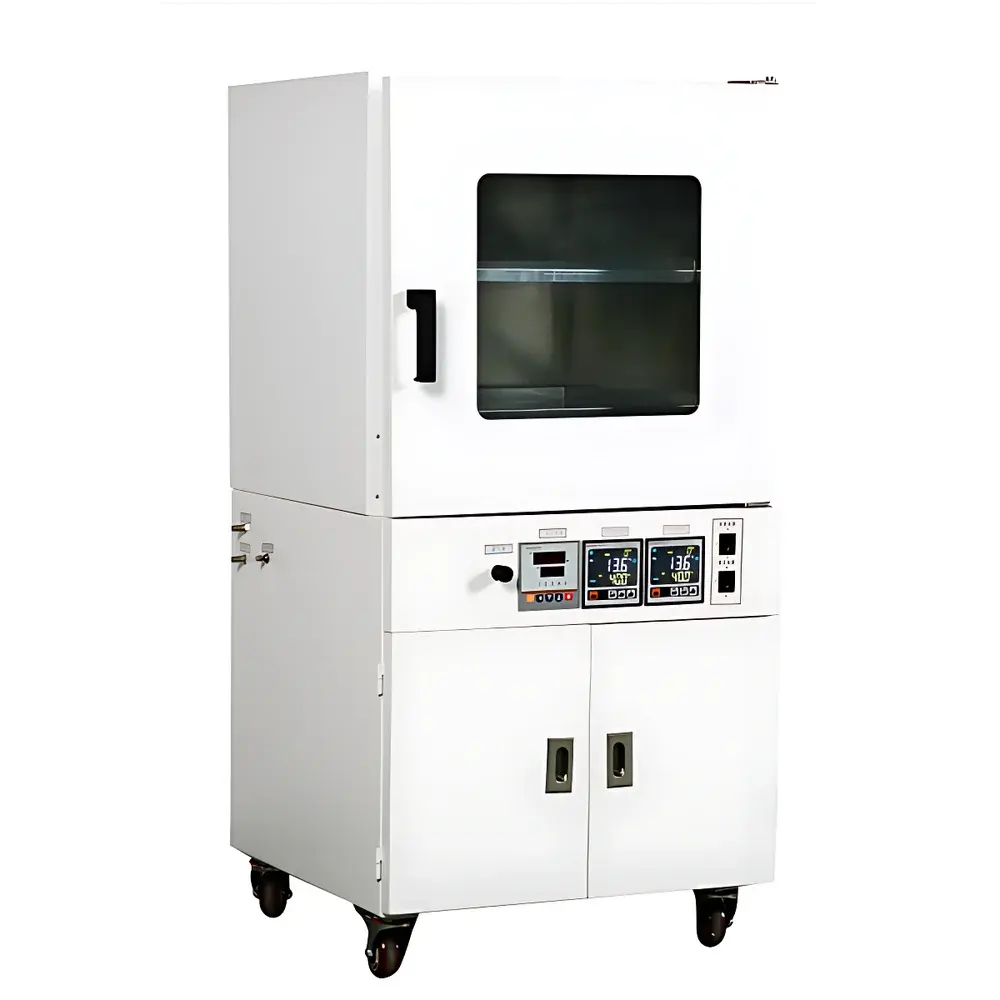
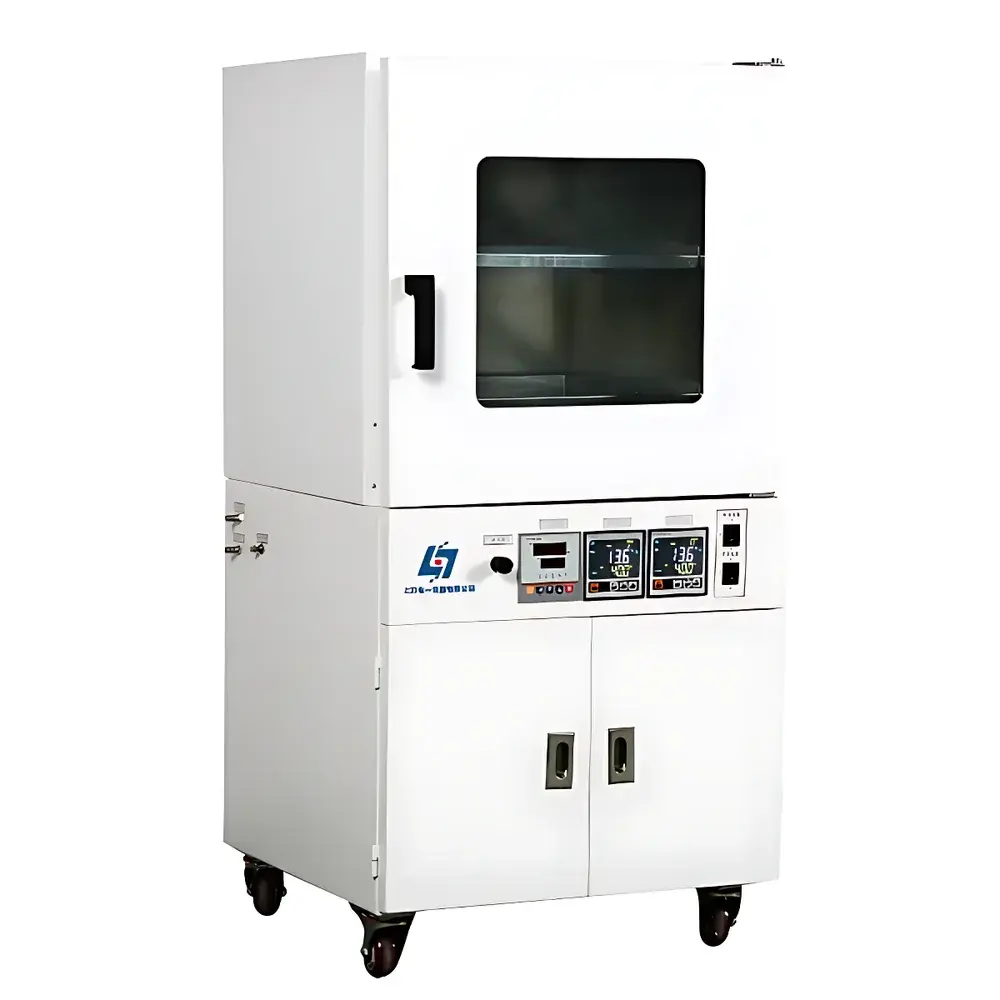
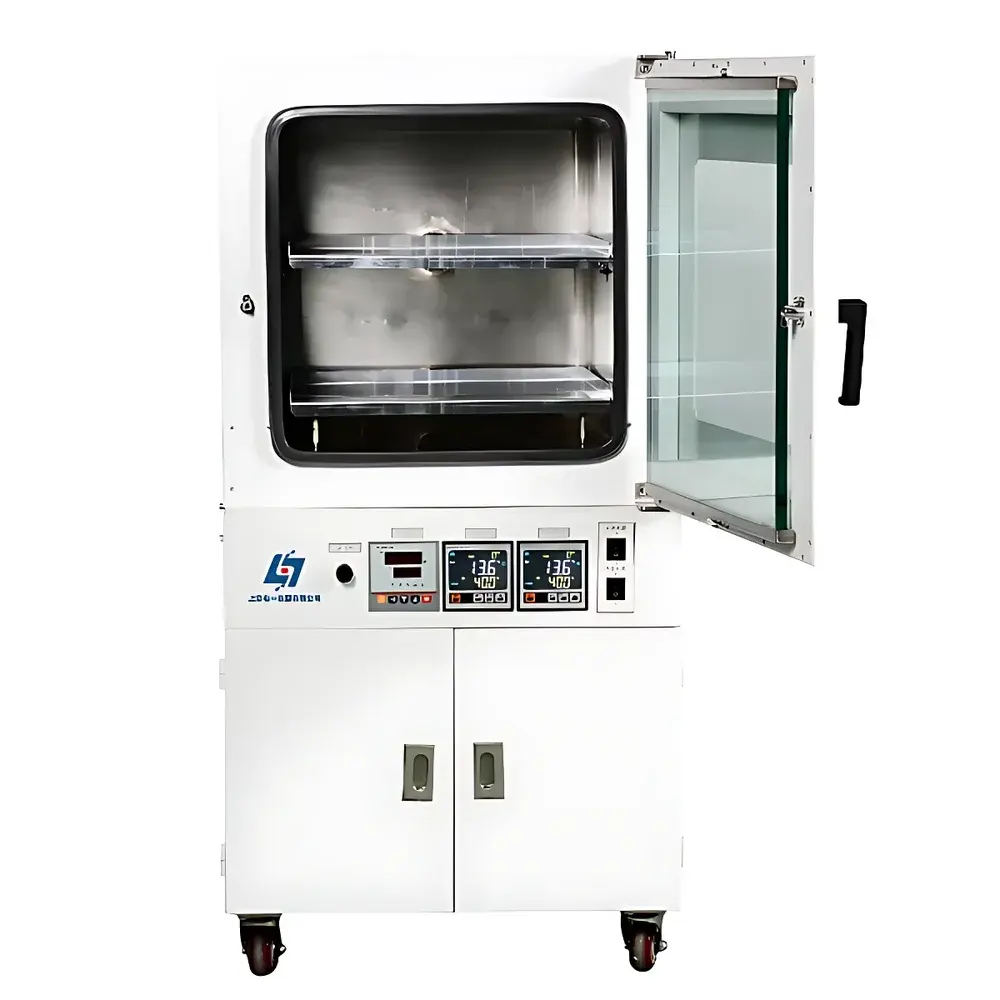
Yoyilab DZF-6210S Digital Vacuum Drying Oven with Automatic Vacuum Control and Resistive Silicon Pressure Sensor
| Brand | Yoyilab |
|---|---|
| Origin | Shanghai, China |
| Manufacturer Type | Direct Manufacturer |
| Instrument Type | Vacuum Oven |
| Model | DZF-6210S |
| Temperature Range | RT+10 to 250 °C |
| Temperature Uniformity | ±1 °C |
| Temperature Resolution | 0.1 °C |
| Vacuum Range | 1.0×10⁻¹ to 1.0×10⁵ Pa (adjustable, ±1% control accuracy) |
| Chamber Dimensions (W×D×H) | 560×600×640 mm |
| External Dimensions (W×D×H) | 720×805×1680 mm |
| Chamber Material | Stainless Steel (304) |
| Door | Double-layer tempered glass with adjustable silicone gasket |
| Heating Method | Electric resistive heating via aluminum alloy shelves |
| Power Input | 2200 W (AC 220 V, 50 Hz) |
| Timer Range | 1–9999 minutes |
| Standard Accessories | 1 adjustable stainless steel shelf, integrated lower cabinet, and external vacuum pump |
Overview
The Yoyilab DZF-6210S is a high-capacity digital vacuum drying oven engineered for precise thermal processing under controlled low-pressure environments. It operates on the principle of vacuum-assisted dehydration—reducing ambient pressure to lower the boiling point of volatile components, thereby enabling gentle, uniform drying of thermally sensitive, oxygen-sensitive, or chemically unstable samples without thermal degradation. Designed for laboratories requiring reproducible, inert-atmosphere processing, the unit supports both vacuum-only and inert-gas-purged operation (e.g., N₂ or Ar), making it suitable for applications ranging from lyophilization pre-drying to residual solvent removal in pharmaceutical intermediates and moisture analysis in polymer composites.
Key Features
- Microprocessor-based digital controller with large backlit LCD display showing real-time chamber temperature, setpoint, vacuum level (in Pa), and timer status—all on a single screen.
- Integrated resistive silicon pressure sensor for stable, drift-resistant vacuum measurement and closed-loop feedback control; enables programmable two-point or zone-based vacuum regulation within 1.0×10⁻¹–1.0×10⁵ Pa (±1% accuracy).
- Stainless steel 304 inner chamber (560×600×640 mm) with seamless welding and electropolished finish to ensure corrosion resistance and ease of cleaning—critical for GLP-compliant residue testing and QC workflows.
- High-efficiency electric heating system with aluminum alloy shelves (special stamping process) offering rapid thermal response, minimal oxidation at elevated temperatures, and improved heat distribution across load volume.
- Dual-layer tempered glass door with infinitely adjustable silicone sealing gasket ensures long-term vacuum integrity (>72 h hold at ≤133 Pa) and visual monitoring without compromising pressure stability.
- Power-fail recovery function retains all parameter settings—including temperature setpoint, vacuum target, and timer value—eliminating manual reconfiguration after unexpected outages.
- Front-panel inert gas inlet port (with precision needle valve) allows controlled purging to maintain reducing or inert atmospheres during heating cycles.
Sample Compatibility & Compliance
The DZF-6210S accommodates heterogeneous sample formats including powder-filled desiccators, open petri dishes, volumetric flasks, and sealed ampoules—provided they are rated for vacuum and thermal exposure up to 250 °C. Its design aligns with core requirements of ISO 5725 (accuracy and precision of measurement methods), ASTM E145 (standard specification for gravity-convection and vacuum ovens), and USP (assessment of drying processes). The vacuum control architecture supports audit-ready operation when paired with validated external vacuum pumps meeting ISO 8573-1 Class 2 purity standards. Optional data logging modules (not included) may be configured to meet FDA 21 CFR Part 11 requirements for electronic records and signatures.
Software & Data Management
While the DZF-6210S operates as a standalone instrument with no embedded PC interface, its controller supports analog output (0–5 V or 4–20 mA) for integration into centralized lab monitoring systems (e.g., LabVIEW, Ignition SCADA). All operational parameters—including ramp/soak profiles, vacuum setpoints, and timer events—are stored non-volatile memory and accessible via front-panel navigation. For regulated environments, users may implement external validation protocols using calibrated reference sensors traceable to NIST standards. The absence of proprietary software minimizes cybersecurity exposure while preserving full user control over process logic.
Applications
- Pre-drying of samples prior to Karl Fischer titration or gravimetric moisture analysis (ASTM D445, ISO 15512).
- Stabilization of enzyme preparations, antibodies, and nucleic acid derivatives where oxidative denaturation must be avoided.
- Removal of residual solvents (e.g., chloroform, DMF) from synthesized APIs under GMP-aligned conditions.
- Conditioning of hygroscopic reference materials (e.g., anhydrous sodium carbonate) for primary standard preparation.
- Accelerated aging studies of battery electrode slurries and solid-state electrolyte films under inert vacuum.
- Sterilization and depyrogenation of glassware and stainless steel tools via dry-heat vacuum cycles (complementary to autoclaving).
FAQ
What vacuum level can the DZF-6210S achieve, and how is it maintained?
The chamber achieves ≤133 Pa (1 Torr) under standard configuration with the included vacuum pump; sustained vacuum integrity relies on the molded silicone door seal and chamber weld integrity.
Is the temperature uniformity verified per ASTM E145?
Yes—uniformity is specified as ±1 °C at 100 °C across the working volume, consistent with Class II vacuum oven performance criteria in ASTM E145-22.
Can this oven be used for nitrogen-purged drying?
Yes—the rear-mounted inert gas inlet allows continuous or batch-wise N₂ flow; users must supply regulated gas source and inline filter.
Does the unit comply with electrical safety standards for international labs?
It meets GB 4793.1 (equivalent to IEC 61010-1) for laboratory equipment safety; CE marking requires local certification by authorized EU representative.
What maintenance is required for long-term vacuum stability?
Biannual inspection of door gasket elasticity and pump oil level; replacement of vacuum pump oil every 500 operating hours is recommended for optimal performance.



