
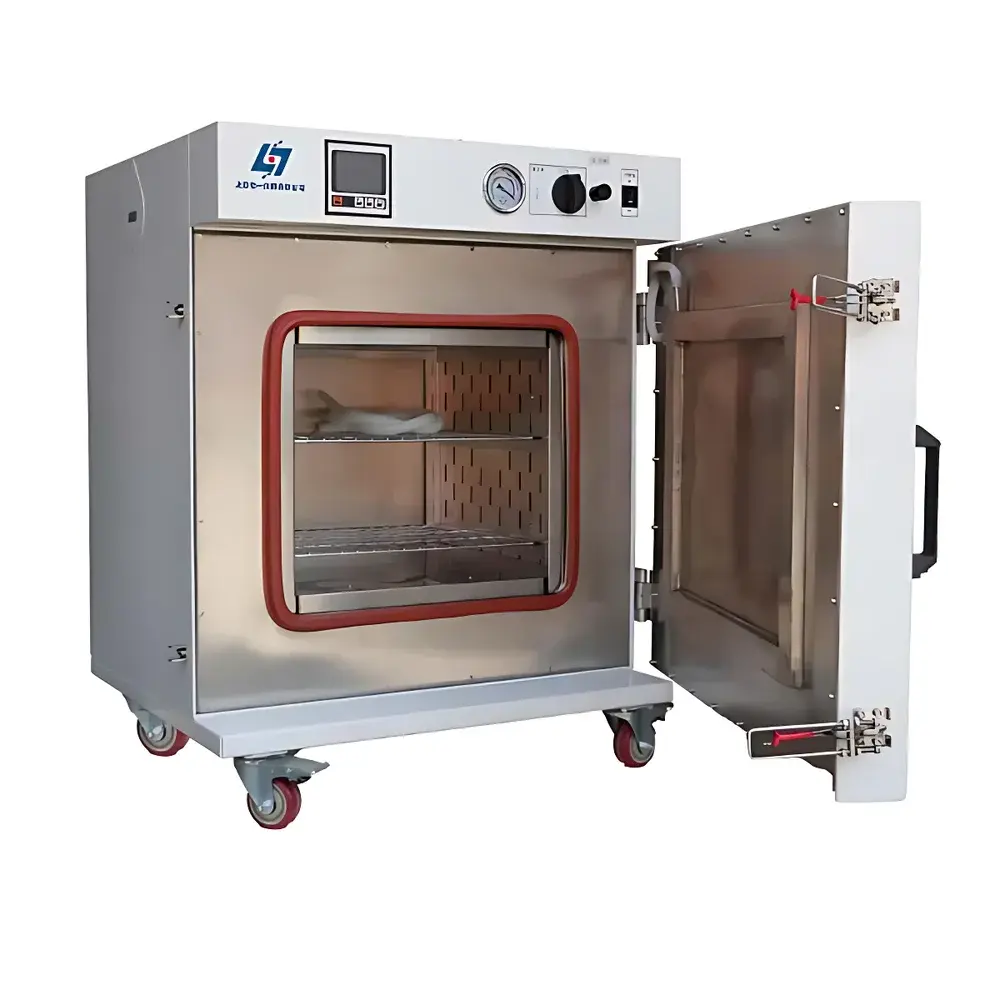
Shanghai RightOne GZF-6500A 430L High-Temperature Vacuum Drying Oven
| Brand | Shanghai RightOne (SHYY) |
|---|---|
| Origin | Shanghai, China |
| Manufacturer Type | Direct Manufacturer |
| Instrument Type | Vacuum Oven |
| Temperature Range | RT+10°C to 400°C |
| Temperature Uniformity | ±1°C |
| Chamber Dimensions | 630 × 810 × 845 mm |
| External Dimensions | 1035 × 1110 × 1460 mm |
| Temperature Resolution | 0.1°C |
| Chamber Material | 304 Stainless Steel |
| Heating Method | Electric Resistance Heating |
| Ultimate Vacuum | ≤133 Pa |
Overview
The Shanghai RightOne GZF-6500A is a high-capacity (430 L), high-temperature vacuum drying oven engineered for precision thermal processing under controlled low-pressure environments. It operates on the principle of vacuum-assisted thermal desorption—reducing ambient pressure to lower the boiling points of solvents and volatile components, thereby enabling rapid, gentle, and oxygen-free drying of thermally sensitive, oxidizable, or compositionally complex samples. Designed for rigorous laboratory and industrial R&D workflows, this oven supports applications requiring strict thermal stability, reproducible moisture removal, and inert-atmosphere processing up to 400°C. Its robust architecture integrates electric resistance heating with a fully sealed 304 stainless steel chamber, ensuring long-term corrosion resistance, dimensional stability at elevated temperatures, and compliance with fundamental safety and performance expectations for Class II vacuum thermal equipment.
Key Features
- Microprocessor-based PID temperature control system with dual-stage over-temperature protection and real-time deviation monitoring for ±1°C thermal uniformity across the full working volume.
- 4.3-inch backlit LCD interface displaying setpoint, actual temperature, elapsed time, vacuum status, and alarm codes simultaneously—supporting intuitive menu-driven operation without external software.
- Non-volatile memory retention: automatically saves user-defined parameters (setpoint, timer, alarm thresholds) during power interruption; resumes operation upon power restoration with no manual reconfiguration required.
- Optimized chamber geometry (630 × 810 × 845 mm internal) maximizes usable volume while maintaining laminar thermal distribution via natural convection—no forced air circulation that could disturb powders or fragile specimens.
- Integrated silicone rubber door gasket with adjustable clamping mechanism ensures consistent vacuum integrity down to ≤133 Pa; validated via leak-rate testing per ISO 2859-1 sampling protocols.
- Aluminum alloy heating shelves (custom-formed, anodized) provide rapid thermal response, minimal oxidation at 400°C, and uniform heat transfer—reducing thermal gradients and energy loss by up to 18% compared to standard steel trays.
- Optional configurable modules include programmable 5-segment temperature ramping, digital vacuum regulation with auto-pressure hold, nitrogen purge inlet with calibrated mass flow controller (0–10 L/min), and integrated gas–liquid separator for solvent recovery compatibility.
Sample Compatibility & Compliance
The GZF-6500A accommodates diverse sample formats—including lyophilized biological matrices, ceramic precursors, metal-organic frameworks (MOFs), pharmaceutical granules, catalyst supports, and multi-layer electronic substrates—without risk of oxidation, decomposition, or mechanical displacement. Its oxygen-free operation meets ASTM E145-22 requirements for gravimetric moisture analysis in inert atmospheres and aligns with USP guidelines for residual solvent determination in drug substances. The 304 stainless steel chamber complies with ISO 7207-2 surface finish standards (Ra ≤ 0.8 µm), facilitating cleaning validation under GLP/GMP environments. While not certified to IEC 61010-1 Annex BB for explosion-proof use, its vacuum-first operational sequence inherently mitigates combustion hazards associated with organic solvents—consistent with NFPA 45 recommendations for low-oxygen thermal processing.
Software & Data Management
The embedded controller logs timestamped temperature and vacuum readings at user-selectable intervals (1–60 sec) into internal flash memory (≥10,000 data points). Export is supported via USB 2.0 port in CSV format for traceability and audit readiness. Optional RS485 Modbus RTU interface enables integration into centralized LabVantage or Siemens Desigo CCMS platforms. All configuration changes—including setpoint modifications, timer resets, and alarm acknowledgments—are recorded with operator ID (if network-authenticated) and time stamp, satisfying FDA 21 CFR Part 11 requirements for electronic record integrity when paired with validated third-party audit trail software.
Applications
- Accelerated drying of heat-labile APIs and excipients prior to tablet compression, minimizing degradation pathways observed above 60°C in ambient ovens.
- Post-synthesis dehydration of nanomaterials (e.g., TiO₂ nanoparticles, zeolites) where residual hydroxyl groups impair catalytic activity—achieved at 120°C/50 Pa vs. 250°C in air.
- Residual solvent removal from lithium-ion battery electrode slurries, ensuring ≤50 ppm NMP before calendaring—validated via headspace GC-MS correlation studies.
- Pre-sterilization conditioning of glassware and stainless steel components in cleanroom assembly lines, eliminating water spots and biofilm nucleation sites.
- Thermal aging studies of polymer composites under controlled partial pressures, simulating space or deep-well downhole conditions per ASTM D3045 protocols.
FAQ
What vacuum level is achievable with the standard configuration?
The base unit achieves ≤133 Pa using the integrated vacuum valve and compatible external pump (not included); final pressure depends on pump selection, chamber loading, and outgassing rate of materials.
Is the oven suitable for drying samples containing flammable solvents?
Yes—operation under vacuum eliminates oxygen, suppressing ignition risk; however, solvent vapor concentration must remain below LEL thresholds, and condensate traps or cold traps are strongly recommended.
Can the temperature program be customized for multi-step processes?
The optional 5-segment programmable controller supports ramp-soak sequences with independent rate limits (0.1–20°C/min) and dwell times (1 min–999 h), stored in non-volatile memory.
How is calibration traceability maintained?
The unit includes dual PT100 sensors (working + reference); users may perform on-site verification using NIST-traceable dry-block calibrators per ISO/IEC 17025 procedures.
What maintenance is required for long-term vacuum integrity?
Quarterly inspection of door gasket compression force and annual replacement of silicone seals are recommended; vacuum gauge recalibration every 12 months ensures ≤5% reading drift.



