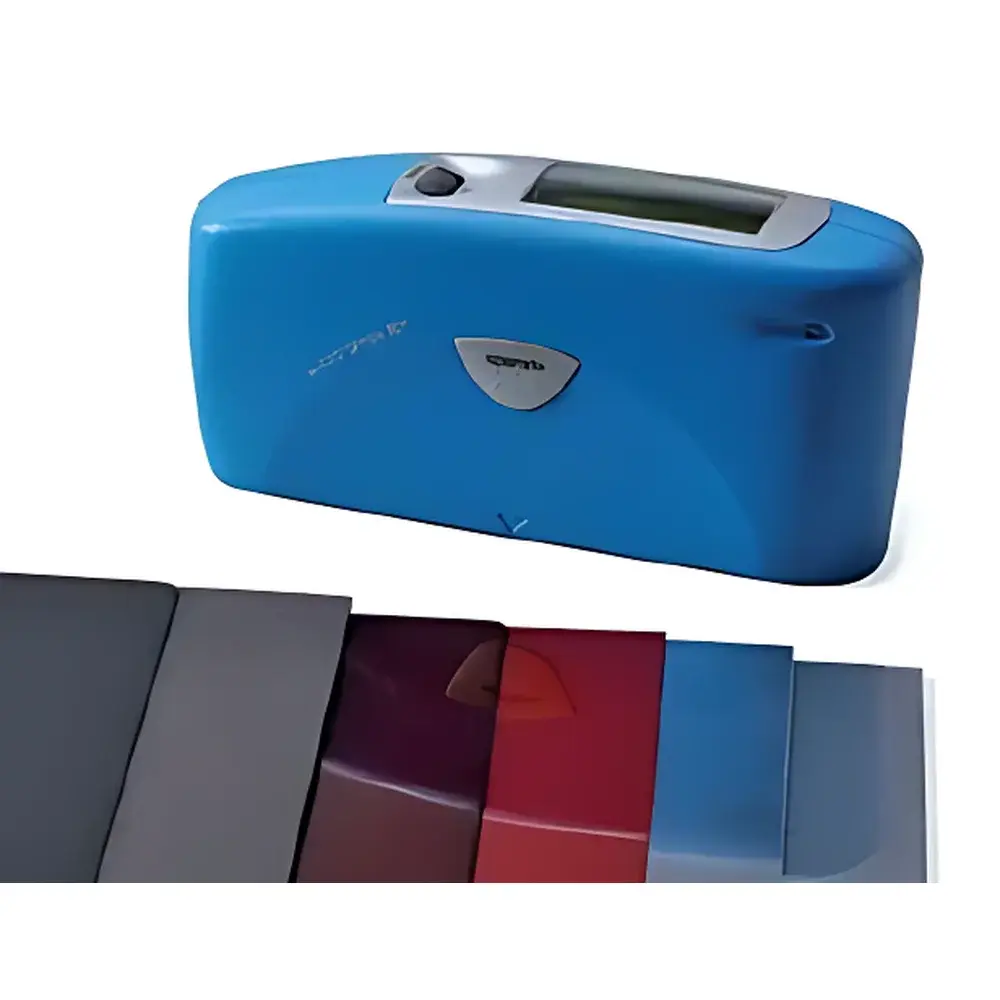
BYK-Gardner micro-TRI-gloss 4568 Portable Gloss Meter (75° Angle)

| Brand | BYK-Gardner |
|---|---|
| Country of Origin | Germany |
| Model | BYK 4568 |
| Type | Automatic |
| Transmission Range | 0–100% |
| Transmission Repeatability | ±0.2% |
| Measurement Angle | 75° |
| Application Focus | Paper, Paperboard, Coated & Uncoated Substrates, PVC Vinyl Wall Panels |
| Compliant Standards | ASTM D2457, ASTM D3679, TAPPI T 480, JIS Z 8741 |
Ask about pricing, availability and specifications.
Overview
The BYK-Gardner micro-TRI-gloss 4568 is a precision-engineered, handheld gloss meter optimized for 75° specular gloss measurement — a standardized geometry specified in ASTM D2457, ASTM D3679, TAPPI T 480, and JIS Z 8741 for evaluating the optical surface response of paper, paperboard, polyethylene films, and rigid vinyl wall panels. Unlike general-purpose 60° instruments, the 75° angle minimizes interference from substrate color and ink density, enabling robust inter-laboratory comparability across diverse white, off-white, and lightly pigmented surfaces. The device operates on the principle of specular reflectance: a collimated beam at 75° incidence strikes the sample surface, and the intensity of reflected light measured within the mirror-reflection angle is converted into gloss units (GU) using a calibrated reference standard (100 GU polished black glass). This geometry is particularly effective for low-to-medium gloss substrates where 60° or 85° measurements may lack resolution or dynamic range. Designed for high-reproducibility field and QC lab use, the 4568 integrates optical stability, thermal drift compensation, and real-time diagnostic feedback to maintain traceable performance without routine recalibration.
Key Features
- Single-angle 75° configuration engineered specifically for paper, board, and PVC vinyl applications per ASTM and TAPPI protocols
- Compact ergonomic housing with tactile scroll wheel navigation and high-contrast color display for rapid visual interpretation under variable ambient lighting
- Integrated auto-diagnostic system continuously monitors calibration status, standard plate cleanliness, and sensor alignment — alerts user when verification or cleaning is required
- Measurement aperture: 7 × 24 mm — optimized for longitudinal scanning across sheet-fed or roll-based substrates while maintaining geometric conformity to ISO 2813-defined beam divergence
- Extended gloss range: 0–140 GU with repeatability of ±0.2 GU (0–20 GU), ±0.5 GU (20–100 GU), and ±0.5% (100–140 GU), supporting both QC pass/fail thresholds and trend analysis
- On-device statistical mode computes mean, range, and standard deviation from ≥3 readings per sample — essential for assessing gloss uniformity across large-format materials
- Continuous measurement mode enables real-time gloss profiling during linear translation over surfaces such as extruded vinyl cladding or coated paper webs
Sample Compatibility & Compliance
The micro-TRI-gloss 4568 is validated for non-destructive gloss assessment of planar or gently curved substrates including uncoated and clay-coated papers, corrugated board, laminated packaging films, and rigid PVC-based architectural wall panels. Its 75° geometry suppresses chromatic influence — differential readings between white and black substrates remain below 1 GU under identical surface finish conditions. Instrument compliance extends to ISO 2813 (general gloss measurement), ASTM D2457 (plastics and paint), ASTM D3679 (paper and board), TAPPI T 480 (quality control sampling for coated papers), and JIS Z 8741 (Japanese industrial standard for gloss). All factory calibrations are traceable to NIST-certified reference standards; documented calibration certificates include uncertainty budgets aligned with ISO/IEC 17025 requirements. The instrument supports GLP-compliant operation through audit-trail-enabled data logging and password-protected configuration settings.
Software & Data Management
Data export and long-term quality tracking are enabled via BYK’s SmartLab Gloss software (Windows-based, USB or Bluetooth connectivity). SmartLab Gloss provides secure project-based data structuring, configurable report templates (PDF/Excel), and time-series visualization for monitoring batch-to-batch consistency or process drift. Each measurement record includes timestamp, operator ID, instrument serial number, environmental temperature/humidity metadata (when paired with optional external sensors), and raw gloss values per reading. Software enforces FDA 21 CFR Part 11 compliance through electronic signature capability, role-based access control, and immutable audit trails for all data modifications. Exported datasets retain full metrological context — including calibration history, standard plate ID, and diagnostic flags — ensuring regulatory readiness for GMP or ISO 9001 audits.
Applications
- Quality assurance of coated and uncoated printing papers in converting and publishing facilities
- Gloss uniformity validation of cast-coated, calendered, or matte-finished paperboards
- Process control of extruded PVC vinyl wall panels used in commercial building façades
- Supplier qualification testing for polyethylene-based flexible packaging films
- R&D evaluation of anti-glare coatings and low-sheen finishes on interior automotive trim substrates
- Correlation studies between gloss metrics and printability, ink adhesion, or surface energy characteristics
FAQ
What standards does the BYK 4568 comply with for paper gloss measurement?
ASTM D2457, ASTM D3679, TAPPI T 480, and JIS Z 8741 — all specifying 75° geometry for paper and board.
Can the 4568 measure curved or textured surfaces?
It is designed for planar or low-curvature substrates; pronounced texture or radius < 50 mm may affect beam geometry conformity and require empirical correlation.
Is the instrument suitable for measuring gloss loss after chemical exposure?
Yes — its statistical mode and multi-point acquisition support quantitative gloss degradation analysis per ASTM C346 (ceramic enamels) or custom corrosion resistance protocols.
Does the device store measurement data internally?
Yes — up to 2,000 readings with full metadata; data is retained during battery replacement and exportable via SmartLab Gloss.
How often must the instrument be recalibrated?
Calibration verification is recommended before each shift; full recalibration is required only if auto-diagnostics indicate sensor drift or standard plate contamination — typically every 6–12 months under controlled lab conditions.