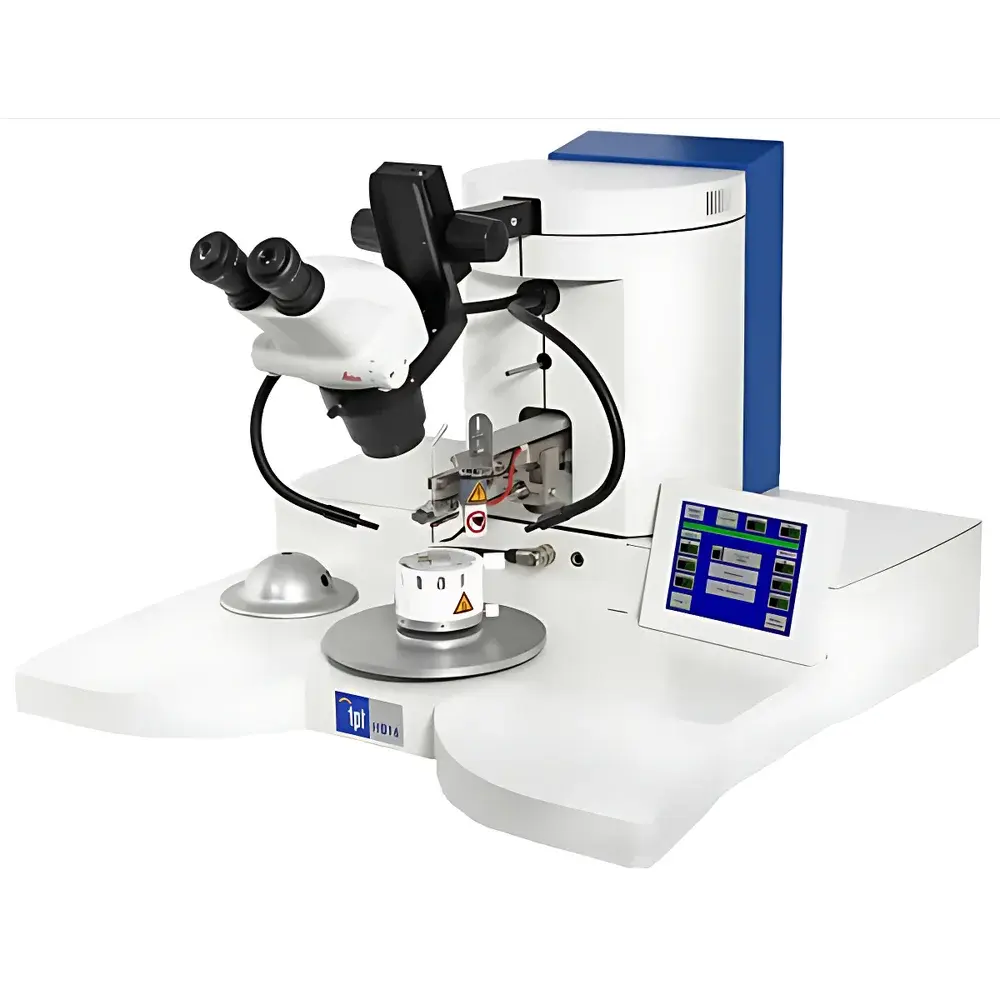
TPT HB16 Semi-Automatic Thermosonic Wire Bonder
| Brand | TPT |
|---|---|
| Origin | Germany |
| Model | HB16 |
| Bonding Methods | Ball-Wedge, Wedge-Wedge, Ribbon & Bump Bonding |
| Wire Diameter Range | 17–75 µm (Au/Al) |
| Ribbon Size | Up to 25 × 250 µm |
| Ultrasonic Frequency | 62 kHz, PLL-controlled |
| Ultrasonic Power Output | 0–5 W |
| Bond Force Range | 5–150 cNm (350 cNm optional) |
| Z-axis Motorized Stroke | 17 mm |
| Y-axis Motorized Stroke | 7 mm |
| Bond Head Depth Capacity | 16 mm |
| Bond Arm Length | 165 mm |
| Programmable Profiles | 100 |
| Touchscreen Interface | 6.5" Capacitive LCD |
| Temperature Control | Up to 250 °C ±1 °C |
| Platform Fine Adjustment | 10 mm |
| Mechanical Reduction Ratio | 6:1 |
| Power Supply | 100–240 V AC, 50/60 Hz, ≤10 A |
| Dimensions (W×D×H) | 680 × 640 × 490 mm |
| Net Weight | 42 kg |
Overview
The TPT HB16 is a precision-engineered semi-automatic thermosonic wire bonder designed for R&D laboratories, university cleanrooms, and low-volume semiconductor packaging pilot lines. Built upon TPT’s two-decade heritage in microelectronic interconnect equipment, the HB16 integrates motorized Y- and Z-axis motion control with real-time ultrasonic energy delivery to enable repeatable, process-controlled ball and wedge bonding of gold and aluminum wires (17–75 µm), ribbons (up to 25 × 250 µm), and gold bumps. Its thermosonic operation combines precisely regulated heat (up to 250 °C ±1 °C) with high-frequency (62 kHz) ultrasonic vibration—synchronized via phase-locked loop (PLL) feedback—to ensure metallurgical bond integrity on fragile substrates including silicon die, GaAs, SiC, and ceramic packages. Unlike fully automated production bonders, the HB16 prioritizes operator flexibility and parameter transparency, allowing direct access to all critical bonding variables—including force ramp profiles, ultrasonic burst timing, and thermal soak duration—without proprietary software abstraction.
Key Features
- Motorized dual-axis positioning: Independent Y- and Z-axis stepper motor drives enable precise, programmable bond head placement with 7 mm Y-travel and 17 mm Z-stroke—critical for stepped dies, stacked packages, and deep-cavity applications.
- 6.5-inch capacitive touchscreen interface: Intuitive GUI with dedicated soft-keys for real-time adjustment of ultrasonic power (0–5 W), bond force (5–150 cNm), time (0–10 s), and temperature setpoint; supports on-screen arc trajectory editing and manual jog controls.
- Multi-mode bonding head: Single tooling platform accommodates interchangeable capillaries and wedge tools—enabling seamless switching between ball bonding (with electronic ball diameter control), wedge-wedge bonding, ribbon bonding, and bump bonding without mechanical recalibration.
- Deep-cavity compatibility: Bond head design supports cavity depths up to 16 mm, verified per JEDEC MO-220 standards for encapsulated ICs and MEMS packages.
- Electronic wire tail control: Motor-driven clamp system ensures consistent post-bond tail length (±2 µm repeatability), minimizing risk of short circuits during subsequent molding or testing.
- Integrated pick-and-place assist: Optional vacuum nozzle module enables precise die handling and alignment prior to bonding—reducing manual handling errors and improving first-pass yield.
- Programmable arc shaping: User-defined wire loop geometry (height, sag, sweep angle) stored across 100 memory slots; USB export/import supports version-controlled process transfer between instruments.
- Robust thermal management: PID-controlled heater block with ±1 °C stability over full 250 °C range, compliant with IPC-7095B thermal profile requirements for Au-Al intermetallic suppression.
Sample Compatibility & Compliance
The HB16 accommodates standard 4″ and 6″ wafer fragments, discrete die (down to 0.3 × 0.3 mm), QFN, SOIC, and custom ceramic substrates mounted on TPT’s modular XYZ-theta stage (10 mm fine travel, 6:1 reduction ratio). It supports bonding to Al, Cu, NiPdAu, and ENEPIG metallizations per IPC-4552A specifications. All ultrasonic energy delivery meets IEC 61000-4-3 immunity requirements, and thermal controller calibration is traceable to NIST-certified reference standards. The system architecture supports audit-ready operation under GLP and GMP environments: timestamped parameter logs, user-access-level permissions, and optional 21 CFR Part 11-compliant electronic signature modules are available upon request.
Software & Data Management
Firmware v4.2 provides native CSV export of full bond logs—including ultrasonic RMS amplitude, actual bond force, thermal deviation, and loop height—for statistical process control (SPC) integration. Parameter sets are encrypted and password-protected; USB backup preserves calibration offsets, tooling configurations, and recipe histories. No cloud dependency—the system operates offline with local firmware updates via secure HTTPS portal. Data structure complies with SEMI E142 (Equipment Data Acquisition) metadata schema, enabling direct ingestion into factory MES platforms such as Siemens Opcenter or Applied Materials EnduraConnect.
Applications
- R&D validation of novel bond pad metallurgies (e.g., palladium-doped copper, graphene-enhanced UBM layers)
- Process development for advanced packaging: Fan-Out Wafer-Level Packaging (FOWLP), 2.5D/3D IC stacking, and heterogeneous integration
- Reliability qualification per MIL-STD-883 Method 2011.9 (wire pull testing preparation) and JESD22-B116 (ball shear test sample prep)
- Failure analysis lab support: Controlled rework of failed bonds without substrate damage
- University teaching platforms for microelectronics packaging courses—paired with TPT’s optional force-sensing calibration kit and ultrasonic waveform capture module
FAQ
Does the HB16 support copper wire bonding?
Yes—optional copper wire bonding configuration includes inert gas purge port, modified ultrasonic transducer tuning, and enhanced oxidation mitigation algorithms.
Can the system be integrated into an automated material handling workflow?
The HB16 features RS-232 and Ethernet/IP interfaces for SECS/GEM protocol compliance; third-party robotic arm synchronization requires TPT’s OEM integration kit (PN: HB16-SECS-Kit).
Is ISO/IEC 17025 calibration documentation available?
Factory calibration certificates—including force sensor NIST traceability, thermal uniformity mapping, and ultrasonic power linearity verification—are supplied with each unit and updated annually per customer request.
What maintenance intervals are recommended for the ultrasonic transducer?
Transducer performance verification is advised every 1,000 operating hours; full recalibration—including horn wear compensation—is required every 5,000 hours or after capillary replacement.
Does the HB16 meet RoHS and REACH compliance requirements?
Yes—full substance declaration (IMDS code: TPT-HB16-2024) confirms absence of restricted substances per Annex XIV of EU Regulation 1907/2006 and Directive 2011/65/EU.