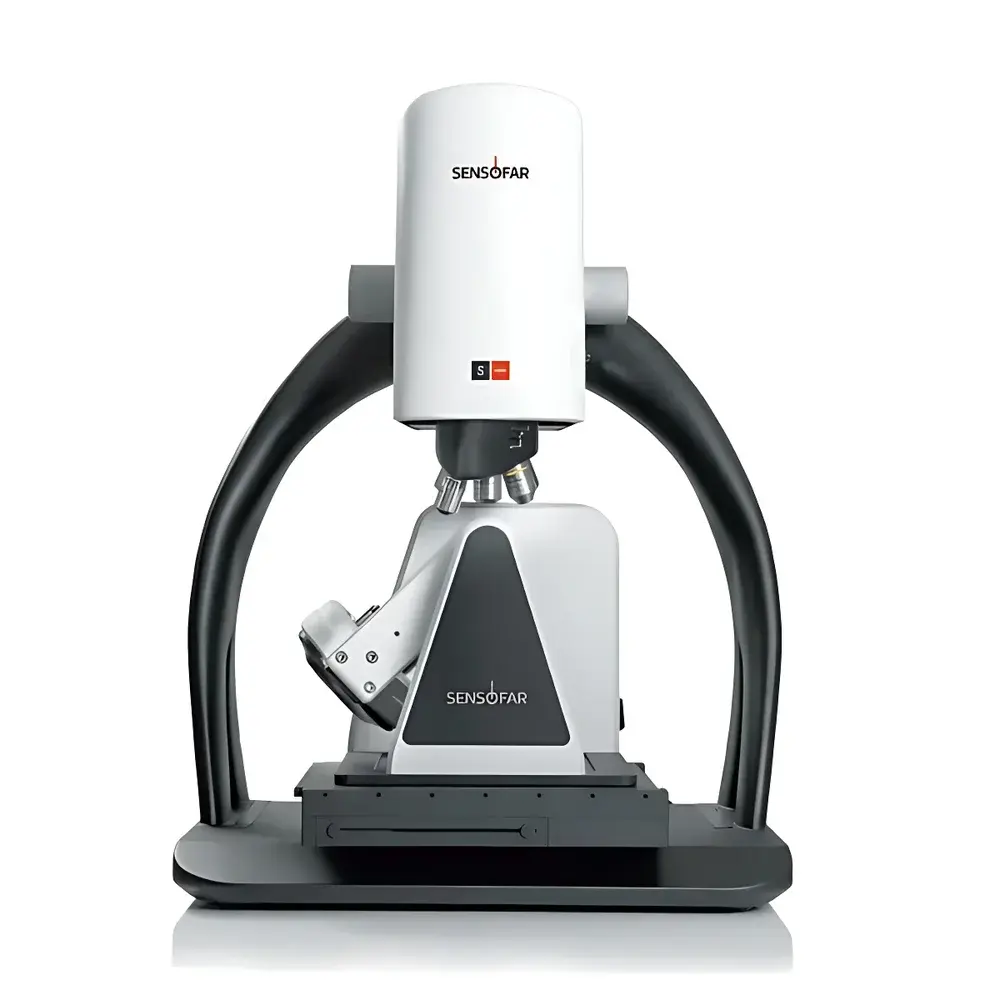
Sensofar S neox Five Axis Non-Contact 3D Optical Profilometer
| Brand | Sensofar |
|---|---|
| Origin | Spain |
| Model | S neox Five Axis |
| Measurement Principle | White-Light Interferometry |
| Product Type | Non-Contact Profilometer / Surface Roughness Analyzer |
| Axes Configuration | 5-Axis (A-axis: 360° continuous rotation, B-axis: −30° to +110°, 0.5 arcmin positioning accuracy) |
| Vertical Resolution | Sub-nanometer (interferometric mode) |
| Lateral Resolution | Diffraction-limited (dependent on objective magnification) |
| Illumination | Uniform LED ring light integrated around objective lens |
| Software Platform | SensoFIVE v6.x with GLP-compliant audit trail and data export in ISO-standard formats (ISO 25178, ISO 4287, ISO 11562) |
| Calibration Traceability | NPL/NIST/PTB-traceable roughness standards included |
Overview
The Sensofar S neox Five Axis is a high-precision, non-contact 3D optical profilometer engineered for metrology-grade surface topography characterization across research laboratories, advanced manufacturing QA/QC environments, and semiconductor packaging facilities. It integrates white-light interferometry (WLI), focus variation (multi-focus stacking), and confocal chromatic sensing within a single platform—enabling consistent, traceable measurement of surface form, waviness, roughness, and critical dimensions from sub-nanometer to millimeter-scale vertical ranges. Unlike conventional profilometers constrained by sample geometry or tilt limitations, the S neox Five Axis employs a fully motorized 5-axis stage (A + B rotational axes plus X/Y/Z linear motion) to dynamically reorient samples during acquisition. This architecture eliminates shadowing artifacts on steep-sided features (>90° slopes), enabling complete 3D reconstruction of complex freeform surfaces—including turbine blades, microfluidic channels, MEMS devices, and precision-machined optics—without manual intervention or post-processing stitching.
Key Features
- Multi-technology sensor fusion: Simultaneous access to white-light interferometry (for sub-nm vertical resolution on smooth to moderately rough surfaces), focus variation (for high-slope, structured surfaces up to 85°), and confocal chromatic profiling (for high lateral resolution on reflective or transparent materials).
- 5-axis synchronized motion control: A-axis provides infinite 360° rotation with <1 arcsecond repeatability; B-axis tilts from −30° to +110° with 0.5 arcminute positioning accuracy—enabling full-field coverage of cylindrical, conical, and toroidal geometries.
- Automated multi-position acquisition: User-defined measurement routines allow sequential targeting of discrete regions-of-interest (ROIs); the system automatically repositions, focuses, acquires, and registers each 3D dataset into a unified coordinate frame.
- Integrated LED ring illumination: Uniform coaxial lighting optimized for both interferometric fringe contrast and confocal signal-to-noise ratio—critical for reliable measurements on low-reflectivity or heterogeneous surfaces.
- System3R clamping system: Modular fixturing supports flat, cylindrical, and irregular samples; includes calibrated reference artifacts (flat mirror, step height standard, roughness standards traceable to NPL/NIST/PTB) and interchangeable chucks for rotational symmetry analysis.
Sample Compatibility & Compliance
The S neox Five Axis accommodates samples ranging from 10 mm × 10 mm to Ø200 mm diameter and up to 150 mm height, with no requirement for conductive coating or vacuum. It measures surfaces with reflectivity spanning 0.1% (matte black anodized aluminum) to >95% (polished silicon wafers or fused silica). All measurement algorithms comply with ISO 25178-2 (areal surface texture parameters), ISO 4287 (profile-based roughness), and ISO 11562 (filtering specifications). Data integrity meets FDA 21 CFR Part 11 requirements via SensoFIVE’s role-based user authentication, electronic signatures, and immutable audit trails—ensuring full traceability for GLP/GMP-regulated workflows.
Software & Data Management
SensoFIVE v6.x serves as the unified interface for instrument control, real-time visualization, and metrological analysis. Its modular architecture separates acquisition, registration, filtering, parameter calculation, and reporting functions—each conforming to ISO/IEC 17025 validation guidelines. Raw interferograms, Z-stacks, and confocal intensity maps are stored in vendor-neutral HDF5 format with embedded metadata (objective ID, illumination settings, environmental conditions). Batch processing supports automated parameter extraction (Sa, Sq, Sz, Sdr, Vmp, etc.) across hundreds of ROIs, with export options compliant with ASTM E2921 and EU Regulation (EU) No 2017/745 for medical device surface verification.
Applications
- Semiconductor packaging: Warpage analysis of flip-chip substrates, solder bump height uniformity, and underfill void detection.
- Precision optics: Form error mapping of aspheric lenses, scratch/defect quantification on anti-reflective coatings.
- Additive manufacturing: As-built surface characterization of Ti-6Al-4V lattice structures, powder-bed fusion porosity assessment.
- Medical devices: Surface texture verification of orthopedic implants per ISO 14644-1 and ISO 10993-1 biocompatibility protocols.
- Automotive powertrain: Cylinder bore cross-hatch angle quantification, piston ring land roughness, and valve seat topography.
FAQ
Does the S neox Five Axis require vibration isolation?
Yes—optimal performance demands passive or active vibration isolation compatible with <5 µm/s RMS floor noise, particularly when operating in interferometric mode at sub-nanometer vertical sensitivity.
Can it measure transparent or semi-transparent films?
Yes, using focus variation or confocal modes with appropriate objective selection and refractive index compensation; WLI mode is limited to opaque or highly scattering layers.
Is calibration traceable to international standards?
Yes—the delivered calibration kit includes NPL/NIST/PTB-certified roughness and step-height standards, and all software algorithms undergo annual metrological validation per ISO/IEC 17025.
What file formats does SensoFIVE support for data exchange?
HDF5 (primary native format), CSV (parameter tables), STP/STEP (3D mesh export), TIFF (height maps), and PDF (automated reports with digital signatures).
How is measurement uncertainty estimated?
Uncertainty budgets follow GUM (JCGM 100:2008) principles and incorporate contributions from environmental drift, stage positioning error, pixel size, and algorithmic bias—documented in the instrument’s Certificate of Conformance.