
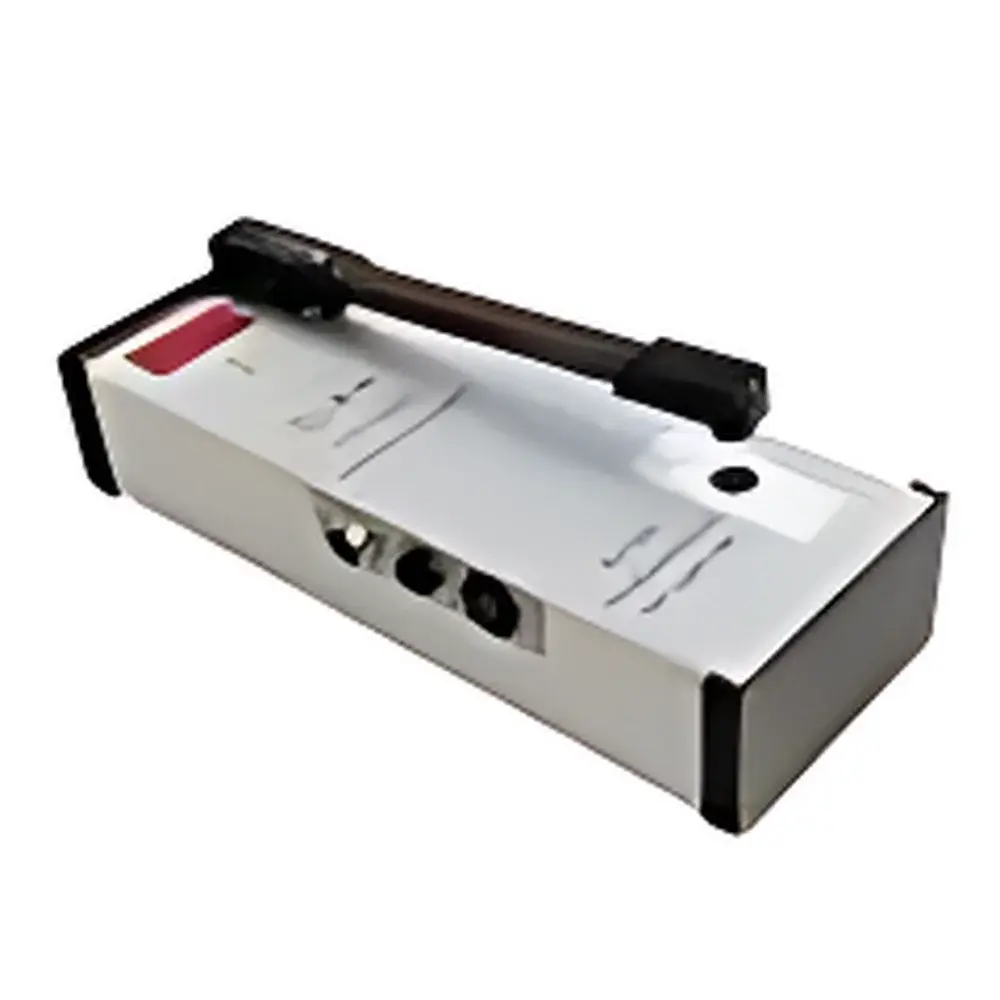
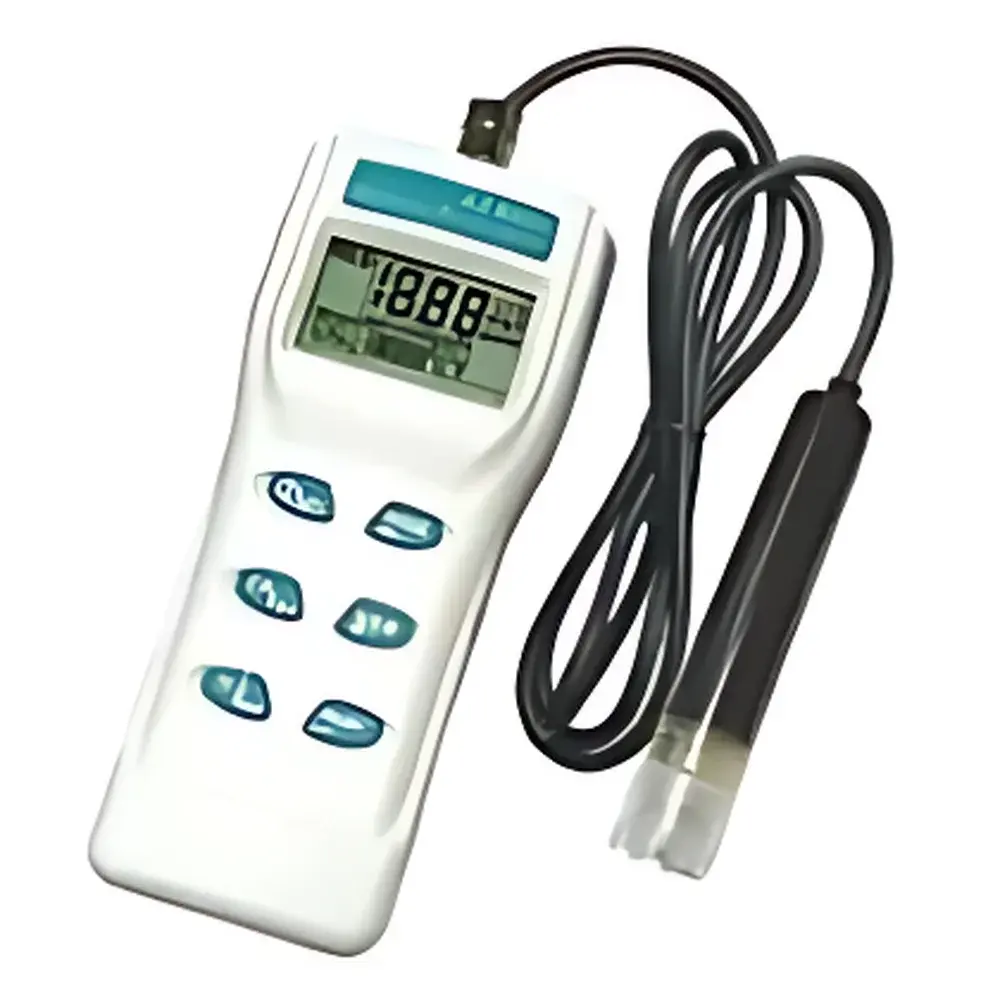
HengaoDe H586A Digital Densitometer for Black-and-White Radiographic Films
| Brand | HengaoDe |
|---|---|
| Origin | Beijing, China |
| Manufacturer Type | Authorized Distributor |
| Region | Domestic (China) |
| Model | H586A |
| Price | USD 138 (excl. tax & shipping) |
| Display | 3-digit LED direct-read |
| Density Range | D = 0.00–5.00 |
| Sampling Time | 0.8 s |
| Operating Temperature | 0 °C–40 °C |
| Relative Humidity | ≤85% RH |
| Aperture Diameter | 2 mm |
| Power Supply | AC 220 V ±10%, 50–60 Hz |
| Reading Stability | ±0.02 D |
| Power Consumption | ~10 W |
| Uncertainty | ≤±0.02 D (0.00–3.00), ≤±0.04 D (3.00–5.00) |
| Dimensions (L×W×H) | 300 × 110 × 58 mm |
| Net Weight | 1.5 kg |
| Calibration Verification | Supplied with traceable density calibration film set |
Overview
The HengaoDe H586A Digital Densitometer is a precision optical instrument engineered for quantitative measurement of optical density (D) in black-and-white radiographic films used across non-destructive testing (NDT), medical imaging, industrial radiography, and quality assurance laboratories. It operates on the principle of transmitted light photometry: a stabilized tungsten-halogen light source emits collimated beam through a fixed 2 mm aperture; incident light passes through the film, and the attenuated intensity is captured by a high-linearity silicon photodiode sensor. The analog signal undergoes 12-bit analog-to-digital conversion and is processed in real time by an embedded microcontroller to compute optical density using the standard definition D = log10(I0/I), where I0 is incident intensity and I is transmitted intensity. Unlike legacy analog densitometers subject to drift and operator-dependent interpretation, the H586A delivers repeatable, operator-independent results with minimal warm-up time and no manual zeroing required.
Key Features
- Stable, low-noise tungsten-halogen light source with thermal regulation ensures consistent spectral output over extended operation.
- High-precision photodiode sensor with temperature-compensated amplifier circuitry minimizes thermal drift across ambient conditions (0–40 °C).
- 3-digit LED display provides direct-read optical density values from 0.00 to 5.00 with 0.01 D resolution—optimized for ISO 11699-1 compliance in industrial film classification.
- 0.8-second sampling time enables rapid throughput during batch film evaluation without compromising measurement fidelity.
- Integrated calibration verification: Each unit ships with a certified density step wedge (traceable to national standards) for daily performance validation per ASTM E1815 and ISO 5576 protocols.
- Compact benchtop form factor (300 × 110 × 58 mm) and lightweight construction (1.5 kg) support portability between QA labs, field radiography stations, and hospital darkrooms.
- No external PC or software dependency—fully self-contained operation with push-button zeroing and auto-ranging circuitry.
Sample Compatibility & Compliance
The H586A is validated for use with all standard silver-halide-based black-and-white radiographic films—including Agfa Structurix, Kodak Industrex, Fuji RX, and Konica SR series—across thicknesses up to 0.3 mm and base densities up to 0.25 D. Its 2 mm aperture conforms to ISO 5576 Annex A requirements for spot densitometry in weld inspection and pressure vessel certification. The instrument meets electromagnetic compatibility (EMC) Class B limits per GB/T 18268.1–2010 (IEC 61326-1) and electrical safety requirements per GB 4793.1–2007 (IEC 61010-1). While not certified to IEC 62304 or FDA 21 CFR Part 11, its deterministic firmware architecture and absence of user-modifiable calibration coefficients support GLP-aligned documentation practices when paired with laboratory-controlled SOPs.
Software & Data Management
The H586A operates as a standalone hardware device with no onboard data logging or digital interface. All measurements are displayed in real time only; no internal memory, USB, Bluetooth, or RS-232 connectivity is provided. This design prioritizes metrological integrity and regulatory simplicity—eliminating potential sources of electronic interference, firmware version drift, or audit trail complexity. For laboratories requiring traceable records, users are advised to integrate the instrument into validated manual entry workflows or pair it with third-party image analysis systems that accept calibrated D-value inputs via external film scanners. Density verification films included with each unit provide documented evidence of baseline accuracy for internal quality audits.
Applications
- Radiographic film quality control: verification of film batch uniformity, fog level, and contrast sensitivity prior to exposure in ASME Section V or EN ISO 17636-1 inspections.
- Processing chemistry monitoring: quantification of developer activity decay and fixer exhaustion through periodic base+fog and maximum density (Dmax) tracking.
- Medical X-ray QA: compliance checks per AAPM TG-142 for diagnostic film processors in mammography and general radiography departments.
- Archival assessment: evaluation of long-term film degradation in storage environments using density shift trends across time-series measurements.
- Educational training: hands-on instruction in radiographic density fundamentals, exposure reciprocity, and H&D curve analysis for NDT Level II candidates.
FAQ
What standards does the H586A comply with for industrial radiography?
It supports conformance to ISO 11699-1 (film classification), ISO 5576 (densitometer specifications), and ASTM E1815 (standard practice for densitometer calibration) when used with certified reference films.
Can the H586A measure color film or digital detector images?
No—it is optimized exclusively for monochromatic transmission densitometry of silver-halide radiographic films. It does not support RGB or CMYK color space analysis or phosphor plate scanning.
Is routine recalibration required?
The factory calibration is stable for 12 months under normal use. Daily verification using the supplied density step wedge is mandatory per ISO 9001 clause 7.6; full recalibration by an accredited metrology lab is recommended annually.
How is zero adjustment performed?
With no film in the aperture, press and hold the “ZERO” button for 2 seconds—the display resets to 0.00 D, compensating for ambient light leakage and sensor offset.
Does the instrument include NIST-traceable calibration documentation?
Each unit ships with a manufacturer’s certificate of conformance and a calibration verification film set bearing individual serial-numbered density values, traceable to China National Institute of Metrology (CNIM) reference standards.






