
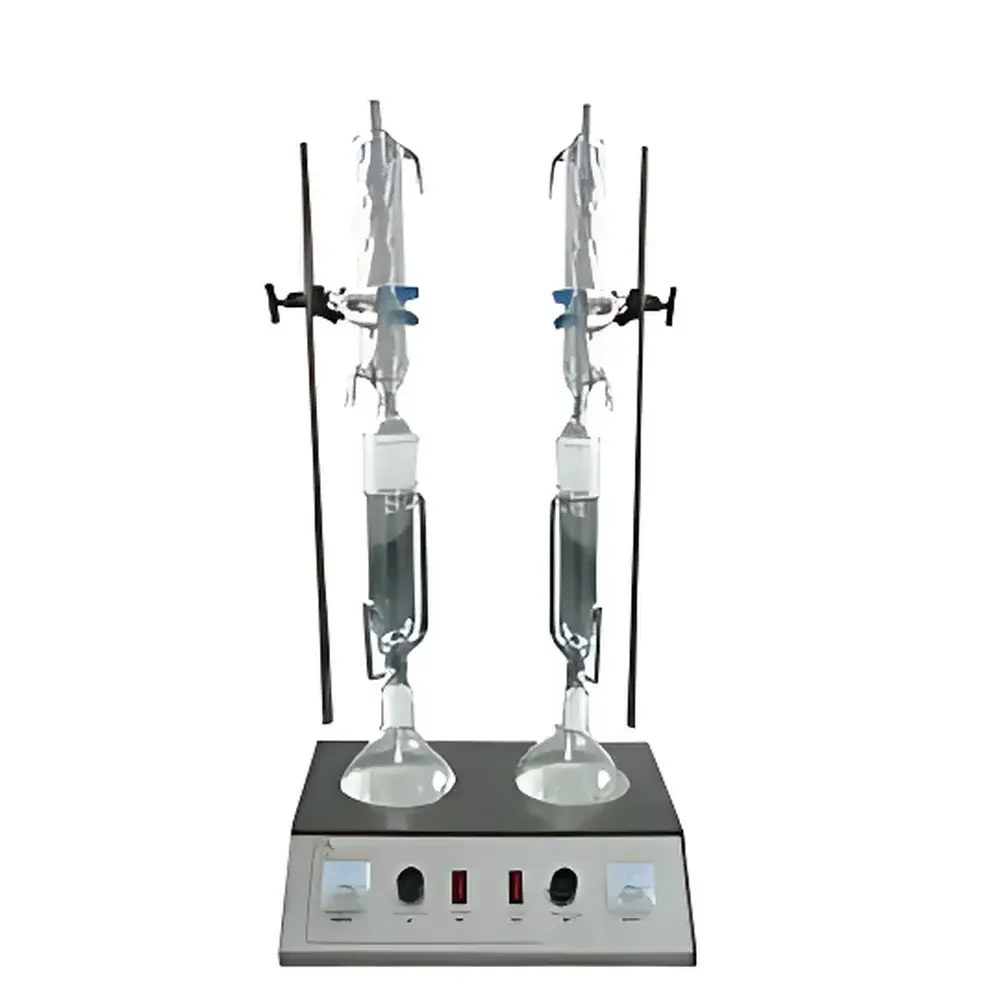
HengaoDe H28151 Toluene-Insoluble Content Analyzer for Coal Tar and Coal Pitch
| Brand | HengaoDe |
|---|---|
| Origin | Beijing, China |
| Manufacturer Type | Authorized Distributor |
| Country of Origin | China |
| Model | H28151 |
| Heating Method | Electric Heating Mantle (Solid-State SCR Controlled) |
| Standard Compliance | GB/T 2292–1997 |
| Capacity | 250 mL per unit |
| Temperature Range | Ambient to 300 °C |
| Control | Imported Solid-State Voltage Regulator |
| Configuration | Dual-Sample Parallel Operation |
| Power Rating | 1 kW |
| Supply | 220 V ±10%, 50 Hz |
| Operating Environment | –5 °C to 40 °C, ≤85% RH |
| Net Weight | 5 kg |
Overview
The HengaoDe H28151 Toluene-Insoluble Content Analyzer is a precision laboratory instrument engineered for the quantitative determination of toluene-insoluble (TI) fractions in coal-derived materials—including coal tar, coal pitch, modified pitch, road-paving pitch, wood-preservative oils, and coking feedstocks for carbon black production. It operates in strict accordance with the Chinese national standard GB/T 2292–1997, which specifies gravimetric methodology based on selective solvent extraction. The analytical principle relies on the differential solubility of aromatic hydrocarbons and heteroatom-rich macromolecules: while low-molecular-weight components dissolve readily in hot toluene, the TI fraction—comprising highly condensed polyaromatics, char particles, and cross-linked asphaltenes—remains retained on quantitative filter paper after exhaustive extraction. This residue, when dried to constant mass under controlled thermal conditions, yields the TI content as a mass percentage of the original sample. The instrument’s dual-station design enables simultaneous processing of two independent samples, enhancing throughput while maintaining inter-sample comparability under identical thermal and fluid-dynamic conditions.
Key Features
- Dual-channel parallel operation ensures consistent thermal profiles and extraction kinetics across both sample positions, minimizing batch-to-batch variability.
- Electric heating mantle with solid-state SCR (Silicon Controlled Rectifier) temperature regulation delivers precise, stepless control from ambient to 300 °C—critical for reproducible toluene reflux without localized overheating or thermal degradation.
- No open flame design meets modern laboratory safety protocols and eliminates fire hazard associated with traditional oil-bath or gas-heated systems.
- 250 mL extraction capacity accommodates standard GB/T 2292–1997 sample-to-solvent ratios, supporting both coal pitch (sand-mixed pre-treatment) and coal tar (direct toluene immersion) workflows.
- Robust stainless-steel and high-temp polymer construction ensures long-term stability in aggressive organic solvent environments and repeated thermal cycling.
- Compact footprint (≤0.3 m²) and low net weight (5 kg) facilitate integration into QC labs with space constraints, including mobile or field-deployable testing units.
Sample Compatibility & Compliance
The H28151 analyzer is validated for use with solid, semi-solid, and viscous liquid samples within the scope defined by GB/T 2292–1997. Compatible matrices include raw coal tar, distilled tars, oxidized or polymer-modified pitches, cutback paving binders, creosote-type wood preservatives, and heavy aromatic refinery streams. The method aligns with internationally recognized practices for asphaltene and insoluble residue quantification—principles referenced in ASTM D4024 (for asphaltene content in petroleum bitumens) and ISO 12903 (for coal tar distillates). While GB/T 2292–1997 is a national standard, laboratories operating under GLP or ISO/IEC 17025 accreditation may incorporate this instrument into validated test procedures, provided full documentation of calibration, maintenance, and operator training is maintained. No regulatory claim is made for FDA, USP, or EP compliance; users are responsible for method validation per their internal quality system requirements.
Software & Data Management
The H28151 is a standalone benchtop instrument with analog temperature control and manual operational sequencing—no embedded firmware, touchscreen interface, or digital data logging capability. Temperature setting and monitoring rely on calibrated external thermometers or optional PT100 probes connected to independent data loggers (not supplied). Users must record extraction time, drying duration, and final residue mass manually or via LIMS-integrated balance interfaces. For laboratories requiring audit-ready records, integration with electronic lab notebooks (ELNs) or chromatography data systems (CDS) is achievable through RS-232 or USB-connected weighing instruments compliant with FDA 21 CFR Part 11 (when paired with appropriate access controls and electronic signature modules). All procedural steps—including sand mixing (for pitch), toluene volume addition, reflux duration (minimum 2 h per GB/T 2292), filtration, drying at 105 °C ±2 °C, and cooling in desiccators—must be documented per internal SOPs.
Applications
- Quality control of coal tar distillation fractions in coke oven plants and carbon material manufacturing facilities.
- Specification verification of road-grade coal tar pitch per JTG F40 or EN 12597 equivalents.
- Process monitoring during pitch oxidation or air-blown modification, where TI content correlates with softening point and rheological stiffness.
- Feedstock screening for carbon electrode or anode production, where excessive TI may impair green strength or baking yield.
- Research into thermal condensation behavior of polycyclic aromatic hydrocarbons under simulated coking conditions.
- Forensic analysis of aged bituminous binders in historical infrastructure restoration projects.
FAQ
Does the H28151 support automated temperature ramping or programmable hold times?
No. Temperature adjustment is manual via the solid-state voltage regulator; users must monitor and adjust setpoints using an external thermometer.
Can the instrument be used for non-coal-derived samples such as petroleum asphalt or shale oil?
GB/T 2292–1997 does not validate such applications. While extraction mechanics are similar, method transfer requires full re-validation per ISO 17025 Clause 7.2.2.
Is replacement filter paper specified in the standard included with the instrument?
No. Users must procure Grade 41 or equivalent ashless quantitative filter paper meeting GB/T 1914–2017 specifications separately.
What maintenance is required for long-term accuracy?
Annual verification of heating mantle output uniformity and calibration of external temperature measurement devices are recommended. Clean all solvent-contact surfaces after each use with toluene followed by acetone rinse.
Is CE or UL certification available for export outside China?
The unit carries no third-party safety certification. Exporters must arrange local conformity assessment (e.g., CE self-declaration with technical file, or UL 61010-1 evaluation) prior to market placement.





