Hengaode HAD-DS1 Handheld Probe-Type Insulation Resistance Tester with Automatic Discharge Function
| Brand | Hengaode |
|---|---|
| Origin | Beijing, China |
| Manufacturer Type | Authorized Distributor |
| Region of Manufacture | Domestic (China) |
| Model | HAD-DS1 |
| Price | USD 92 (based on ¥650 at 1:7.07 exchange rate) |
Overview
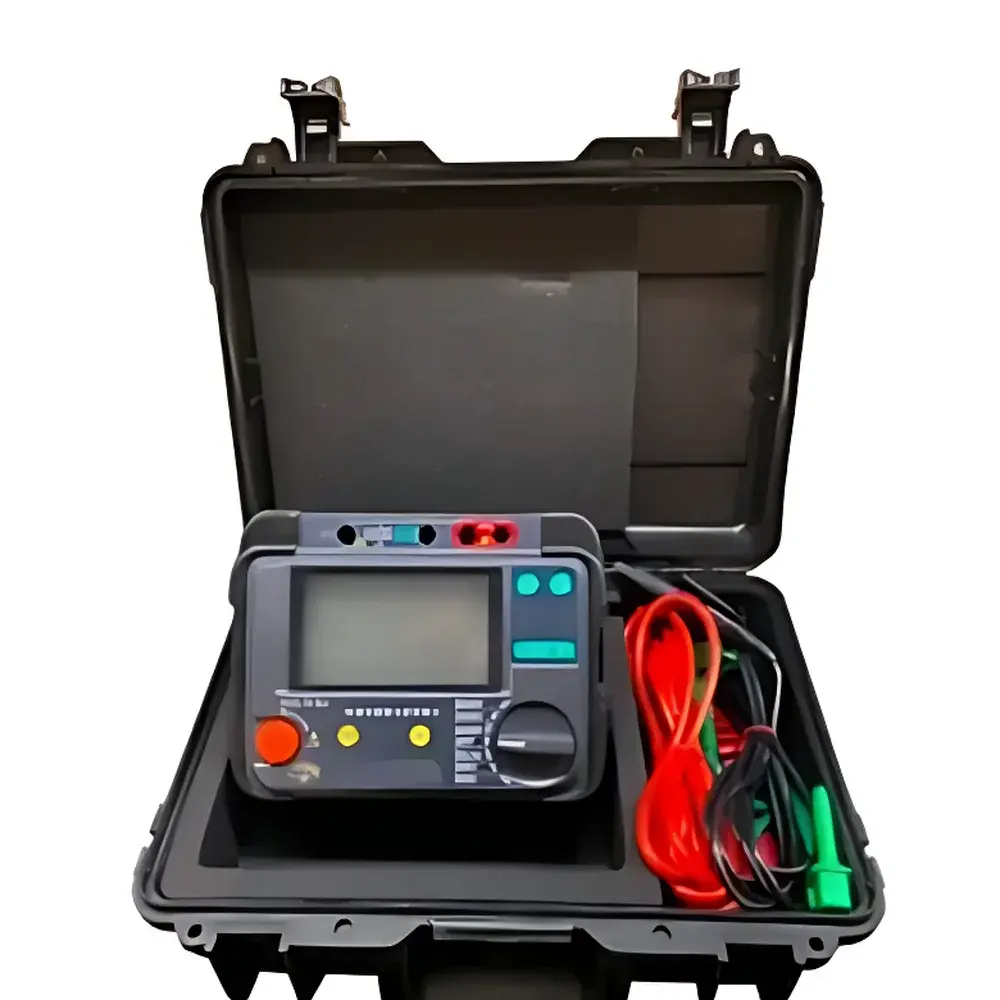
The Hengaode HAD-DS1 is a handheld, probe-style insulation resistance tester engineered for field and maintenance applications in electrical infrastructure, pipeline coating integrity verification, and cathodic protection systems. It operates on the principle of applying a stable DC test voltage across an insulating barrier—such as pipeline anti-corrosion coatings, cable jackets, or transformer insulation—and measuring the resulting leakage current to calculate insulation resistance (R = V/I) in accordance with IEC 61010-1 and IEC 61010-031 safety standards. Designed for CAT III 600 V / CAT IV 300 V environments (Pollution Degree 2), the instrument supports five selectable test voltage ranges to accommodate diverse asset classes—from low-voltage distribution networks to medium-voltage transmission components. Its core function is non-destructive assessment of dielectric integrity, enabling predictive maintenance by identifying moisture ingress, aging, contamination, or mechanical damage before catastrophic failure occurs.
Key Features
- Automatic Capacitive Discharge: After completing an insulation resistance measurement on capacitive loads (e.g., long cables or coated pipelines), the HAD-DS1 automatically discharges stored energy to safe levels (<60 V within 1 s), verified via real-time voltage mode display—ensuring compliance with lockout/tagout (LOTO) protocols and personnel safety.
- Multi-Range Insulation Testing: Five fixed test voltages (e.g., 50 V, 100 V, 250 V, 500 V, 1000 V DC) enable optimized stress application per IEEE 43 and ASTM D257 guidelines, minimizing risk of insulation breakdown during routine diagnostics.
- Polarization Index (PI) & Dielectric Absorption Ratio (DAR): Integrated timed measurement algorithms compute PI (R10min/R1min) and DAR (R60s/R30s) ratios—key indicators of insulation dryness and contamination per IEEE 43-2013 and IEC 60204-1.
- Live-Circuit Detection & Visual/Audible Alert: Built-in voltage detection circuitry triggers a red LED warning icon and audible beep when hazardous AC/DC potentials (>50 V) are sensed at the probe tips—preventing inadvertent testing on energized assets.
- Backlit LCD & Bar Graph Display: A high-contrast monochrome LCD with adjustable backlight ensures readability in low-light conditions (e.g., substation trenches or underground vaults); real-time bar graph visualization supports rapid trend interpretation without numeric parsing.
- Power Management: Auto-power-off activates after 10 minutes of inactivity; low-battery indicator and replaceable alkaline batteries (typically 6 × AA) ensure operational continuity during extended field surveys.
Sample Compatibility & Compliance
The HAD-DS1 is validated for use on coated steel pipelines, buried utility cables, motor windings, switchgear busbars, and transformer bushings. It complies with international safety and performance standards including IEC 61010-1 (electrical safety), IEC 61010-031 (handheld probe requirements), and IEC 60529 (IP54-rated enclosure for dust and splash resistance). While not certified to UL or CSA for North American listing, its design aligns with functional safety expectations for Class I, Division 2 hazardous locations when used with appropriate personal protective equipment (PPE). No calibration certificate is supplied ex-factory; users must perform periodic verification using traceable reference resistors per ISO/IEC 17025 laboratory practices.
Software & Data Management
The HAD-DS1 is a standalone hardware instrument with no embedded data logging or PC connectivity. All measurements are displayed in real time only; no internal memory, USB interface, or Bluetooth capability is provided. Users must manually record results—including test voltage, resistance value, PI/DAR ratio, and environmental notes—into field notebooks or digital CMMS platforms. For audit readiness under GLP or ISO 55001 asset management frameworks, organizations are advised to supplement usage with external documentation workflows, timestamped photos of test points, and standardized reporting templates aligned with API RP 571 or NACE SP0169.
Applications
- Pre-commissioning verification of pipeline coating integrity prior to backfilling or hydrostatic testing
- Routine inspection of cathodic protection system effectiveness on buried metallic infrastructure
- Condition assessment of aged power cables in industrial plants and municipal utilities
- Quality control of factory-applied anti-corrosion coatings on structural steel and tank interiors
- Troubleshooting ground faults in photovoltaic array DC strings and EV charging infrastructure
FAQ
Does the HAD-DS1 meet IEC 61557-2 requirements for insulation resistance testers?
Yes—it satisfies the general safety and metrological criteria defined in IEC 61557-2:2019 for portable insulation resistance measuring devices operating up to 1000 V DC.
Can it measure polarization index on rotating machinery?
Yes, provided the motor is de-energized, isolated, and grounded prior to testing; PI calculation requires sequential 1-minute and 10-minute resistance readings at a fixed test voltage.
Is calibration traceable to national standards included?
No—calibration is user-responsible. A valid calibration certificate from an ISO/IEC 17025-accredited lab is required for regulated environments (e.g., oil & gas, power generation).
What is the maximum cable length it can reliably test?
Performance depends on cable capacitance and ambient noise; for typical 1 kV XLPE cables, reliable measurements extend to ~2 km at 500 V DC—beyond which leakage current may approach instrument resolution limits.
Does it support IEEE 43-2013 winding insulation evaluation protocols?
Yes—the PI and DAR functions directly support the acceptance criteria outlined in IEEE 43-2013 for AC and DC rotating machines.