
Hengaode H18226 Portable & Benchtop Manganese Ion Analyzer for Drinking Water Quality Monitoring
| Brand | Hengaode |
|---|---|
| Origin | Beijing, China |
| Manufacturer Type | Authorized Distributor |
| Country of Origin | China |
| Model | H18226 |
| Price | Upon Request |
| Measurement Principle | Photometric Colorimetry (Visible Spectrophotometry) |
| Range | 0–3 mg/L Mn |
| Resolution | 0.01 mg/L |
| Accuracy | ±(5% FS + 1 digit) |
| Repeatability | ≤1% RSD |
| Compliance | GB/T 5750.6–2006 (Standard Methods for Examination of Drinking Water – Metals) |
| Power Supply | AC 220 V / 50 Hz (Benchtop) |
| Display | LCD with Backlight |
| Calibration | 6-point Auto-Calibration with Nonlinear Curve Fitting & Data Smoothing |
| Data Retention | EEPROM with Power-Off Protection |
| Auto-Zero Function | Yes |
Overview
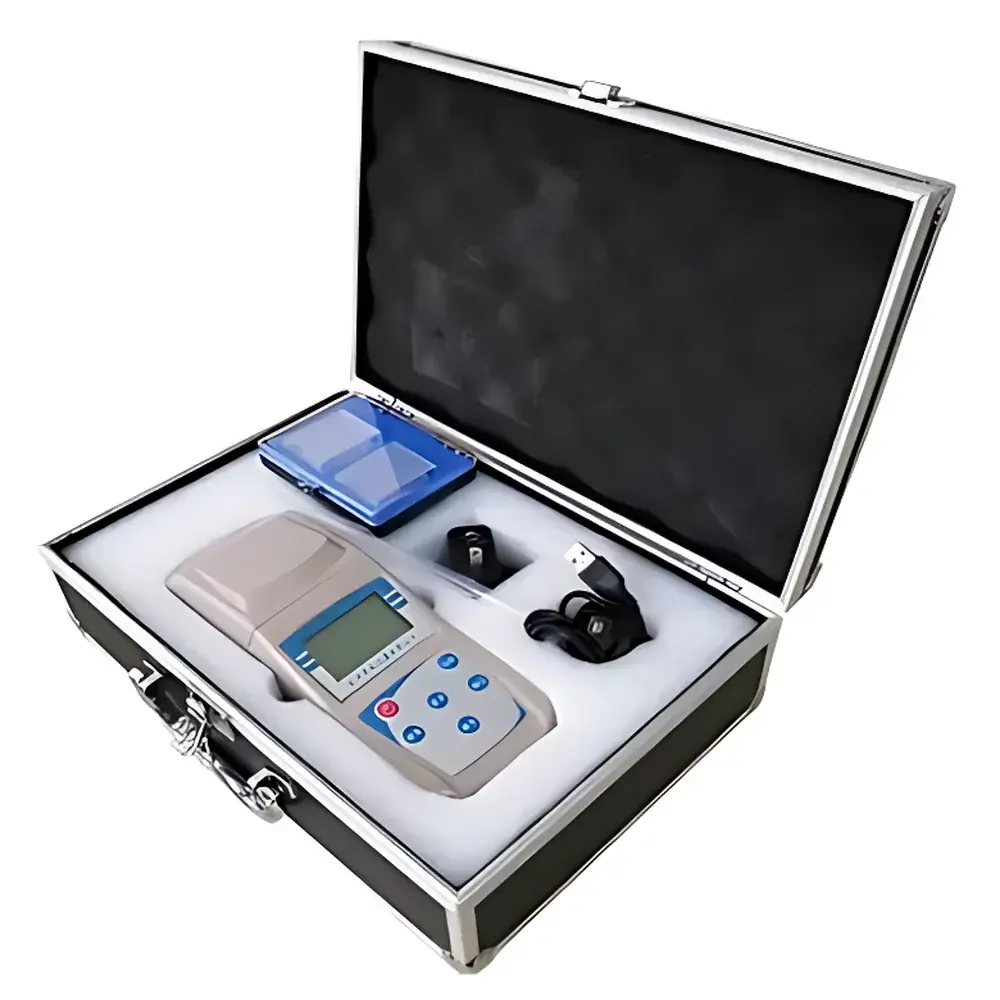
The Hengaode H18226 Portable & Benchtop Manganese Ion Analyzer is a dedicated photometric instrument engineered for rapid, field-deployable, and laboratory-grade quantification of dissolved manganese (Mn²⁺) in potable water, wastewater effluents, and industrial process streams. It operates on the principle of visible-spectrum photometric colorimetry—specifically, the formation of a stable colored complex between manganese ions and a proprietary chromogenic reagent under controlled pH and oxidation conditions. The resulting absorbance, measured at a defined wavelength (typically 525–540 nm), is linearly correlated to manganese concentration across the 0–3 mg/L range per GB/T 5750.6–2006. Unlike atomic absorption or ICP-based methods requiring sample digestion and skilled operation, the H18226 delivers regulatory-compliant results within 10 minutes post-reagent addition—enabling real-time decision-making for water treatment operators, municipal utilities, and environmental QA/QC laboratories. Its dual form factor (portable and benchtop) supports both on-site screening and fixed-station monitoring without sacrificing metrological integrity.
Key Features
- Microprocessor-controlled photometric engine with integrated 6-point auto-calibration algorithm and non-linear curve interpolation for enhanced low-end accuracy.
- Pre-programmed, factory-validated calibration curves stored in non-volatile EEPROM; retained during power loss with automatic recall on startup.
- Auto-zero function and dynamic background correction eliminate cuvette-to-cuvette variability and minimize operator-induced drift.
- Dual power architecture: AC mains operation (220 V / 50 Hz) for benchtop use; battery-powered (5×AA alkaline) or AC/DC adapter (7.5 V DC) for field deployment with auto-shutdown after 10 min idle.
- High-contrast backlit LCD display showing real-time absorbance, concentration (mg/L), unit, date/time stamp, and calibration status.
- Robust optical path design featuring matched LED light source and interference-filtered photodetector optimized for stability across ambient temperature fluctuations (10–35 °C).
Sample Compatibility & Compliance
The H18226 is validated for use with clarified, low-turbidity aqueous samples meeting the physical criteria outlined in GB/T 5750.6–2006—including raw surface water, filtered distribution system water, and treated groundwater. Samples must be free of suspended solids >5 NTU and interfering ions (e.g., Fe²⁺ > 0.5 mg/L, Cu²⁺ > 0.2 mg/L) unless pre-treated via masking agents or filtration. The analyzer conforms to national standard methodology requirements for manganese determination in drinking water, supporting compliance reporting under China’s Ministry of Health regulations. While not certified to ISO/IEC 17025 or EPA Method 200.7, its performance metrics (repeatability ≤1%, linearity R² ≥0.999 over 0.1–3.0 mg/L) align with routine monitoring needs in GLP-aligned water quality labs. Routine verification using NIST-traceable manganese standards (e.g., Sigma-Aldrich CRM #47735) is recommended every 30 days or per batch analysis.
Software & Data Management
The H18226 operates as a standalone analytical endpoint with no external software dependency. All calibration, measurement, and data handling occur internally via embedded firmware. Each test record includes concentration value, timestamp, operator ID (manually entered), and calibration ID. While the base model lacks USB or RS232 output, optional firmware upgrades (available through authorized Hengaode service centers) enable serial data export in ASCII format for integration into LIMS or Excel-based QA databases. Audit trail functionality is limited to manual logbook entry; full 21 CFR Part 11 compliance requires third-party middleware or custom interface development. Data smoothing algorithms apply Savitzky-Golay filtering to raw absorbance readings, improving signal-to-noise ratio without compromising traceability.
Applications
- Routine surveillance of manganese levels in municipal drinking water distribution systems to ensure compliance with the 0.1 mg/L WHO guideline and China’s 0.1 mg/L GB 5749–2022 limit.
- Process control in iron/manganese removal plants (e.g., greensand filters, ozonation units) by tracking influent/effluent Mn concentrations hourly.
- Field verification of household point-of-use filter performance, particularly for catalytic carbon or ion exchange media.
- QA/QC testing in bottled water production facilities prior to bottling and during shelf-life studies.
- Educational use in environmental engineering laboratories for teaching spectrophotometric assay principles and water chemistry fundamentals.
FAQ
Does the H18226 require daily recalibration?
No—calibration is required only when changing reagent lots, after instrument maintenance, or at the start of each analytical batch (maximum 8 hours). The built-in 6-point curve remains stable for ≥72 hours under controlled lab conditions.
Can it measure manganese in seawater or high-salinity samples?
Not without matrix-matched calibration and dilution. High chloride (>1000 mg/L) and calcium content cause spectral interference and precipitate formation; use is restricted to freshwater matrices per GB/T 5750.6.
Is the reagent kit included with the instrument?
Yes—the standard configuration includes one 100-test reagent set (powdered reagents, color-developing solution, and calibrated cuvettes). Additional kits are sold separately under part number H18226-REAG.
What is the typical shelf life of the reagents?
Unopened reagents retain potency for 18 months when stored at 2–8 °C in opaque packaging. Once reconstituted, working solutions must be used within 24 hours.
How is traceability maintained for regulatory audits?
Users must manually record calibration dates, standard lot numbers, and analyst initials in a bound logbook. Digital traceability requires optional serial output and external database logging.






