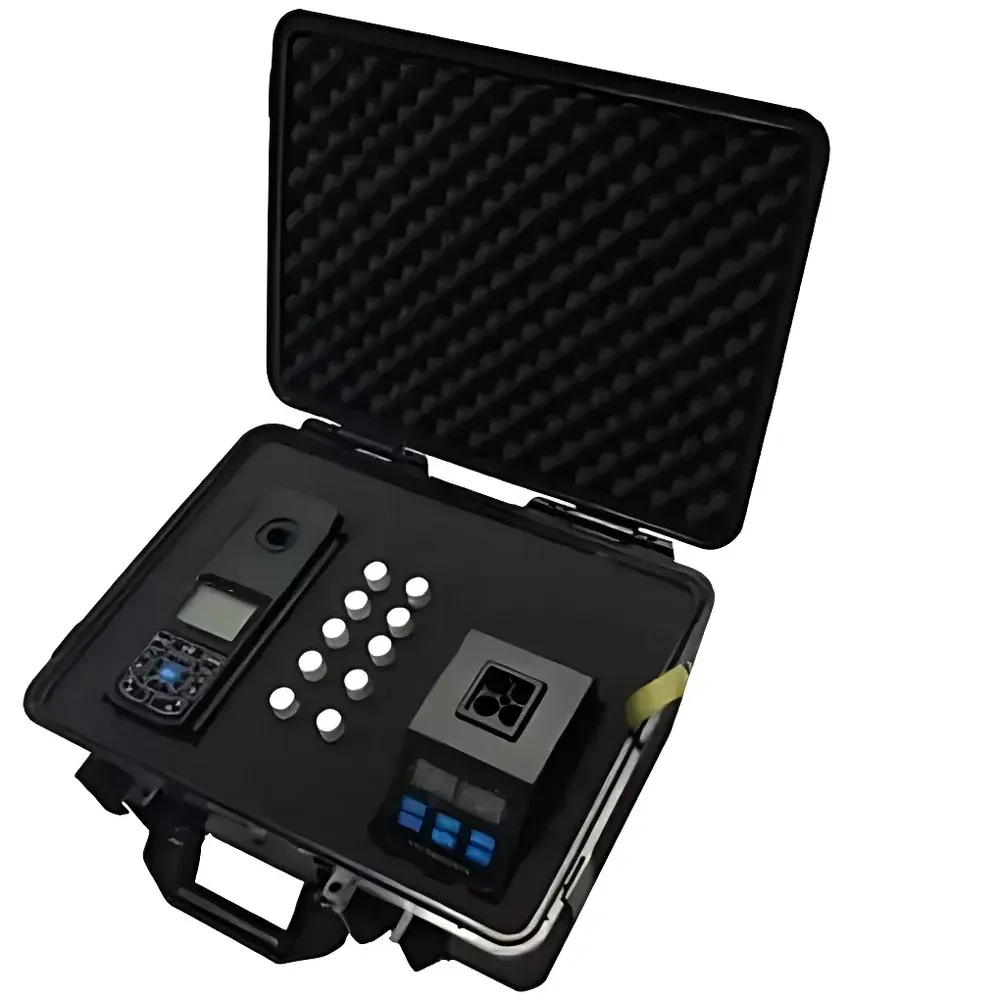
HengaoDe H28116 Portable COD & Ammonia-N Dual-Parameter Water Quality Analyzer with Over-Dilution Capability
| Brand | HengaoDe |
|---|---|
| Origin | Beijing, China |
| Manufacturer Type | Authorized Distributor |
| Product Origin | Domestic (China) |
| Model | H28116 |
| Price | USD 70.50 (FOB Beijing) |
| COD Range | 5–2000 mg/L (with over-dilution) |
| Ammonia-N Range | 0.02–25 mg/L |
| COD Accuracy | ≤±5% FS |
| Ammonia-N Accuracy | ≤±3% FS |
| Repeatability | ≤3% |
| Chloride Interference Tolerance (COD) | ≤2000 mg/L |
| Digestion Temperature Control | 165°C (adjustable from ambient to 180°C) |
| Temperature Accuracy | ±0.5°C |
| Digestion Time | 15 min (programmable 1–999 min) |
| Optical Drift | <0.002 A in 20 min |
| Batch Capacity | 4 samples |
| Dimensions (Analyzer) | 80 × 230 × 55 mm |
| Dimensions (Digestor) | 105 × 160 × 90 mm |
| Weight (Analyzer) | 0.5 kg |
| Weight (Digestor) | 1.0 kg |
| Analyzer Power | <40 µA (rechargeable Li-ion battery) |
| Digestor Power | <65 W (dual-input: 12 V DC via car socket or 220 V AC) |
| Operating Ambient | 5–40°C, ≤85% RH, non-condensing, low-vibration, EMI-shielded environment |
Overview
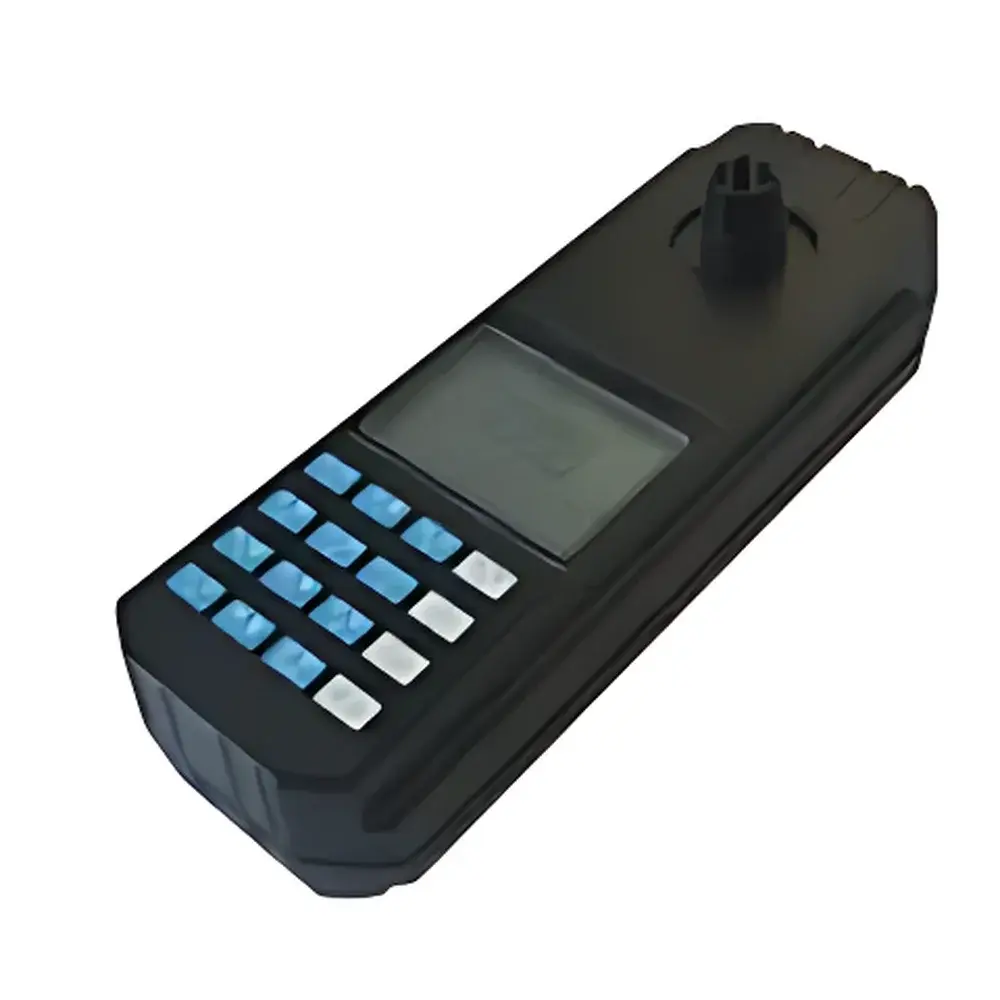
The HengaoDe H28116 Portable COD & Ammonia-N Dual-Parameter Water Quality Analyzer is an integrated field-deployable photometric system engineered for rapid, on-site quantification of chemical oxygen demand (COD) and ammonia nitrogen (NH₃-N) in surface water, wastewater, and industrial effluents. It operates on the principle of colorimetric analysis—COD measurement follows the dichromate digestion method (EPA 410.4 / ISO 6060), while ammonia-nitrogen determination employs the Nesslerization reaction (ISO 7150-1). The instrument incorporates a built-in digital temperature-controlled digestion module compliant with standard heating profiles required for complete oxidation and chromogenic development. Its over-dilution capability extends effective measurement ranges beyond nominal limits through programmable dilution factor compensation, enabling reliable analysis of high-strength samples without manual pre-dilution errors. Designed for regulatory screening and process monitoring, the H28116 meets foundational performance criteria aligned with ISO/IEC 17025 method validation prerequisites for field instruments.
Key Features
- Integrated dual-parameter architecture: single instrument platform for simultaneous COD and NH₃-N analysis—eliminates need for separate devices and cross-calibration drift.
- Programmable digestion control: precise thermal regulation (±0.5°C) across 1–999 min duration; fixed 165°C protocol for COD ensures full organic oxidation per ISO 6060.
- Optical stability assurance: drift <0.002 A over 20 minutes enables reproducible absorbance readings under variable ambient lighting conditions.
- Robust interference mitigation: chloride tolerance up to 2000 mg/L during COD digestion reduces masking effects common in saline or industrial wastewaters.
- Field-optimized power management: analyzer powered by high-capacity rechargeable lithium-ion battery (<40 µA standby); digestor supports triple-source operation (12 V DC automotive, 220 V AC, or optional portable Li battery pack).
- Compact modular design: total system footprint <0.01 m³; combined weight <1.5 kg—meets IEC 60529 IP54 ingress protection requirements for portable lab equipment.
- Calibration traceability: factory-set wavelength filters at 620 nm (COD) and 420 nm (NH₃-N); user-accessible zero and span calibration routines with NIST-traceable standard solutions.
Sample Compatibility & Compliance
The H28116 accepts aqueous liquid samples within pH 4–10 and turbidity <100 NTU (pre-filtration recommended above this threshold). It is validated for use with drinking water (GB/T 5750.7), municipal wastewater (HJ/T 399–2007), and industrial discharge matrices (GB 8978–1996). While not certified to ISO/IEC 17025 as a standalone testing laboratory, its measurement protocols align with ASTM D1252 (COD) and ASTM D1426 (NH₃-N), supporting data admissibility in preliminary environmental compliance reporting. Instrument firmware complies with GB/T 27025–2019 Annex B for field instrument documentation, including audit-ready calibration logs, operator ID tagging, and timestamped result export. No internal memory encryption or FDA 21 CFR Part 11 electronic signature functionality is included; raw data files are stored in CSV format compatible with LIMS integration.
Software & Data Management
Data acquisition and calculation are handled by embedded microcontroller firmware (ARM Cortex-M4 core) with real-time correction algorithms for temperature-dependent absorbance drift and path-length variance. Results display directly on the 5.1-inch TFT LCD with backlight (auto-activated under low illumination). All measurements—including sample ID, date/time stamp, dilution factor, raw absorbance, and final concentration—are stored internally (up to 1000 records) and exportable via USB-C to external storage or PC. Exported CSV files include columns for QC flags (e.g., “out-of-range”, “high chloride warning”, “digestion timeout”) to support GLP-aligned data review workflows. Firmware updates are performed via DFU mode using standard Windows/Linux host utilities; no proprietary software installation is required.
Applications
The H28116 serves critical roles in decentralized water quality surveillance: routine effluent monitoring at small-scale WWTPs lacking central labs; source water assessment during flood response or algal bloom events; QA/QC verification of onsite treatment systems (e.g., MBR, constructed wetlands); and educational field studies requiring quantitative parameter correlation (COD:NH₃-N ratios inform biodegradability estimation). Its portability and battery autonomy make it suitable for unpowered remote sites—such as rural reservoirs, aquaculture ponds, or construction runoff catchments—where grab sampling followed by immediate analysis prevents analyte degradation (e.g., NH₃ volatilization, nitrite oxidation). Field technicians report typical measurement turnaround time of <25 minutes per 4-sample batch, including digestion, cooling, and photometric readout.
FAQ
Does the H28116 require external reagents or consumables beyond standard COD and NH₃-N test kits?
Yes—users must supply certified reagent kits meeting GB/T 11914 (COD) and GB/T 7479 (NH₃-N) specifications. The instrument does not include onboard reagent dispensing.
Can the digestion module be used independently for other thermal protocols?
No—the heating profile is hard-coded to meet regulatory digestion standards only; no user-defined ramp/soak programming is available.
Is the optical system calibrated for turbid or colored samples?
Turbidity correction is not implemented; samples exceeding 100 NTU must be filtered (0.45 µm membrane) prior to analysis to avoid scattering artifacts.
What is the shelf life of the internal battery under typical field usage?
The analyzer’s Li-ion battery retains ≥80% capacity after 500 charge cycles; full charge supports ≥120 sequential measurements without recharge.
Are calibration certificates provided with each unit?
A factory calibration report (traceable to national metrology institutes) is supplied; users must perform initial field verification using certified reference materials before first deployment.