
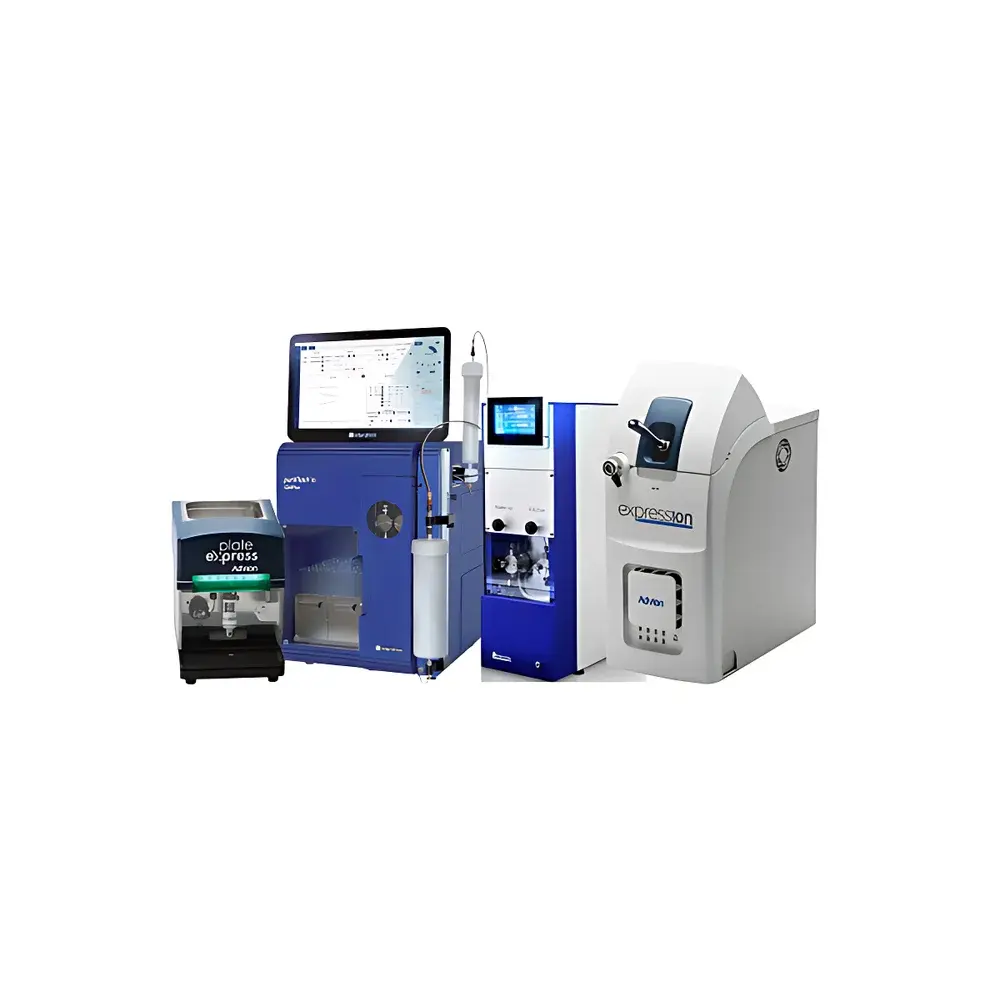
puriFlash® Active Splitter – Mass Spectrometry-Guided Fraction Collection Interface
| Brand | Advion Interchim Scientific |
|---|---|
| Origin | France |
| Model | puriFlash® Active Splitter |
| Flow Path Architecture | Active Valve-Based Splitting |
| Split Ratio Control | Software-Defined Switching Frequency |
| Pressure Management | Zero Backpressure Generation |
| Compatibility | Interchim puriFlash® Systems & All Interchim HPLC/UHPLC Columns |
| Detection Integration | Simultaneous UV + MS Trigger Logic |
| Software Control | Intersoft® X Platform (FDA 21 CFR Part 11 Compliant Audit Trail Optional) |
Overview
The puriFlash® Active Splitter is an engineered interface module designed to enable robust, real-time mass spectrometry–guided fraction collection in preparative liquid chromatography workflows. Unlike passive splitters—whose flow division relies solely on fixed capillary resistance and inherently introduces system backpressure—the Active Splitter employs a high-speed, precision solenoid switching valve to dynamically divert discrete volumes of the main chromatographic effluent into a dedicated auxiliary stream directed to the mass spectrometer. This active diversion mechanism decouples MS detection from column flow constraints: the majority of eluent proceeds unimpeded to the fraction collector, while only a precisely metered, time-synchronized aliquot is routed to the MS ion source. As a result, the system maintains full chromatographic resolution and peak integrity at preparative-scale flow rates (up to 100 mL/min), without compromising MS sensitivity or inducing pressure fluctuations that could destabilize gradient delivery or column performance.
Key Features
- Active valve-based splitting architecture eliminates hydraulic resistance and backpressure accumulation across the entire flow path
- Software-defined split ratio via adjustable valve actuation frequency—enabling method-specific optimization without hardware reconfiguration
- Simultaneous dual-trigger logic: fractions are collected only when both UV absorbance and user-defined m/z signal exceed independently set thresholds
- Fully integrated with Intersoft® X software for synchronized control of puriFlash® LC systems, MS acquisition, and fraction collector actuation
- Compliant with GLP/GMP data integrity requirements when configured with audit trail, electronic signatures, and secure user access levels
- Compatible with all Interchim puriFlash® columns—including silica, C18, amino, cyano, and specialized chiral phases—without flow-path adaptation
- Integrated dilution capability: auxiliary stream can be mixed with make-up solvent prior to MS introduction, enhancing ionization efficiency for low-concentration analytes
Sample Compatibility & Compliance
The puriFlash® Active Splitter supports a broad range of sample matrices encountered in natural product isolation, synthetic chemistry purification, and pharmaceutical impurity profiling. It accommodates mobile phases containing volatile buffers (e.g., ammonium formate, ammonium acetate), organic modifiers (acetonitrile, methanol), and up to 0.1% formic acid—fully compatible with electrospray ionization (ESI) and atmospheric pressure chemical ionization (APCI) sources. The device complies with ISO 9001-certified manufacturing protocols and meets mechanical safety standards per IEC 61010-1. When deployed in regulated environments, its integration with Intersoft® X enables compliance with FDA 21 CFR Part 11 (electronic records and signatures), EU Annex 11, and ASTM E2500-13 (verification of computerized systems).
Software & Data Management
Control and configuration are executed exclusively through Intersoft® X—a unified platform supporting method development, instrument orchestration, and raw data archival. Within the software, users define target m/z values, intensity thresholds, retention time windows, and UV wavelength bands. The system logs every valve actuation event, MS trigger timestamp, fraction collection command, and associated chromatographic metadata in a structured SQLite database. Raw files adhere to mzML 1.1.0 format; processed data exports support CSV, PDF, and XML for LIMS ingestion. Audit trails record operator identity, parameter changes, and system state transitions—retained for ≥36 months per configurable policy.
Applications
- Targeted isolation of bioactive compounds from complex plant extracts using MS-selected ion monitoring (SIM)
- Rapid purification of synthetic intermediates where UV-inactive or co-eluting species require mass-selective discrimination
- Impurity isolation and structural characterization in API development workflows under ICH Q5A/Q5B guidelines
- Automated generation of compound libraries for high-throughput screening, with direct linkage between LC-MS identification and physical sample retrieval
- Method development for orthogonal purification strategies combining UV, MS, and CAD detection modalities
FAQ
How does the Active Splitter differ from conventional T-piece or restrictor-based splitters?
It replaces passive hydrodynamic resistance with timed, volumetric valve actuation—eliminating backpressure, enabling consistent split ratios across variable flow rates, and preserving chromatographic fidelity.
Can the split ratio be adjusted during a single run?
Yes—Intersoft® X supports dynamic ratio modulation within a method, allowing higher MS sampling density during peak elution and reduced diversion during baseline periods.
Is post-column dilution supported?
Yes—the auxiliary stream connects to an optional mixing tee where make-up solvent (e.g., 50:50 MeOH:H₂O) is introduced prior to the MS source, mitigating ion suppression in high-salt or high-organic eluents.
Does the interface require recalibration when switching between different puriFlash® column dimensions?
No—flow path geometry is decoupled from column specifications; only software parameters (e.g., expected peak width, dwell time) require adjustment.
What level of MS sensitivity loss occurs relative to full-flow infusion?
Sensitivity reduction is proportional to the split ratio (e.g., 1:100 yields ~1% of total signal); however, enhanced duty cycle and elimination of flow-induced ionization instability often yield superior S/N versus passive alternatives at equivalent diverted flow rates.
Related Products





