
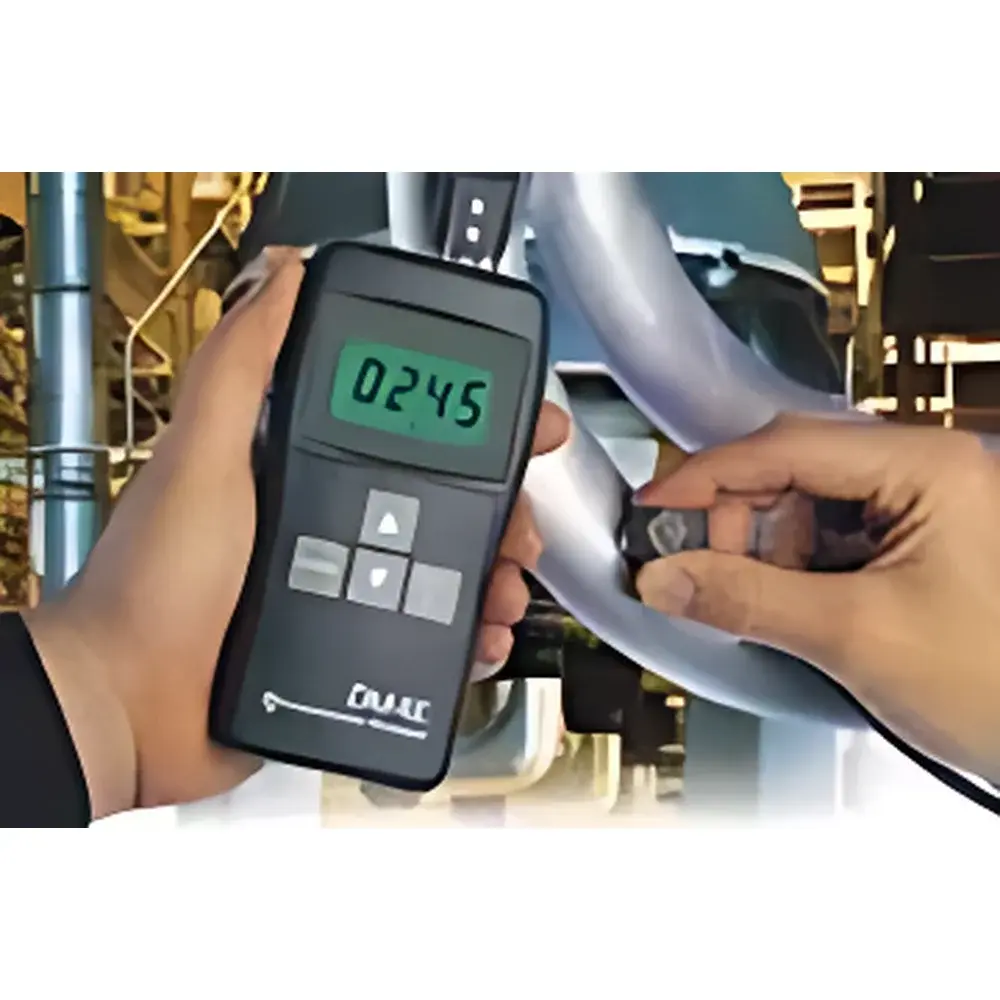
Krautkramer DM4E / DM4 / DM4DL Ultrasonic Thickness Gauge
| Origin | USA |
|---|---|
| Manufacturer Type | Authorized Distributor |
| Origin Category | Imported |
| Model | DM4E / DM4 / DM4DL |
| Price Range | USD 6,800 – 13,600 |
| Measurement Range | 0.6–300 mm (steel, dependent on probe and material) |
| Resolution | 0.01 mm (<99.99 mm), 0.1 mm (≥99.99 mm) |
| Sound Velocity Range | 1000–9999 m/s |
| Update Rate | 4 Hz (standard), 25 Hz (Min-Max mode) |
| Display | 4-digit backlit LCD |
| Data Storage | 5390 readings (DM4DL only) |
| Interface | RS232 (DM4DL only) |
| Power | Two AA batteries (200 h operation without backlight) |
| Operating Temperature | −10 to +50 °C |
| Dimensions & Weight | 146 × 76 × 34 mm, 255 g |
Overview
The Krautkramer DM4E / DM4 / DM4DL series represents a lineage of precision-engineered ultrasonic thickness gauges designed for non-destructive evaluation (NDE) of metallic and non-metallic materials in industrial, maintenance, and quality assurance environments. Based on pulse-echo ultrasonic principle—where a high-frequency sound wave is transmitted into the material and the time-of-flight of the reflected echo from the back wall is measured—the instruments calculate thickness using the known acoustic velocity of the test material. This method enables rapid, contact-based measurement without surface preparation, making it ideal for in-service inspection of pipelines, pressure vessels, storage tanks, ship hulls, and structural steel components. The DM4 platform integrates digital signal processing, temperature-compensated time-of-flight analysis, and adaptive gain control to ensure high reproducibility across varying surface conditions, including curved geometries and rough or oxidized surfaces.
Key Features
- DUAL-MULTI mode (exclusive to DM4 and DM4DL): Enables accurate base-material thickness measurement through paint, enamel, or polymer coatings up to 3 mm thick—eliminating the need for coating removal and reducing inspection downtime.
- Automatic probe recognition: The gauge detects connected probe type (e.g., DA301, DA303, HT400) and auto-configures calibration parameters, velocity settings, and range limits.
- V-path correction algorithm: Compensates for sound path deviation in curved or non-parallel surfaces, improving accuracy on pipes and cylindrical components.
- Zero-offset calibration: Supports manual or automatic zeroing on known reference blocks or directly on the test piece using couplant.
- Min-Max measurement mode: Captures and displays real-time minimum and maximum thickness values at 25 Hz refresh rate—critical for corrosion mapping and localized thinning assessment.
- LED visual alarm system (DM4/DM4DL): Configurable threshold-based LED indicators provide immediate pass/fail feedback during field inspections.
- Ruggedized housing with IP65-rated ingress protection: Ensures reliable operation in dusty, humid, or mildly corrosive industrial environments.
Sample Compatibility & Compliance
The DM4 series supports a wide range of engineering materials—including carbon steel, stainless steel, aluminum, copper, titanium, fiberglass, and certain plastics—provided their acoustic impedance permits sufficient echo return. Probe selection is critical: standard 5 MHz probes (e.g., DA301) are optimal for general-purpose steel; low-frequency 2 MHz probes (DA303) extend range for coarse-grained or highly attenuative alloys; high-frequency 10 MHz probes (DA312) resolve thin-wall tubing or sheet metal; and high-temperature probes (DA305, HT400) maintain stable performance up to 600 °C when used with certified high-temp couplants. All models comply with ASTM E797 (Standard Practice for Measuring Thickness by Manual Ultrasonic Pulse-Echo Contact Method) and ISO 2400 (Ultrasonics — Characterization of Ultrasonic Examination Equipment). The DM4DL’s data logging functionality supports traceability requirements under ASME B31.4/B31.8, API RP 570, and EN 1504-4 for integrity management systems.
Software & Data Management
The DM4DL model incorporates an embedded data logger capable of storing 5,390 timestamped thickness readings with associated probe ID, material velocity, date/time stamp, and measurement mode flag. Data export is performed via RS232 serial interface to PC-based reporting software (e.g., Krautkramer UltraMatic Suite), enabling CSV or XML output for integration into CMMS platforms such as SAP PM or IBM Maximo. Audit trails include operator ID input (via keypad), calibration history logs, and firmware version tracking—supporting GLP/GMP documentation needs and FDA 21 CFR Part 11 compliance when deployed with validated software configurations. No proprietary cloud services or remote connectivity are implemented; all data remains under full user control.
Applications
- Corrosion monitoring in oil & gas pipeline networks and refinery infrastructure
- Pre- and post-hydrotest wall thickness verification per ASME Section V Article 4
- In-service inspection of boiler tubes, heat exchanger shells, and condenser piping
- Quality control of rolled plate, extruded profiles, and castings during manufacturing
- Shipyard hull thickness surveys in accordance with IACS UR W21 and IMO SOLAS Chapter II-1
- Aerospace component screening for fatigue-induced thinning in airframe skins and landing gear housings
- Power generation: turbine casings, feedwater heaters, and nuclear primary coolant piping (subject to NRC-approved procedures)
FAQ
Does the DM4 series require calibration against certified reference standards?
Yes. Initial calibration must be performed using traceable thickness standards (e.g., NIST-traceable step wedges) per ASTM E797 Section 7. Field recalibration is recommended before each inspection shift or after probe change.
Can the DM4 measure thickness through rubber linings or epoxy coatings?
DUAL-MULTI mode supports measurement through uniform, acoustically coupled coatings ≤3 mm thick. Performance degrades with air gaps, delamination, or highly attenuative elastomers—verification with representative test pieces is required.
What is the minimum pipe diameter measurable with standard probes?
DA301 achieves reliable readings on steel pipes ≥25 mm OD; DA312B16 enables measurements down to 15 mm OD. Curved-surface correction must be enabled for diameters <100 mm.
Is battery life affected by backlight usage or low-temperature operation?
Backlight activation reduces battery life by ~40%. Below 0 °C, alkaline AA performance declines; lithium AA cells are recommended for sustained sub-zero operation.
Are firmware updates available, and how are they applied?
Firmware revisions are distributed via Krautkramer’s authorized service centers. Updates require dedicated programming hardware and are performed under controlled bench conditions—not in-field.



