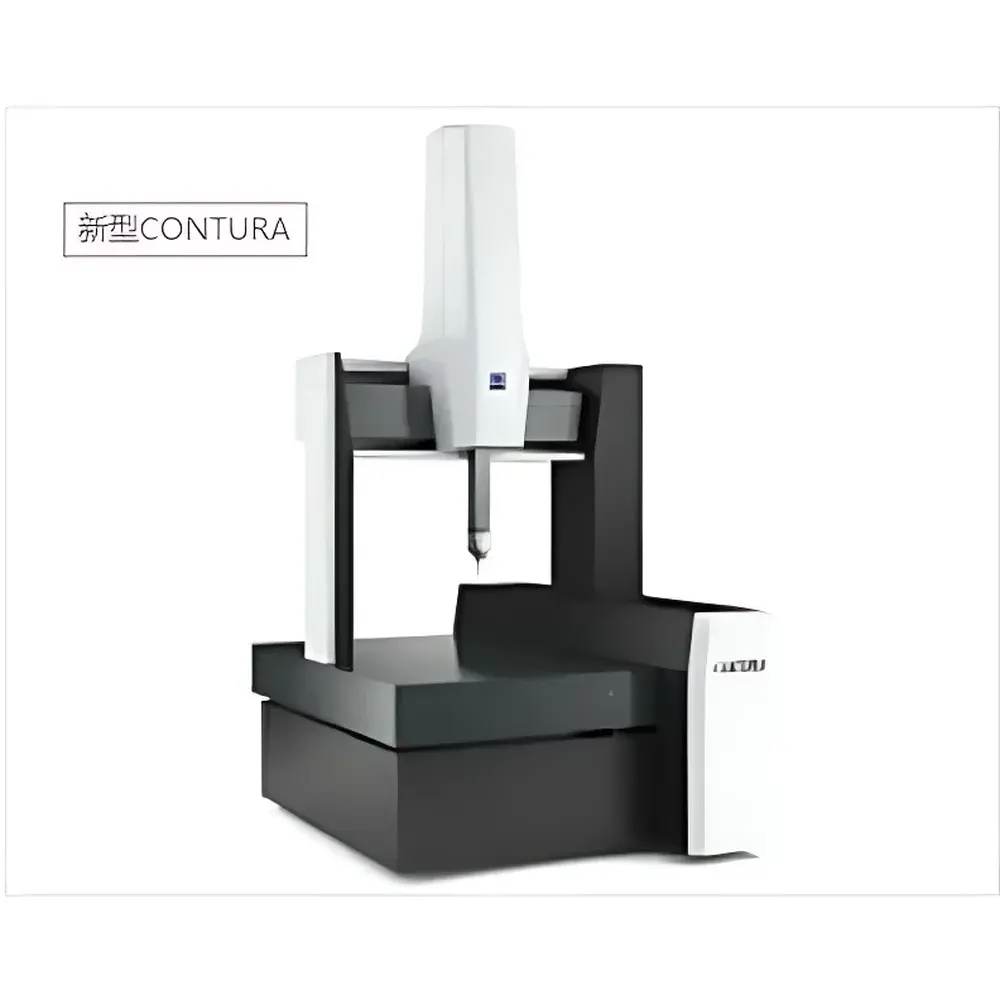
ZEISS CONTURA Coordinate Measuring Machine (CMM)
| Brand | ZEISS |
|---|---|
| Origin | Germany |
| Configuration | Hybrid (Contact + Optical Capable) |
| Operation Mode | Fully Automated |
| Machine Type | Vertical Bridge CMM |
| Measurement Volume Range | 700 × 700 × 600 mm to 1200 × 2400 × 1000 mm |
| Length Measurement Error E₀ | Starting from 1.5 + L/350 µm |
| Standard Environmental Temperature | 18–22 °C |
| Optional HTG (High-Temperature Gradient) Operation | 18–26 °C |
| Guideway Material | Industrial Ceramic or CARAT® ceramic composite |
| Bearing System | Four-sided air-bearing guidance on all three axes |
| Scale Type | Zero-expansion glass-ceramic linear encoders |
| CAA (Computer-Aided Accuracy) | Real-time dynamic bridge deformation compensation |
| Air Consumption Reduction | Up to 60% via ZEISS AirSaver™ |
Overview
The ZEISS CONTURA is a high-precision vertical bridge coordinate measuring machine (CMM) engineered for metrological reliability in demanding production and quality assurance environments. Based on the proven kinematic architecture of the ZEISS bridge design, the CONTURA integrates advanced mechanical stability, thermal robustness, and real-time accuracy correction to deliver traceable dimensional measurements across complex geometries. Its measurement principle relies on precise displacement sensing via zero-expansion glass-ceramic linear encoders mounted on suspended guideways—eliminating the need for temperature-based error compensation under standard conditions. The system operates within ISO 10360-compliant volumetric accuracy specifications, with length measurement uncertainty (E₀) defined per ISO 10360-2 as 1.5 + L/350 µm (L in mm), verified under controlled environmental conditions (18–22 °C). Optional HTG configuration extends certified performance to 18–26 °C, supporting integration into less climate-controlled shop-floor settings without compromising metrological integrity.
Key Features
- Hybrid probing capability: Native support for tactile (VAST XXT, VAST XT gold, VAST XTR gold), kinematic (RDS articulating probe head), and optical sensors—including structured light and chromatic confocal modules—enabling comprehensive geometry, surface texture, and form analysis.
- Dynamically compensated metrology: Integrated Computer-Aided Accuracy (CAA) continuously models and corrects for thermally induced and motion-dependent bridge deformations during scanning, ensuring consistent E₀ compliance at scanning speeds up to 500 mm/s.
- Thermally stable mechanical architecture: Guideways constructed from industrial ceramic or CARAT®—a ZEISS-developed ceramic composite—deliver ultra-low coefficient of thermal expansion (<0.1 × 10⁻⁶/K), high stiffness-to-weight ratio, and long-term geometric stability.
- Four-sided air-bearing guidance on X, Y, and Z axes ensures nanometer-level motion repeatability and minimal drift during high-acceleration maneuvers, critical for both point-to-point and continuous scanning routines.
- Integrated control interface: Standalone operator panel with ergonomic joystick enables intuitive manual axis positioning, jog speed adjustment, and CNC program initiation—reducing dependency on external PCs for routine operation.
- Resource-efficient operation: ZEISS AirSaver™ technology dynamically regulates compressed air supply to the air bearings, reducing average consumption by up to 60% compared to conventional constant-flow systems—lowering operational cost and environmental footprint.
Sample Compatibility & Compliance
The CONTURA accommodates workpieces ranging from small precision components (e.g., medical implants, watch gears) to large structural parts (e.g., automotive chassis subassemblies, aerospace turbine housings), supported by its scalable volume options (700 × 700 × 600 mm to 1200 × 2400 × 1000 mm). Its IP52-rated enclosure and vibration-damped granite base allow direct deployment in regulated manufacturing areas—fully compliant with ISO 14644-1 Class 8 cleanroom-adjacent environments. All measurement data generated meets GLP/GMP documentation requirements when used with ZEISS CALYPSO software configured for FDA 21 CFR Part 11 compliance (audit trail, electronic signatures, role-based access control). Calibration protocols align with VDI/VDE 2617, ISO 10360, and ASME B89.4.1 standards; RDS probe head calibration follows ZEISS’s proprietary 20,736-position angular mapping procedure, minimizing requalification frequency.
Software & Data Management
ZEISS CALYPSO serves as the unified metrology platform for the CONTURA, providing ISO-compliant GD&T evaluation (per ISO 1101, ISO 5459), automated reporting (PDF, Excel, XML), and seamless integration with PLM and MES systems via OPC UA and RESTful APIs. The software supports full measurement plan portability across ZEISS CMM platforms, enabling standardized inspection workflows across global facilities. Built-in statistical process control (SPC) modules generate real-time capability indices (Cp, Cpk), trend charts, and out-of-tolerance alerts—directly feeding into Six Sigma and APQP processes. All raw encoder data, probe deflection logs, and environmental sensor readings (optional workpiece & machine temperature monitoring) are time-stamped and archived with SHA-256 hash integrity verification.
Applications
- Aerospace: Blade root profile verification, turbine disk concentricity, and fastener hole pattern inspection per NAS 971 and SAE AS9102.
- Automotive: Powertrain component validation (cylinder heads, transmission cases), body-in-white dimensional release, and ADAS sensor mounting geometry certification.
- Medical device manufacturing: ISO 13485-compliant verification of orthopedic implant surfaces, dental CAD/CAM restorations, and minimally invasive surgical instrument tolerances.
- Tooling & moldmaking: Electrode geometry confirmation, cavity/core matching, and wear analysis of injection molds using time-series scanning datasets.
- Electronics: PCB fiducial placement accuracy, semiconductor package coplanarity (J-STD-006), and micro-optical lens array alignment metrology.
FAQ
What environmental conditions are required to achieve stated E₀ accuracy?
The specified length measurement error (1.5 + L/350 µm) is validated under ISO 10360-2 conditions: ambient temperature 20 ± 0.5 °C, temperature gradient ≤0.5 °C/h, and relative humidity 40–60%. With the optional HTG package, full E₀ compliance is maintained across 18–26 °C.
Can the CONTURA perform both contact and optical measurements in a single setup?
Yes—its modular sensor interface supports simultaneous or sequential use of tactile probes (e.g., VAST XXT) and optical sensors (e.g., ZEISS OptoFit or ChromaScan), with automatic tool center point (TCP) registration and unified coordinate system alignment in CALYPSO.
Is RDS probe head calibration traceable to national standards?
Calibration of the RDS articulating probe head is performed using ZEISS-certified reference artifacts (e.g., sphere stacks, step gauges) traceable to PTB (Physikalisch-Technische Bundesanstalt) and NIST, with full uncertainty budgets documented per ISO/IEC 17025.
How does CAA differ from traditional temperature compensation?
CAA models dynamic structural deformation—caused by motor torque, air bearing lift forces, and thermal mass asymmetry—not just static thermal expansion. It applies real-time corrections derived from finite element simulations validated against empirical metrological testing.
What maintenance intervals are recommended for air-bearing systems?
With AirSaver™ active, typical maintenance (filter replacement, pressure regulator check) is scheduled every 12 months; air bearing inspection and recalibration are recommended every 24 months or after 10,000 operating hours, whichever occurs first.