
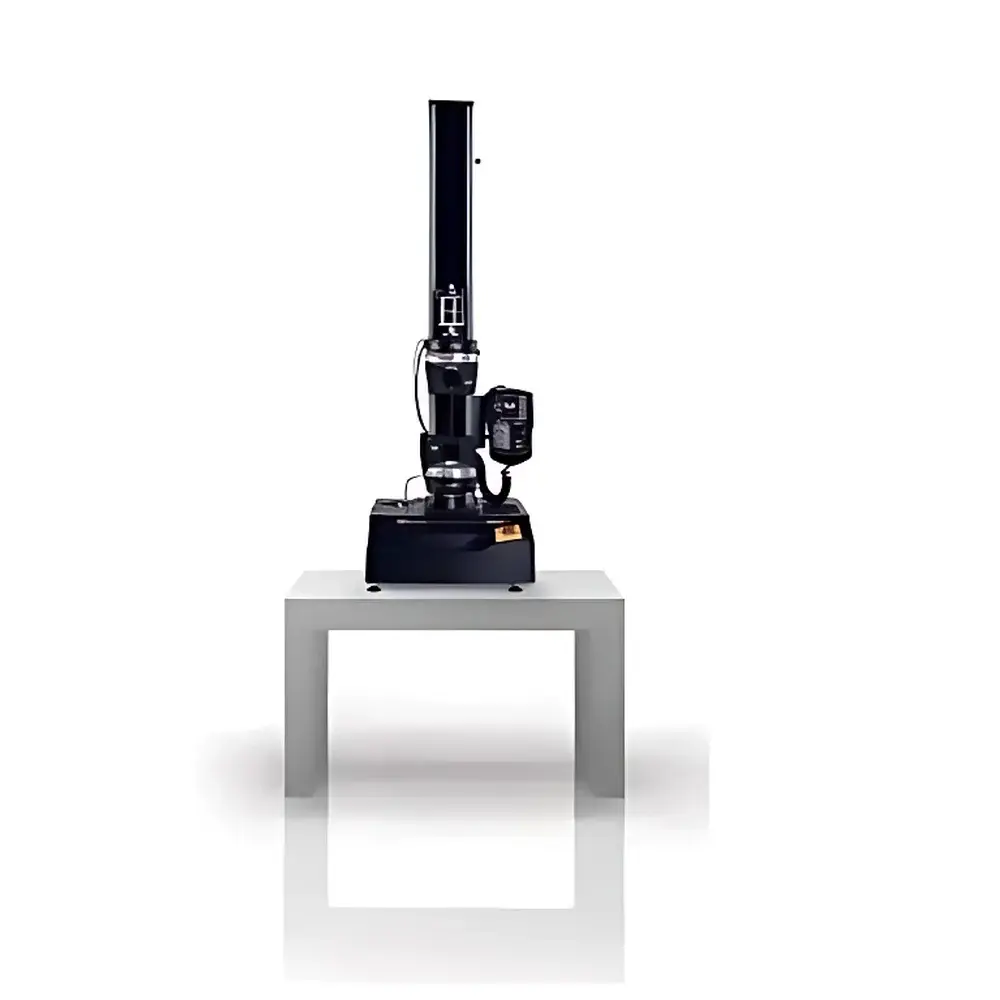
INSTRON 5940 Single-Column Universal Testing System
| Brand | INSTRON |
|---|---|
| Origin | USA |
| Model | 5940 |
| Load Capacity | Up to 2 kN (450 lbf / 200 kgf) |
| Type | Electromechanical Universal Testing Machine |
| Compliance | ASTM E4, ASTM E8, ISO 6892-1, ISO 527, USP <1041>, FDA 21 CFR Part 11 (via Bluehill software) |
| Max. Data Acquisition Rate | 10 kHz (standard), upgradable |
| Speed Range | 0.001–2500 mm/min |
| Return Speed | Up to 2500 mm/min |
| Sensor Channels | Up to 4 integrated analog input channels |
| Frame Stiffness | ≥ 120 kN/mm |
| Alignment Accuracy | ≤ ±0.01° angular misalignment |
| Footprint | 432 × 406 mm (W × D) |
Overview
The INSTRON 5940 Single-Column Universal Testing System is an electromechanical materials testing platform engineered for precision tensile, compression, flexure, peel, and shear testing of small- to medium-scale specimens. Utilizing a high-rigidity single-column frame with linear motion bearings and monolithic load column construction, the system ensures minimal deflection and optimal axial alignment—critical for reproducible force-displacement measurements per ASTM E4 and ISO 7500-1 calibration requirements. Designed for laboratories with space constraints, the 5940 delivers full compliance-grade performance in a compact footprint (less than 0.18 m²), making it ideal for quality control labs, R&D facilities, and regulatory-compliant environments such as medical device manufacturing and pharmaceutical packaging validation.
Key Features
- High-stiffness monolithic column and precision-ground linear bearings ensure axial alignment accuracy better than ±0.01°, minimizing bending moments and enhancing measurement fidelity.
- Integrated Ethernet interface enables deterministic, low-latency communication with host PCs—eliminating USB latency and driver dependency for GLP/GMP audit-ready data capture.
- Up to four synchronized analog sensor inputs support simultaneous acquisition of load, displacement, strain (via extensometers or video-based DIC), and environmental signals (e.g., temperature or humidity).
- Enhanced speed control architecture achieves ±0.1% speed accuracy across its full range (0.001–2500 mm/min), with return-to-start velocity up to 2500 mm/min to reduce cycle time between tests.
- Digital servo controller with 10 kHz native sampling rate (field-upgradable) supports high-fidelity capture of transient mechanical events—including yield point detection, creep onset, and fracture propagation in brittle films or hydrogels.
- Front-panel touchscreen interface with soft-key navigation, real-time graphing, and programmable specimen protection limits reduces operator dependency and minimizes test setup errors.
Sample Compatibility & Compliance
The 5940 accommodates specimens ranging from microfibers (<10 µm diameter) to rigid polymer components (up to 200 mm height). Its modular fixture ecosystem includes pneumatic wedge grips, roller clamps, peel fixtures (180°/90°), three-point bend assemblies, and custom T-slot mounting plates. All configurations comply with standardized test methods including ASTM D638 (plastics), ASTM D882 (thin films), ISO 179 (impact-modified polymers), ISO 13934-1 (textiles), and USP (mechanical testing of pharmaceutical packaging). The system’s traceable calibration path adheres to ISO/IEC 17025 requirements when paired with INSTRON-certified load cells and extensometers.
Software & Data Management
Controlled exclusively via INSTRON Bluehill Universal software (v4.x or later), the 5940 supports method-driven workflows, automated pass/fail evaluation, and configurable report generation compliant with 21 CFR Part 11 Annex 11. Audit trails record all user actions, parameter changes, and raw data modifications with time-stamped, non-erasable entries. Raw data exports are provided in ASCII CSV and INSTRON’s native .iqw format—both fully compatible with third-party statistical analysis tools (e.g., JMP, Minitab) and LIMS integration via ODBC or REST API. Optional Bluehill Image Capture module synchronizes high-resolution video (up to 120 fps) with force-displacement curves for failure mode correlation.
Applications
This system is routinely deployed in regulated and research-intensive settings: mechanical characterization of absorbable sutures (ASTM D2256), burst strength of sterile barrier packaging (ISO 11607-1), tensile properties of electrospun nanofibers, adhesion testing of pressure-sensitive tapes (PSTC-101), modulus mapping of hydrogel scaffolds, and cyclic fatigue of orthopedic implant coatings. Its repeatability (CV < 0.8% at 10%–90% FS) and resolution (0.001 N typical) make it suitable for ISO 13485-certified QC laboratories validating Class II/III medical devices.
FAQ
What load cell options are available for the 5940 system?
Standard configurations include 0.5 kN (5942), 1 kN (5943), and 2 kN (5944) load cells, all featuring temperature-compensated semiconductor strain gauges and NIST-traceable calibration certificates.
Can the 5940 perform closed-loop strain control without an external extensometer?
No—displacement-based control is standard; true closed-loop strain control requires integration of a contact or non-contact extensometer (e.g., AUTOX 750 or VIDEO 2 extensometer) and corresponding Bluehill license module.
Is the 5940 compatible with existing INSTRON accessories from older systems?
Yes—mechanical fixtures using the standard 12.7 mm T-slot pattern and digital sensors with 6-pin LEMO connectors maintain full backward compatibility with prior-generation controllers and software.
Does the system meet FDA requirements for electronic records and signatures?
When configured with Bluehill Universal v4.3+ and enabled 21 CFR Part 11 settings (electronic signatures, audit trail, role-based access), the system satisfies FDA and EU MDR documentation integrity requirements.
What maintenance intervals are recommended for long-term metrological stability?
Annual verification per ASTM E74 is recommended; load cell recalibration every 12 months or after 10,000 cycles—whichever occurs first—is advised for GxP environments.



