
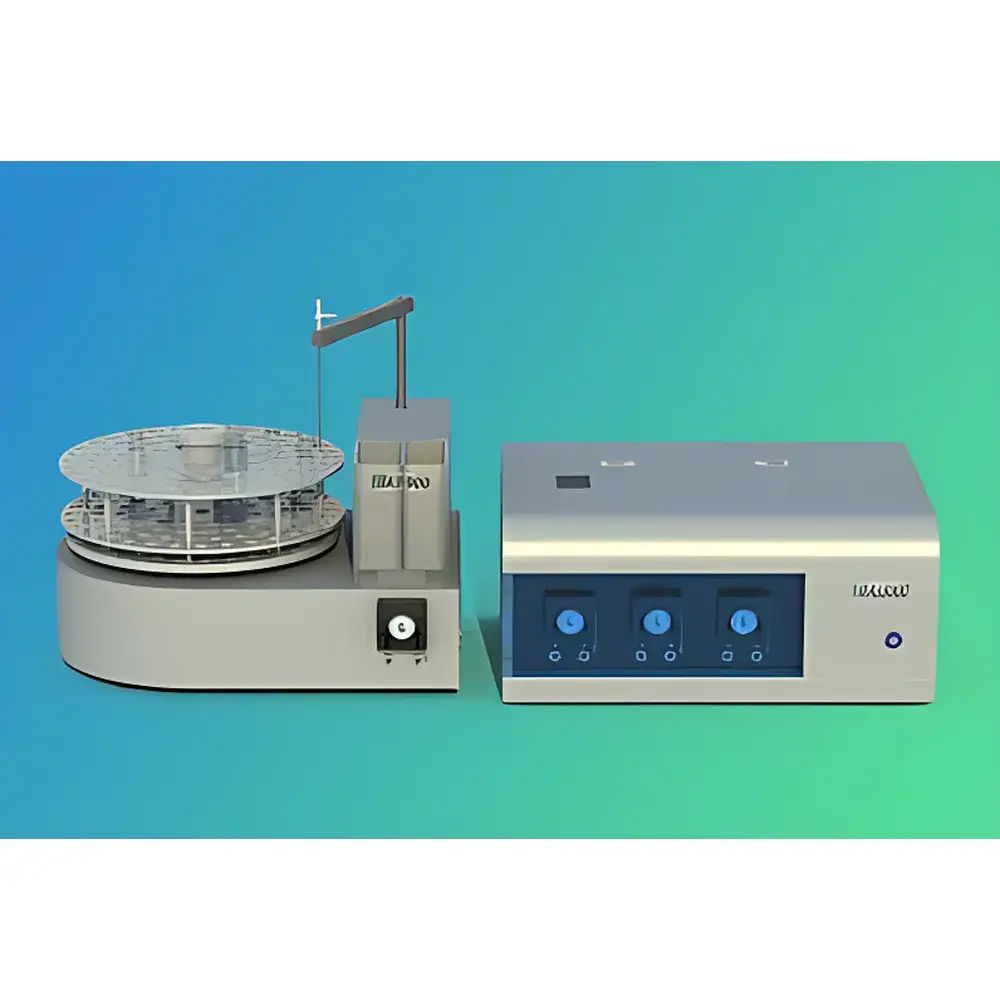
ANJIE AJ-3150 Plus Automated Ammonia Nitrogen Analyzer
| Brand | ANJIE |
|---|---|
| Origin | Shanghai, China |
| Model | AJ-3150 Plus |
| Instrument Type | Laboratory Analyzer |
| Measurement Principle | Gas-Phase Chemiluminescence (GPC) with Onboard Oxidation |
| Measurement Range | 0.08–100 mg/L NH₃–N |
| Accuracy | ≤ ±5% of reading |
| Detection Limit | 0.02 mg/L NH₃–N |
| Analysis Time per Sample | 1–3 minutes |
| Batch Capacity | 80 samples |
| Air Supply | Integrated Clean Air Generator (Atmospheric Pressure, No High-Pressure Cylinders Required) |
| Onboard Functions | Integrated Oxidation Module, Heating Module (for Nitrate & Total Nitrogen), Homogenizing Sparging System, Refrigerated Water Trap, Sintered-Glass Gas–Liquid Separator, Real-Time Graphical Monitoring, Auto-Dilution (≥40×), Adjustable Lamp Current & Automatic Light Gain Control |
Overview
The ANJIE AJ-3150 Plus Automated Ammonia Nitrogen Analyzer is a fully integrated laboratory instrument engineered for precise, high-throughput quantification of ammonia nitrogen (NH₃–N) in aqueous environmental matrices—including surface water, wastewater, drinking water, and industrial effluents. It operates on the principle of gas-phase chemiluminescence detection following catalytic oxidation of ammonium to nitric oxide (NO) under controlled thermal and chemical conditions. Unlike conventional colorimetric or ion-selective electrode methods, this system eliminates manual reagent addition, operator-dependent timing, and subjective endpoint interpretation. The onboard oxidation module converts NH₄⁺ to NO in situ without external oxidant handling—ensuring reproducibility, reducing analyst exposure risk, and minimizing reagent waste. Its architecture conforms to core requirements of ISO 14911:2022 (water quality — determination of ammonium — automated segmented flow analysis) and supports method validation protocols aligned with EPA Method 350.1 and ASTM D1426–21.
Key Features
- Integrated catalytic oxidation system: Converts NH₄⁺ to NO gas at elevated temperature (≥900 °C) without manual addition of hypochlorite or sodium nitroprusside.
- Onboard clean air generation: Eliminates dependence on high-pressure N₂ or compressed air cylinders; delivers particle- and hydrocarbon-filtered air at ambient pressure via dual-stage filtration and desiccation.
- Programmable heating module: Maintains precise reaction-zone temperature (60–100 °C) for consistent nitrate-to-NO conversion during total nitrogen analysis.
- Homogenizing sparging unit: Ensures representative sampling from turbid, suspended, or particulate-laden matrices by inducing uniform suspension prior to aspiration.
- Refrigerated condensate trap: Removes water vapor from the gas stream at –5 °C, preventing moisture interference in the chemiluminescence detector—no consumable desiccants required.
- Sintered-glass gas–liquid separator: Enhances phase separation efficiency and increases NO transfer yield by >300% compared to standard membrane-based systems.
- Real-time graphical monitoring: Displays signal evolution (intensity vs. time) for each sample run, enabling immediate visual assessment of peak shape, baseline stability, and potential interferences (e.g., chloride quenching or volatile organic co-elution).
- Quantitative flexibility: Supports both peak-height and peak-area integration modes; user-selectable integration windows and baseline correction algorithms.
- Extended lamp service life: Programmable hollow cathode lamp current control combined with adaptive optical gain compensation maintains stable signal output across extended operational cycles.
- Intelligent auto-dilution: Performs single- or multi-step dilution with precision syringe-driven delivery; dilution factors up to 40× are programmable, and the system can autonomously select optimal dilution based on preliminary absorbance screening.
Sample Compatibility & Compliance
The AJ-3150 Plus accommodates raw, filtered, centrifuged, or preserved (H₂SO₄-acidified) water samples within pH 2–12. It meets performance criteria for Class I analytical instrumentation per ISO/IEC 17025:2017 and supports full audit trail generation compliant with FDA 21 CFR Part 11 when paired with validated LIMS integration. All calibration and QC records—including blank verification, multi-point standard curves, spike recovery logs, and instrument performance checks—are timestamped, user-annotated, and exportable in CSV or PDF format. The system is routinely deployed in laboratories accredited to CNAS (China National Accreditation Service) and operates within the measurement uncertainty budget defined in ISO/IEC Guide 98-3 (GUM).
Software & Data Management
The embedded Windows-based control software provides intuitive workflow configuration, method storage (up to 100 user-defined protocols), and real-time data visualization. Raw signal files (.raw) and processed results (.csv) are stored with immutable metadata: operator ID, instrument serial number, environmental chamber temperature/humidity, and calibration history. Software supports GLP-compliant electronic signatures, role-based access control (admin/operator/auditor), and automatic backup to network drives or NAS devices. Export modules include direct integration with Thermo Fisher SampleManager LIMS and LabWare LIMS via ODBC drivers. All data transformations—including dilution correction, matrix-matched calibration, and outlier rejection using Grubbs’ test—are logged and reversible.
Applications
This analyzer is routinely applied in municipal wastewater treatment plant (WWTP) compliance reporting (e.g., discharge permit monitoring per GB 18918–2002), environmental impact assessment (EIA) field labs, potable water safety verification (GB 5749–2022), and research studies on nitrogen cycling in aquatic ecosystems. It supports sequential analysis of NH₃–N, NO₂⁻–N, NO₃⁻–N, and TN in a single batch—enabling comprehensive nutrient profiling without method switching. Its robustness in high-salinity (≤35 g/L NaCl) and high-turbidity (up to 500 NTU) samples makes it suitable for estuarine and coastal monitoring programs.
FAQ
Does the AJ-3150 Plus require external gas cylinders?
No. It incorporates an integrated clean air generator that delivers conditioned, oil-free air at atmospheric pressure—eliminating cylinder storage, regulatory handling permits, and associated safety hazards.
Can the system analyze total nitrogen (TN) in addition to ammonia nitrogen?
Yes. With the optional TN add-on kit (including high-temperature UV/persulfate digestion module), the same platform performs simultaneous NH₃–N, NO₂⁻–N, NO₃⁻–N, and TN determinations using a unified gas-phase detection path.
Is method validation documentation available?
Yes. ANJIE provides a complete validation package including LOD/LOQ verification reports, linearity assessment (R² ≥ 0.999 over 0.08–100 mg/L), precision data (RSD ≤ 2.1% at 5 mg/L, n = 12), and interference testing against common ions (Cl⁻, SO₄²⁻, PO₄³⁻, Ca²⁺, Mg²⁺).
How is calibration traceability maintained?
All calibrants are prepared from NIST-traceable ammonium sulfate reference material (SRM 2783); calibration curves are verified daily using certified reference materials (CRMs) from LGC Standards or AccuStandard.
What maintenance intervals are recommended?
Daily: Check air filter status and water trap level. Weekly: Inspect sintered-glass separator for clogging; clean with 10% HNO₃. Quarterly: Replace oxidation catalyst bed and verify lamp energy output. Annual: Full optical alignment and detector sensitivity recalibration by authorized service engineer.







