
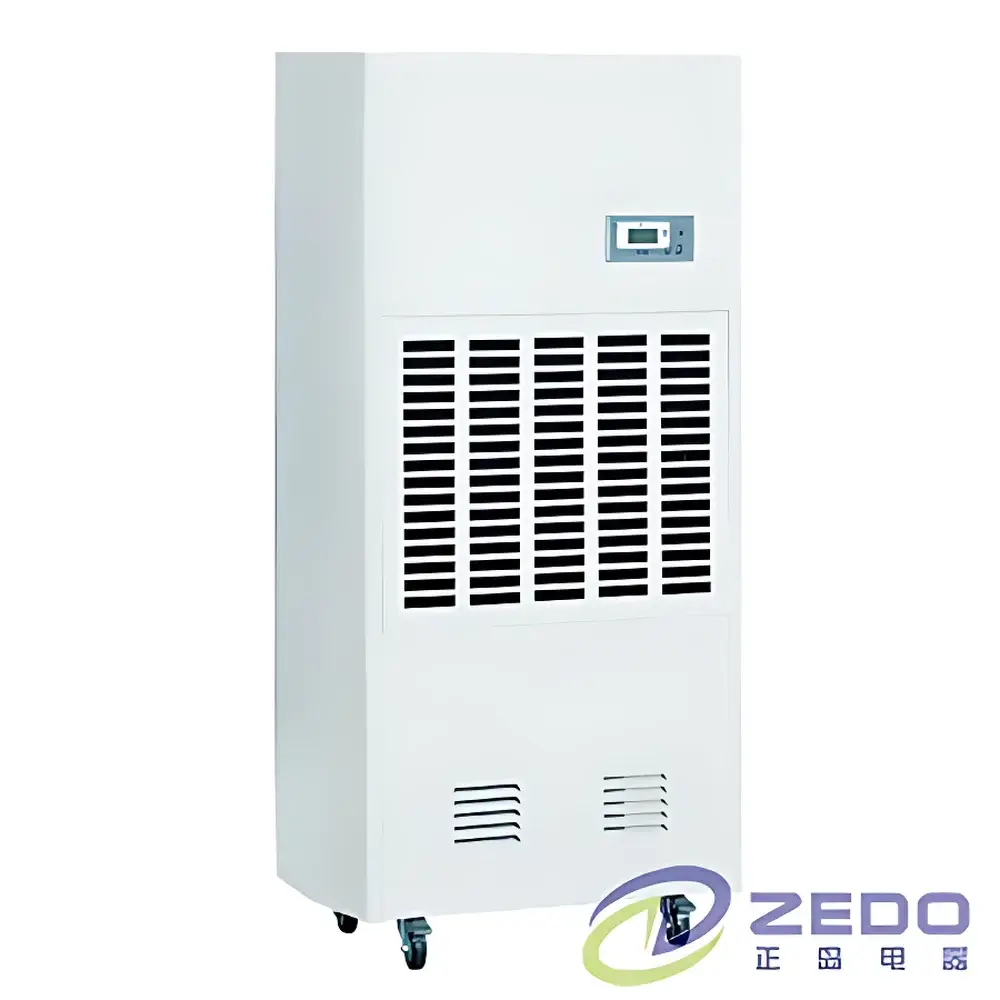
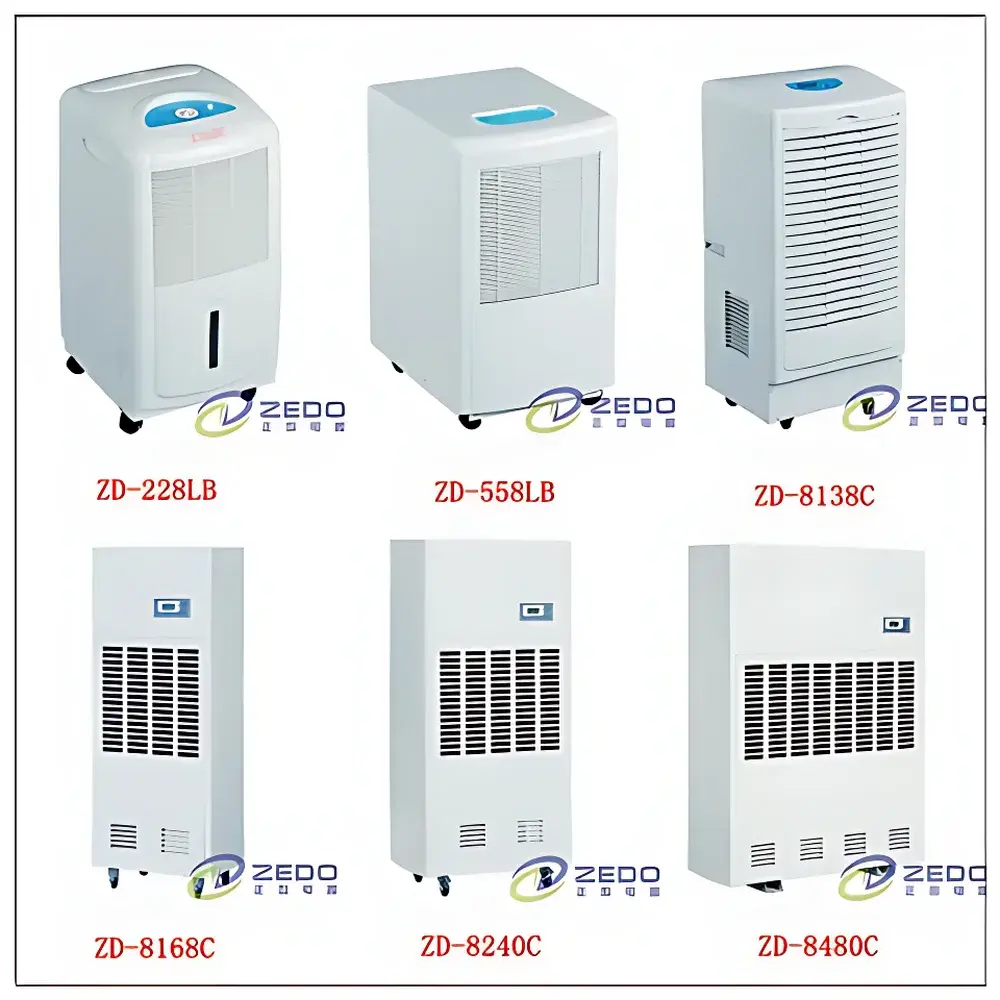
ZEDO ZD-8240C Industrial Warehouse Dehumidifier
| Brand | ZEDO |
|---|---|
| Origin | Zhejiang, China |
| Manufacturer Type | OEM/ODM Manufacturer |
| Country of Origin | China |
| Model | ZD-8240C |
| Dehumidification Capacity | 240 L/day |
| Control Method | Intelligent Humidity Setpoint Control |
| Drainage | Continuous via PVC Drain Hose |
| Power Supply | 380 V AC, 50 Hz |
| Input Power | 4900 W |
| Operating Temperature Range | 5–38 °C |
| Noise Level | 52 dB(A) |
| Dimensions (W×D×H) | 770 × 470 × 1650 mm |
| Net Weight | 160 kg |
| Applicable Area | 180–240 m² |
| Safety Protections | High/Low Pressure, Overload, Undervoltage, Reverse Phase, 3-Minute Compressor Delay |
| Air Filtration | Standard Activated Carbon Filter |
| Fan System | Dual-Centrifugal External Rotor Blower |
| Sensor | Japanese Shinyo High-Accuracy RH/T Sensor |
| Display & Interface | Microcomputer Touch Panel with Fault Diagnostic Indicators |
Overview
The ZEDO ZD-8240C Industrial Warehouse Dehumidifier is a high-capacity, precision-engineered condensation-based dehumidification system designed for continuous operation in mission-critical storage and processing environments. It operates on the principle of refrigerant-driven cooling coil condensation: ambient air is drawn across a low-temperature evaporator coil, where moisture condenses due to reaching dew point; the condensed water is collected and drained continuously, while the air is reheated via the condenser coil to maintain near-constant sensible temperature—ensuring minimal thermal impact on the conditioned space. Engineered for reliability under sustained load, the unit delivers stable humidity control within the recommended preservation range of 40–60 %RH—a critical threshold validated by ISO 1174, ASTM D6403, and ICH Q5C guidelines for hygroscopic material storage.
Key Features
- High-efficiency scroll compressor from a globally certified manufacturer, paired with environmentally compliant R-410A refrigerant for optimal energy conversion and reduced GWP impact.
- Optimized heat exchanger assembly featuring internally grooved copper tubing with hydrophilic aluminum finning—enhancing surface contact area and latent heat transfer efficiency by up to 22% compared to standard flat-fin designs.
- Dual-centrifugal external rotor blower system delivering uniform airflow distribution across large-volume spaces (up to 240 m²), with vibration-damped mounting and aerodynamically balanced impellers ensuring acoustic performance ≤52 dB(A) at 1 m distance.
- Microprocessor-based control system integrating a Shinyo (Japan) high-stability capacitive humidity sensor (±2 %RH accuracy, 0.1 %RH resolution) and real-time diagnostics—including compressor status, filter saturation alert, drainage blockage detection, and fault code logging.
- Robust industrial-grade electrical architecture: Schneider or equivalent circuit breakers, contactors, and thermal relays; comprehensive protection suite covering high/low refrigerant pressure, phase loss, voltage fluctuation, and thermal overload.
- Structural modularity enables field-serviceable separation of refrigeration and airflow subsystems—reducing mean time to repair (MTTR) and supporting preventive maintenance per ISO 55001 asset management protocols.
Sample Compatibility & Compliance
The ZD-8240C is validated for use in environments housing moisture-sensitive assets including but not limited to: archival documents (per ISO 11799:2015), pharmaceutical intermediates (aligned with USP and EU GMP Annex 15), optical calibration standards, semiconductor wafers, and sterile medical device packaging. Its steady-state RH stability (±3 %RH band under nominal load) satisfies the environmental qualification requirements for GLP-compliant storage rooms (OECD GLP Principles, Section 2.2.11). The unit’s non-corrosive internal materials (electro-galvanized steel chassis, stainless steel drain pan, food-grade ABS housing) meet NSF/ANSI 50 and RoHS 3 material restrictions. CE marking compliance includes EN 60335-1 (safety) and EN 60335-2-40 (particular requirements for dehumidifiers).
Software & Data Management
While the ZD-8240C operates as a standalone unit with local touch interface, its embedded controller supports optional RS-485 Modbus RTU communication (via accessory module) for integration into facility-wide BMS platforms (e.g., Siemens Desigo, Honeywell Enterprise Buildings Integrator). Logged operational data—including runtime hours, cumulative dehumidification volume, compressor cycles, and alarm history—is stored in non-volatile memory with timestamping compliant with FDA 21 CFR Part 11 audit trail requirements when connected to validated supervisory software. Remote monitoring and setpoint adjustment are achievable via secure Ethernet gateway (sold separately), enabling centralized humidity governance across multi-zone warehouse facilities.
Applications
This dehumidifier is deployed in regulated and non-regulated industrial settings where moisture-induced degradation compromises product integrity or process continuity. Primary use cases include: cold-chain logistics staging areas maintaining ambient dry-bulb conditions; paper-based records repositories complying with NARA Bulletin 2012-02; cleanroom antechambers requiring pre-conditioned air supply; electronics component kitting zones per IPC-A-610 Class 3 humidity limits; and food ingredient storage vaults adhering to HACCP Principle 6 (verification of environmental controls). Its 240 L/day capacity makes it suitable for high-moisture-load scenarios such as coastal warehouse basements, monsoon-season distribution centers, and fermentation facility buffer zones.
FAQ
What is the minimum ambient temperature at which the ZD-8240C remains effective?
The unit maintains rated dehumidification performance down to 5 °C dry-bulb temperature. Below this threshold, automatic defrost logic activates to prevent evaporator coil icing—extending operational viability in temperate climate-controlled warehouses.
Can the ZD-8240C be integrated into an existing building automation system?
Yes—via optional RS-485 Modbus RTU interface module, enabling read/write access to humidity setpoints, operational status, and historical logs within third-party SCADA or BMS environments.
Is the activated carbon filter replaceable, and what is its service interval?
The standard filter is user-replaceable; typical replacement frequency is every 6–12 months depending on airborne particulate loading, with visual inspection recommended quarterly per ISO 16890-1 guidance.
Does the unit comply with electromagnetic compatibility (EMC) standards for laboratory environments?
Yes—it meets EN 61000-6-3 (emission) and EN 61000-6-2 (immunity) requirements, minimizing interference with adjacent analytical instrumentation such as FTIR spectrometers or mass spectrometers.
How is condensate disposal managed during unattended operation?
Continuous gravity-fed drainage is supported via 16 mm ID PVC hose (included); maximum lift height is 1.2 m, and horizontal run length should not exceed 15 m without slope verification per ASHRAE Handbook—HVAC Applications Chapter 49.



