
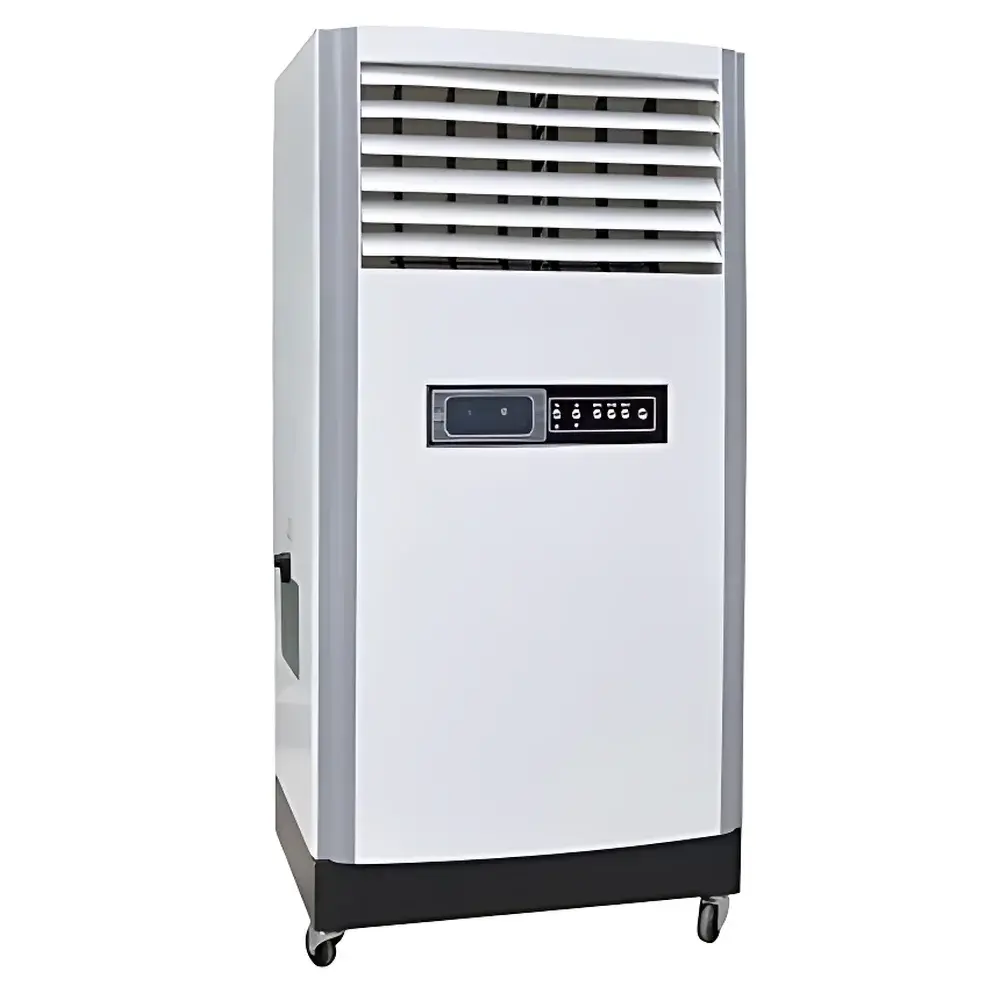
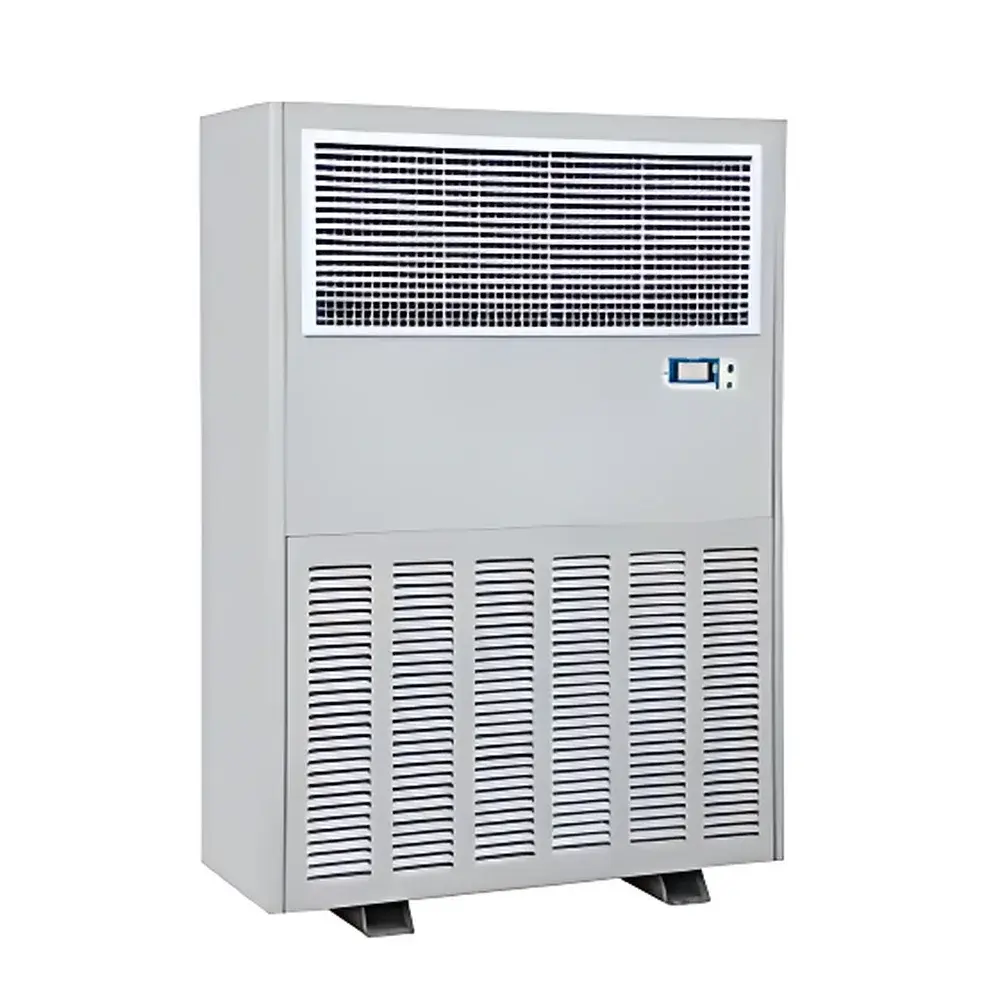
ZEDO QS-3 Dedicated Server Room Humidifier
| Brand | ZEDO |
|---|---|
| Origin | Zhejiang, China |
| Manufacturer Type | Direct Manufacturer |
| Regional Classification | Domestic (China) |
| Model | QS-3 |
| Price | USD 820 (approx. based on ¥5800 @ 1 USD = ¥7.07) |
| Humidification Capacity | ≥3 kg/h |
| Airflow Rate | 1000 m³/h |
| Coverage Area | 150 m³ |
| Power Supply | 220 V / 50 Hz |
| Noise Level | ≤30 dB(A) |
| Control Method | Intelligent Microprocessor Control |
| Power Consumption | 130 W |
| Droplet Size | ≤5 µm |
| Net Weight | 26 kg |
| Dimensions (W×D×H) | 480 × 280 × 1700 mm |
| Humidification Technology | Evaporative Wet-Membrane |
| Compliance | Meets ISO 14644-1 Class 8 ambient air quality guidelines for non-cleanroom critical environments |
Overview
The ZEDO QS-3 Dedicated Server Room Humidifier is an engineered evaporative humidification system designed specifically for mission-critical IT infrastructure environments—including data centers, telecommunications switching rooms, network operations centers (NOCs), and precision electronics manufacturing facilities. Unlike ultrasonic or steam-based humidifiers, the QS-3 employs a passive, energy-efficient wet-membrane evaporation principle: water is uniformly distributed across a vertically oriented cellulose-polymer composite membrane via a precision dosing pump and gravity-fed recirculation loop. As conditioned room air passes through the saturated membrane, latent heat exchange drives controlled evaporation—increasing relative humidity without introducing liquid droplets, mineral aerosols, or thermal load into the space. This mechanism ensures stable RH maintenance within the ASHRAE TC 90.4–recommended range of 40–55% RH while simultaneously acting as a particulate pre-filter (removing >85% of airborne particles ≥10 µm per single pass). The unit operates continuously at ambient temperatures between 15–30°C, making it compatible with standard CRAC/CRAH airflow regimes.
Key Features
- Stable evaporative humidification with zero white dust or mineral dispersion—eliminating risk of conductive residue accumulation on server intakes, PCBs, or optical interfaces
- Integrated intelligent control system with real-time RH feedback loop, adjustable setpoint (35–65% RH), and auto-adaptive fan speed modulation based on inlet air dew point
- Corrosion-resistant stainless-steel water reservoir and food-grade PVC wet-membrane housing—certified to NSF/ANSI 61 for potable water contact compliance
- Low-noise axial fan assembly (<30 dB[A] at 1 m) with vibration-damped mounting—suitable for deployment in acoustically sensitive NOC or control room environments
- Self-cleaning membrane rinse cycle activated every 72 operational hours to inhibit biofilm formation and maintain consistent evaporation efficiency
- Modular design enables front-access serviceability: pump, membrane cartridge, and filter elements are replaceable without tools or system shutdown
Sample Compatibility & Compliance
The QS-3 is validated for use in environments governed by multiple international infrastructure standards. Its non-invasive, droplet-free humidification method complies with ISO/IEC 27001 Annex A.9.4.2 (physical security controls for IT equipment), TIA-942-A Tier III+ environmental requirements, and EN 50600-2-3 (data center infrastructure—climate control). While not classified as medical or pharmaceutical-grade equipment, its construction materials meet UL 94 V-0 flammability rating, and electrical safety conforms to IEC 60335-1. For facilities operating under FDA 21 CFR Part 11 or EU Annex 11, optional RS-485 Modbus RTU interface supports integration into BMS platforms with audit-trail-capable logging of RH setpoints, runtime hours, and maintenance alerts.
Software & Data Management
The embedded controller includes a local LCD interface with dual-language (English/Chinese) support and stores 30 days of compressed environmental logs (RH%, runtime, alarm events). Optional Ethernet/Wi-Fi connectivity (via ZEDO CloudLink Module, sold separately) enables remote configuration, firmware updates, and export of CSV-formatted logs compliant with ISO/IEC 17025 Clause 7.7 (result reporting). All data transmission uses TLS 1.2 encryption. No cloud storage is mandatory—the device operates fully autonomously offline. Audit trails include timestamped records of parameter changes, manual overrides, and scheduled maintenance cycles, satisfying GLP documentation requirements for environmental monitoring systems.
Applications
- Telecom central offices and fiber aggregation hubs requiring static mitigation without compromising signal integrity
- Enterprise data centers deploying high-density blade servers and NVMe storage arrays sensitive to electrostatic discharge (ESD)
- EMC testing laboratories where uncontrolled humidity could skew radiated emission measurements
- Calibration labs maintaining traceable environmental conditions per ISO/IEC 17025 Clause 6.3.3
- Printed circuit board (PCB) assembly cleanrooms operating at ISO Class 8 (100,000) particle limits
- Archival storage vaults housing magnetic media, microfilm, or hygroscopic artifacts requiring stable moisture equilibrium
FAQ
Does the QS-3 introduce water droplets or mist into the server room air?
No. It utilizes pure evaporative transfer across a wetted membrane—no atomization occurs. Output air contains only water vapor, eliminating condensation risk on cold surfaces and preventing contamination of sensitive optics or cooling fins.
Can the unit be integrated into an existing BMS or DDC system?
Yes. Standard Modbus RTU over RS-485 is built-in; optional BACnet/IP or SNMP v3 gateways are available for enterprise-level building automation interoperability.
What maintenance intervals are recommended for sustained performance?
Wet-membrane cartridge replacement every 12 months (or after 8,000 operational hours); pump inspection and reservoir descaling every 6 months; pre-filter cleaning every 2 weeks in high-dust environments.
Is the QS-3 suitable for use in environments with hard water?
Yes. The closed-loop recirculation system minimizes scale buildup, and the membrane’s hydrophilic surface resists calcium carbonate adhesion. For water with >200 ppm total dissolved solids (TDS), optional inline reverse-osmosis pretreatment is recommended.
How does the QS-3 contribute to ESD control beyond RH stabilization?
By maintaining 40–55% RH, surface resistivity of common insulators (e.g., epoxy-coated racks, acrylic enclosures) drops from >10¹² Ω/sq to <10⁹ Ω/sq—within the dissipative range defined by ANSI/ESD S20.20, thereby enabling safe charge bleed-off without grounding dependency.



