
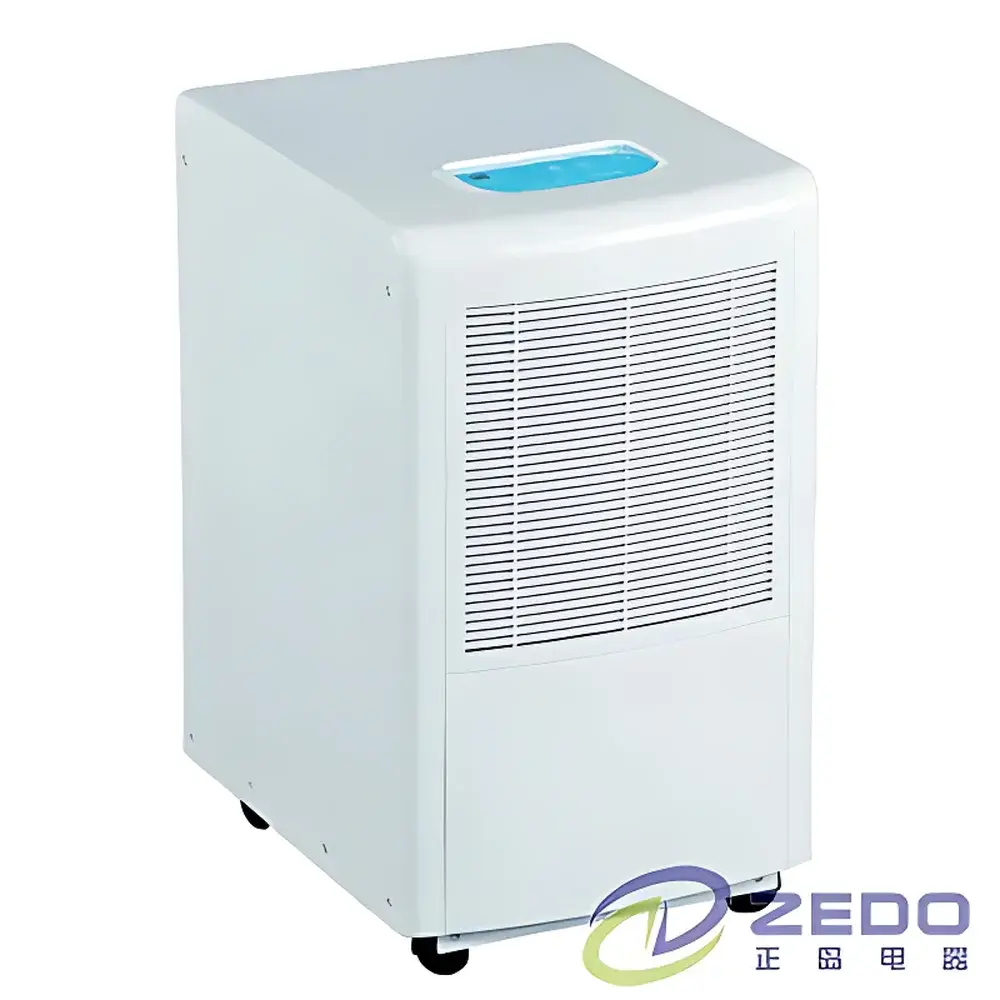
ZEDO ZD-558LB Residential Dehumidifier
| Brand | ZEDO |
|---|---|
| Model | ZD-558LB |
| Type | Compressor-Based Dehumidifier |
| Dehumidification Capacity | 58 L/day |
| Power Input | 670 W |
| Operating Temperature Range | 0–38 °C |
| Noise Level | 28 dB(A) |
| Airflow Rate | 850 m³/h |
| Water Tank Capacity | 6 L |
| Dimensions (W×D×H) | 350 × 455 × 603 mm |
| Net Weight | 25 kg |
| Control System | Microprocessor-Based Humidity Regulation with Auto-Defrost and Fault Code Display |
| Drainage Options | Removable Tank or Continuous Drain via Hose |
| Safety Features | 3-Minute Compressor Delay, Overheat & Overflow Protection |
| Filtration | Integrated Activated Carbon Filter |
Overview
The ZEDO ZD-558LB Residential Dehumidifier is a compressor-based environmental control device engineered for precise humidity management in enclosed indoor spaces. It operates on the principle of refrigerant-cycle condensation: ambient air is drawn across a cold evaporator coil, where moisture condenses and is collected as liquid water; the dried air is then reheated by the condenser and returned to the environment at a lower relative humidity. This thermodynamic process delivers stable, repeatable dehumidification performance without chemical desiccants or consumables. Designed for consistent operation under variable ambient conditions—from near-freezing (0 °C) to tropical heat (38 °C)—the unit maintains rated capacity across its full operational envelope. Its low-noise architecture (28 dB[A]) and compact footprint make it suitable for environments where acoustic integrity and spatial efficiency are prioritized, including controlled laboratories, sample storage rooms, calibration labs, and instrument enclosures requiring stable RH conditions.
Key Features
- High-efficiency rotary compressor from an internationally certified manufacturer, delivering optimal energy conversion ratio and extended service life under continuous duty cycles.
- Microprocessor-controlled humidity regulation with user-defined setpoint (typically 30–80% RH), real-time digital display, and automatic defrost logic to prevent coil icing during low-temperature operation.
- Integrated activated carbon pre-filter captures airborne particulates and volatile organic compounds (VOCs), protecting internal components and improving air quality in sensitive environments.
- Dual drainage configuration: 6-liter removable water tank with level sensor and audible alert, plus threaded outlet for gravity-fed continuous hose drainage—ideal for unattended operation.
- Robust mechanical design includes copper internal tubing with internal threading for enhanced thermal conductivity and corrosion resistance, high-CFM centrifugal blower for uniform airflow distribution, and three-minute compressor restart delay to prevent short-cycling.
- Comprehensive safety architecture: overheat protection, tank overflow cutoff, motor thermal cutoff, and fault-code diagnostics displayed on LCD interface for rapid troubleshooting.
Sample Compatibility & Compliance
While primarily intended for residential and light commercial use, the ZD-558LB is routinely deployed in non-regulated laboratory support zones—including equipment storage cabinets, glove box antechambers, reagent preparation areas, and low-risk analytical workspaces—where ambient RH control is required to prevent hygroscopic degradation of standards, reference materials, or calibration artifacts. It complies with IEC 60335-1 (General Requirements for Household Electrical Appliances) and IEC 60335-2-40 (Particular Requirements for Heat Pumps, Air-Conditioners and Dehumidifiers). Though not certified for GLP/GMP production environments or cleanrooms (ISO 14644), its stable output and traceable operational parameters support documented environmental monitoring protocols when integrated into broader facility management systems.
Software & Data Management
The ZD-558LB operates via embedded firmware with no external software dependency. All operational parameters—including current RH%, target setpoint, runtime hours, and active fault codes—are accessible via the front-panel LCD. While the unit lacks network connectivity or data logging capability, its deterministic control logic ensures reproducible performance across deployments. For integration into centralized building management systems (BMS), optional third-party IoT adapters may be employed to monitor power draw and status signals via dry-contact relays. No FDA 21 CFR Part 11 compliance is claimed, as the device does not store, transmit, or process regulated analytical data.
Applications
- Prevent moisture-induced oxidation of metal calibration weights and precision instrumentation in metrology labs.
- Maintain ≤50% RH in archival storage for paper-based SOPs, logbooks, and legacy documentation.
- Support stability testing environments for hygroscopic pharmaceutical excipients prior to formal climatic chamber qualification.
- Protect optical components, laser alignment tools, and interferometric equipment from condensation-related drift.
- Supplement HVAC systems in basement-level QC labs where dew point control is insufficient during monsoon seasons.
- Enable temporary RH stabilization during equipment commissioning or preventive maintenance shutdowns.
FAQ
What is the recommended operating temperature range for reliable dehumidification performance?
The unit is rated for continuous operation between 0 °C and 38 °C. Below 15 °C, auto-defrost frequency increases; sustained operation below 5 °C is not advised due to reduced condensate yield and potential frost accumulation.
Can this unit be used in a Class 10,000 cleanroom?
No. The ZD-558LB is not constructed to ISO 14644-1 particle emission limits nor equipped with HEPA filtration. It is unsuitable for classified environments requiring particulate control.
Is continuous drainage possible without manual intervention?
Yes—when connected to a gravity-drain hose with ≥1% downward slope, the unit operates indefinitely without tank emptying. Ensure hose termination is below the drain port elevation.
Does the activated carbon filter require scheduled replacement?
ZEDO specifies a nominal service life of 6–12 months under typical indoor air conditions. Replacement interval should be adjusted based on local airborne contaminant load and observed odor retention efficacy.
How does the microprocessor control improve humidity consistency compared to mechanical hygrostat models?
Unlike bimetallic or humidistat-switched units, the ZD-558LB uses digital feedback loops with proportional-integral (PI) logic to minimize RH overshoot and cycling frequency—resulting in ±3% RH stability at setpoint under steady-state conditions.



