
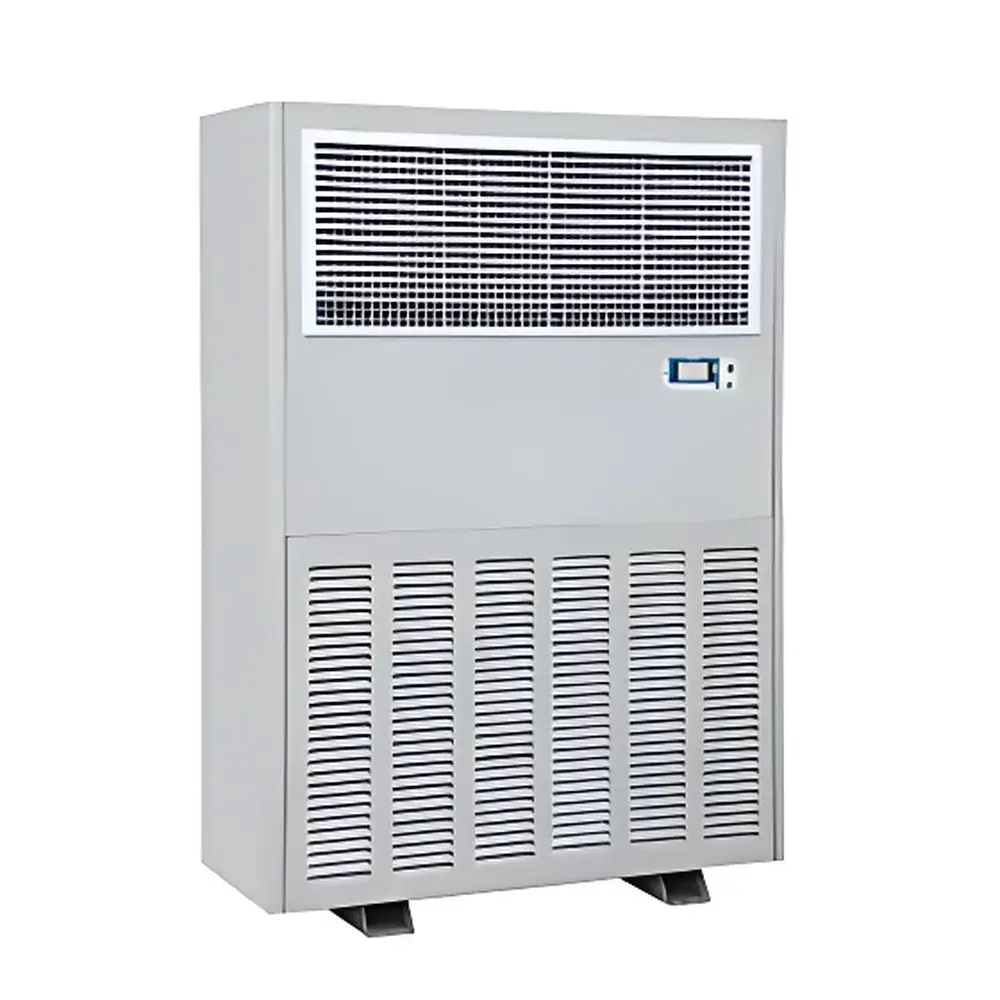
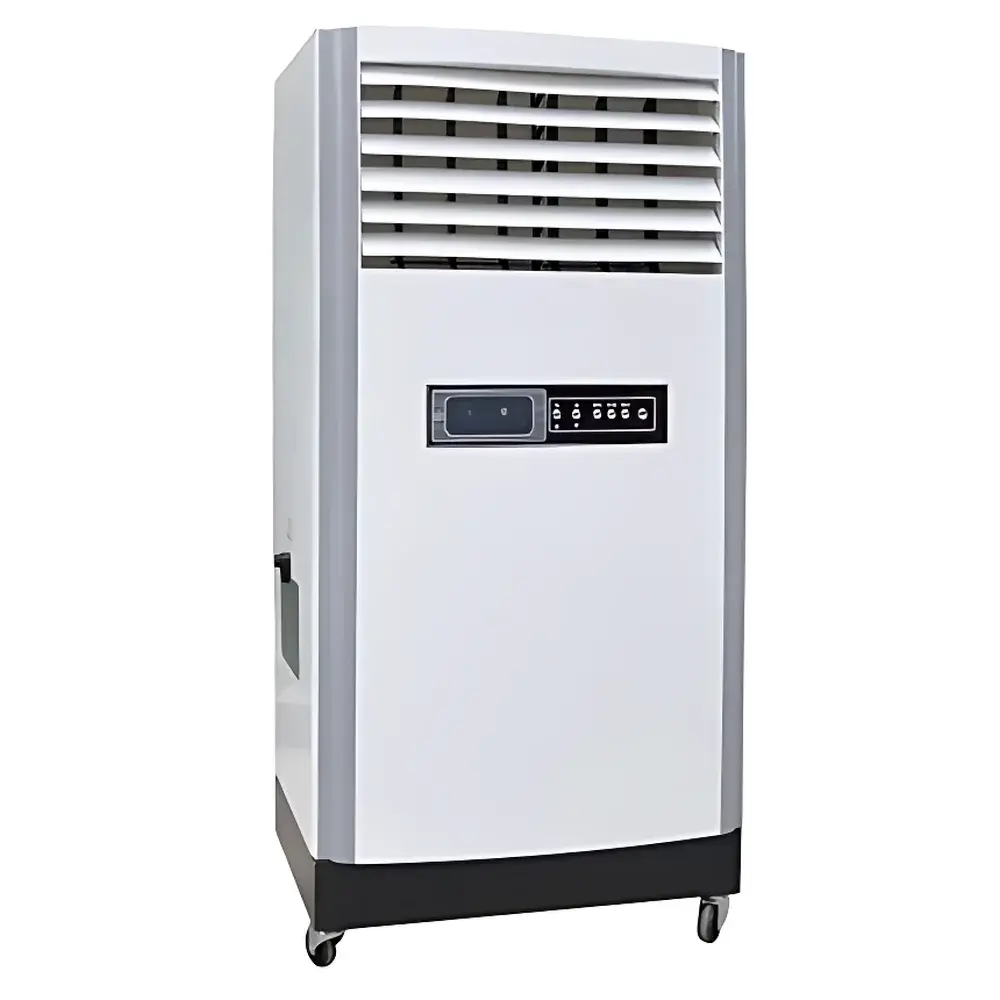
ZEDO QS-15 Electrostatic Discharge (ESD)-Controlled Evaporative Humidifier
| Brand | ZEDO |
|---|---|
| Origin | Zhejiang, China |
| Manufacturer Type | Direct Manufacturer |
| Country of Origin | China |
| Model | QS-15 |
| Power Supply | 220 V / 50 Hz |
| Airflow | 3500 m³/h |
| Humidification Capacity | ≥15 kg/h |
| Coverage Area | 800 m³ |
| Noise Level | ≤60 dB(A) |
| Control Method | Intelligent Microprocessor-Based Control |
| Power Consumption | 450 W |
| Droplet Size | ≤5 µm |
| Net Weight | 47 kg |
| Dimensions (L×W×H) | 118 × 40 × 185 cm |
| Filtration Mechanism | Passive Wet-Membrane Air Contact Surface |
Overview
The ZEDO QS-15 Electrostatic Discharge (ESD)-Controlled Evaporative Humidifier is an engineered environmental control solution designed specifically for precision manufacturing and storage environments where static-sensitive electronic components are handled. Unlike ultrasonic or high-pressure misting systems—which introduce free water droplets that risk condensation, corrosion, or particle dispersion—the QS-15 employs a passive evaporative principle grounded in thermodynamic mass transfer: ambient air is drawn across a vertically oriented, hydrophilic wet membrane; moisture transfers via natural evaporation at the air–water interface without phase change discontinuity. This mechanism ensures humidity augmentation without aerosol generation, eliminating risks associated with microbial propagation, mineral carryover, or uncontrolled particulate release—critical compliance requirements in ISO Class 7/8 cleanrooms, ESD-protected areas (EPAs) per ANSI/ESD S20.20, and controlled environments governed by IEC 61340-5-1.
Key Features
- ESD-optimized enclosure and grounding architecture compliant with ANSI/ESD STM97.1 surface resistance specifications (1×10⁴–1×10⁹ Ω)
- Self-regulating evaporative core composed of high-capacity, anti-microbial treated cellulose-polymer composite membrane with >95% dust capture efficiency for particles ≥10 µm
- Integrated intelligent controller with real-time RH feedback loop, adjustable setpoint range (30–70% RH), and programmable daily/weekly scheduling
- Low-noise axial fan assembly operating at ≤60 dB(A) at 1 m—suitable for continuous operation in QA labs, metrology rooms, and adjacent production zones
- Auto-drain and periodic self-flushing cycle to inhibit biofilm formation and scale accumulation in accordance with ASHRAE Guideline 12-2020
- Modular wet-membrane cartridge design enabling rapid replacement without tools or system shutdown
Sample Compatibility & Compliance
The QS-15 is validated for use in environments requiring strict adherence to electrostatic control protocols, including semiconductor fabrication support areas, PCB assembly lines, wafer probe stations, and Class 10,000 (ISO 7) storage vaults. It meets mechanical safety standards per IEC 60335-1 and EMC compliance under EN 61000-6-3/6-4. While not classified as medical or pharmaceutical-grade equipment, its operational parameters align with baseline environmental controls referenced in ISO 14644-1 (cleanroom classification), JEDEC J-STD-033 (moisture sensitivity level handling), and IPC-A-610 (acceptability of electronic assemblies). No regulatory submission (e.g., FDA 510(k), CE medical device directive) applies, as the unit functions solely as an ambient air conditioning auxiliary—not a direct process tool or life-support component.
Software & Data Management
The onboard microcontroller supports RS-485 Modbus RTU communication for integration into building management systems (BMS) or centralized HVAC supervisory platforms. Optional analog 4–20 mA output enables connection to PLC-based environmental monitoring networks. All operational logs—including runtime hours, RH deviation events (>±3% from setpoint), and maintenance alerts—are timestamped and stored locally for ≥30 days. Audit trail functionality satisfies GLP-aligned documentation requirements for traceability, though full 21 CFR Part 11 electronic signature compliance requires external validation of connected data acquisition hardware and software.
Applications
- Humidity stabilization in ESD-protected workstations during IC packaging, die bonding, and flip-chip assembly
- Prevention of triboelectric charge accumulation on conveyor belts, automated optical inspection (AOI) chambers, and bare-board handling fixtures
- Environmental conditioning of calibration laboratories housing coordinate measuring machines (CMMs), laser interferometers, and high-resolution profilometers
- Support of archival integrity in semiconductor wafer libraries, photomask repositories, and reliability test sample storage cabinets
- Supplemental humidification in HVAC zones where chilled-water coil dehumidification causes seasonal RH drop below 40% RH thresholds
FAQ
Does the QS-15 require demineralized or reverse-osmosis water?
No—standard municipal or softened water is acceptable. The evaporative process inherently rejects dissolved solids; however, water with total hardness >150 ppm may necessitate more frequent membrane cleaning per ASHRAE maintenance guidelines.
Can this unit be ducted into a central air handling system?
It is designed for direct room-air recirculation only. Ducted installation voids ESD performance certification and compromises airflow uniformity across the wet membrane surface.
What is the expected service life of the wet membrane under continuous operation?
With bi-weekly visual inspection and quarterly cleaning using pH-neutral detergent, typical membrane service life exceeds 18 months in controlled indoor environments with stable temperature (20–25°C) and low airborne oil/volatile organic compound loading.
Is remote monitoring capability built-in or add-on?
Basic status indicators (power, alarm, auto-clean cycle) are local-only. Remote monitoring requires optional Modbus gateway hardware and configuration within an existing BMS infrastructure.
How does this unit differ from steam or ultrasonic humidifiers in ESD-critical areas?
Steam systems introduce conductive ions and thermal load; ultrasonic units generate respirable aerosols containing entrained minerals and microbes. The QS-15 adds moisture exclusively via latent heat exchange—preserving air dielectric properties and avoiding contamination pathways inherent to phase-change technologies.



