
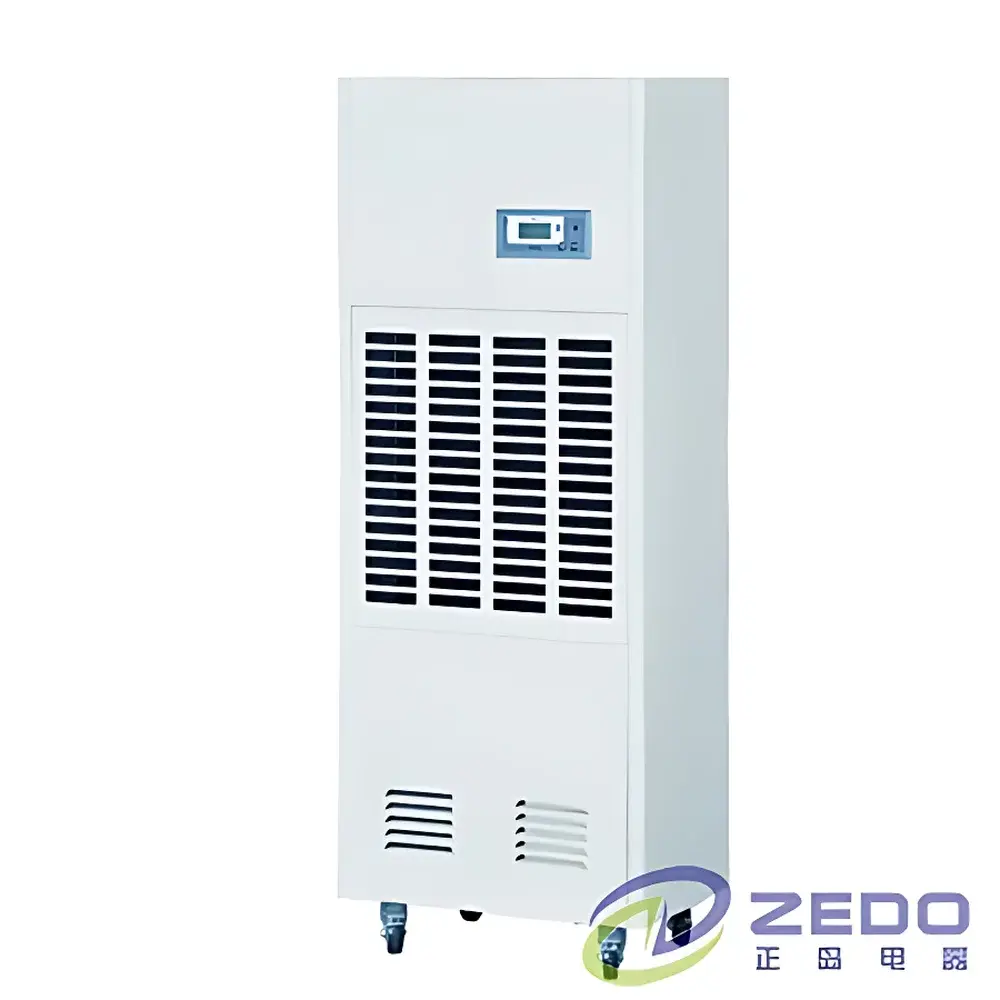
ZEDO ZD-8138C Industrial Dehumidifier for Electronics Manufacturing
| Brand | ZEDO |
|---|---|
| Origin | Zhejiang, China |
| Manufacturer Type | OEM/ODM Manufacturer |
| Country of Origin | China |
| Model | ZD-8138C |
| Instrument Type | Compressor-Based Industrial Dehumidifier |
| Power Supply | 380 V~50 Hz |
| Input Power | 2.8 kW |
| Dehumidification Capacity | 138 L/day (5.75 L/h) |
| Applicable Area | 110–160 m² |
| Operating Temperature Range | 5–38 °C |
| Noise Level | ≤52 dB(A) |
| Dimensions (W×D×H) | 605 × 410 × 1650 mm |
| Net Weight | 126 kg |
| Drainage Method | Continuous via PVC hose |
| Control System | Microcomputer-based humidity setpoint control with auto-fault diagnostics |
| Safety Protections | 3-min compressor delay, high/low pressure protection, overload & phase failure protection |
| Air Filter | Standard activated carbon filter |
| Fan Type | External rotor centrifugal fan with dual impellers |
| Heat Exchanger | Hydrophilic aluminum fin-tube coil with internal-thread copper tubing |
| Compressor | Scroll-type, internationally certified, R410A refrigerant |
Overview
The ZEDO ZD-8138C Industrial Dehumidifier is an engineered solution for precision humidity control in large-scale electronics manufacturing environments—including cleanrooms, SMT assembly lines, PCB storage vaults, and component warehousing facilities. Designed to operate continuously under demanding industrial conditions, it employs a robust refrigerant-based dehumidification cycle grounded in thermodynamic condensation principles: ambient air is drawn across a sub-cooled evaporator coil, where moisture condenses at dew-point temperatures and is collected as liquid water, while the re-heated, low-humidity airstream is discharged back into the controlled space. This process enables stable maintenance of relative humidity (RH) within critical thresholds—typically 40–55% RH—as mandated by IPC-A-610, JEDEC J-STD-033, and ISO 14644-1 for ESD-safe and oxidation-sensitive production workflows. Unlike portable or residential units, the ZD-8138C integrates structural rigidity, thermal stability, and system-level redundancy to ensure uninterrupted operation across shifts and seasonal ambient fluctuations.
Key Features
- Industrial-grade scroll compressor with R410A refrigerant—certified for high COP (Coefficient of Performance), low GWP, and extended service life under continuous 24/7 duty cycles.
- Hydrophilic aluminum fin-and-tube heat exchanger with internally grooved copper tubing—optimized for maximum latent heat transfer efficiency and resistance to corrosion from trace airborne contaminants (e.g., flux residues, organic vapors).
- Dual-impeller external rotor centrifugal fan assembly—delivers consistent airflow ≥1,200 m³/h at static pressures up to 120 Pa, ensuring uniform dehumidification across volumetric spaces exceeding 400 m³.
- Microprocessor-based controller with Japanese SUGINO high-accuracy capacitive RH sensor (±2% RH, 0–90% RH range)—enables programmable setpoints, real-time deviation logging, and automatic defrost cycling without manual intervention.
- Integrated safety architecture—including three-minute compressor restart delay, high/low refrigerant pressure cutoffs, phase-loss detection, and thermal overload relays—compliant with IEC 60335-1 and GB 4706.32 standards.
- Modular frame design with segregated refrigeration and airflow sections—facilitates field servicing, component replacement, and compliance with ISO 55001 asset management protocols.
Sample Compatibility & Compliance
The ZD-8138C is validated for use in ISO Class 7 (10,000) and Class 8 (100,000) cleanroom environments where humidity excursions directly impact solder paste rheology, conformal coating adhesion, and moisture-sensitive device (MSD) shelf-life per J-STD-033B. Its non-oil-lubricated refrigeration circuit eliminates risk of hydrocarbon contamination—a critical requirement for optical sensor assembly and MEMS packaging lines. Unit construction adheres to RoHS Directive 2011/65/EU and REACH Annex XVII restrictions on heavy metals and phthalates. Electrical safety certification includes CCC (China Compulsory Certification) and CE marking for EMC immunity (EN 61000-6-2) and emissions (EN 61000-6-4). Optional validation packages support IQ/OQ documentation for GMP-aligned electronics contract manufacturers.
Software & Data Management
While the ZD-8138C operates as a standalone unit with local HMI control, its embedded controller supports Modbus RTU (RS-485) communication for integration into centralized building management systems (BMS) or MES platforms. Logged parameters—including inlet/outlet RH%, runtime hours, fault codes, and compressor cycle counts—are exportable via USB interface in CSV format for trend analysis and preventive maintenance scheduling. Audit trails comply with ALCOA+ principles: attributable, legible, contemporaneous, original, accurate, complete, consistent, enduring, and available. No cloud connectivity or proprietary software is required—ensuring data sovereignty and alignment with ITAR/EAR-controlled facility policies.
Applications
- Surface-mount technology (SMT) reflow oven pre-conditioning zones, where RH >60% induces solder paste slump and void formation.
- Moisture-barrier bag (MBB) sealing rooms for J-STD-033 Level 3–5 components, maintaining ≤10% RH during dry-packaging operations.
- Wafer probe station environments requiring <45% RH to prevent electrostatic discharge (ESD) events above 100 V.
- High-bay storage for lithium-thionyl chloride (Li-SOCl₂) and lithium-manganese dioxide (Li-MnO₂) batteries, where ambient RH >50% accelerates electrolyte hydrolysis.
- Optical lens coating chambers, where uncontrolled humidity causes micro-droplet condensation on deposition targets and substrate surfaces.
- Automated optical inspection (AOI) stations—stable RH prevents thermal drift in calibration references and reduces false-call rates from hygroscopic particulate swelling.
FAQ
What is the minimum recommended operating temperature?
The unit is rated for continuous operation between 5 °C and 38 °C ambient. Below 5 °C, frost accumulation on the evaporator may impair performance; optional hot-gas bypass kits are available for low-temperature adaptation.
Can this unit be ducted for centralized air handling?
Yes—the ZD-8138C features standard 250 mm diameter supply and return flanges compatible with rigid galvanized ductwork. Static pressure drop is characterized at 85 Pa at rated airflow.
Does it meet FDA or ISO 13485 requirements for medical device manufacturing?
While not sterilizable, its construction materials (powder-coated steel chassis, food-grade aluminum coils, non-outgassing gaskets) and documented cleaning procedures support use in Class 8 medical device assembly areas compliant with ISO 13485:2016 clause 7.5.11.
How often does the activated carbon filter require replacement?
Under typical electronics factory conditions (low VOC load), replacement is recommended every 6 months or after 4,000 operational hours—whichever occurs first—to maintain odor adsorption capacity and airflow integrity.
Is remote monitoring supported via Ethernet or Wi-Fi?
No native IP connectivity is provided; however, third-party Modbus-to-Ethernet gateways (e.g., Moxa EDS-205A) enable secure SCADA integration without firmware modification.



