
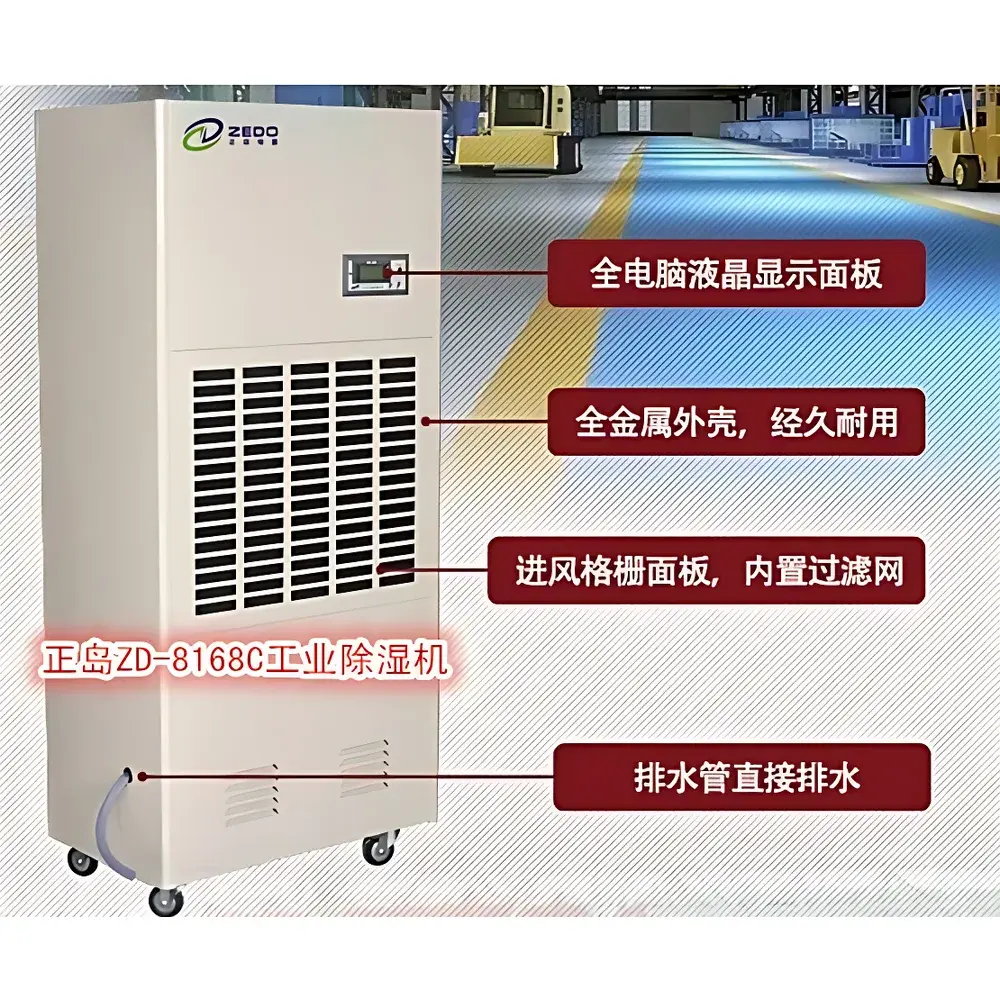
ZEDO ZD-8168C Industrial Desiccant Dehumidifier for Foundry Applications
| Brand | ZEDO |
|---|---|
| Origin | Zhejiang, China |
| Manufacturer Type | Direct Manufacturer |
| Product Category | Industrial Compressor-Based Dehumidifier |
| Model | ZD-8168C |
| Dehumidification Capacity | 168 L/day (7 L/h) |
| Application Area | 130–180 m² |
| Power Supply | 380 V ~ 50 Hz |
| Input Power | 2800 W |
| Noise Level | 52 dB(A) |
| Operating Temperature Range | 5–38 °C |
| Dimensions (W×D×H) | 605 × 410 × 1650 mm |
| Net Weight | 126 kg |
| Control Method | Microprocessor-Based Humidity Setpoint Control |
| Drainage | Continuous via PVC Drain Hose |
| Safety Protections | 3-Minute Compressor Delay, High/Low Pressure Protection, Overload & Undervoltage Protection |
| Filtration | Standard Activated Carbon Filter |
| Sensor | Japanese Shinyo High-Accuracy RH/T Sensor |
| Fan System | Dual-Centrifugal External Rotor Blower with Hydrophilic Aluminum-Fin Heat Exchanger |
| Refrigerant | Eco-Friendly R410A |
| Compressor Type | International Brand Scroll Compressor |
Overview
The ZEDO ZD-8168C Industrial Desiccant Dehumidifier is engineered for precision humidity control in foundry environments where metallurgical integrity and dimensional stability of cast components are critically dependent on ambient moisture management. Unlike passive desiccant systems, this unit employs a mechanical refrigeration cycle—based on the thermodynamic principle of condensation—to actively extract water vapor from process air. When ambient relative humidity exceeds 75% RH, free moisture condenses on cooled metal surfaces, initiating electrochemical corrosion pathways that compromise surface finish, accelerate oxidation of ferrous and non-ferrous alloys, and impair subsequent machining or coating adhesion. The ZD-8168C maintains stable RH levels below 60% across large-volume industrial spaces (130–180 m²), directly supporting ISO 8501-1 surface preparation standards and ASTM D1748 rust prevention protocols for stored castings and machined blanks.
Key Features
- High-capacity refrigeration system featuring an internationally certified scroll compressor and R410A refrigerant—optimized for energy efficiency, low acoustic emission (≤52 dB[A]), and long-term operational reliability under continuous duty cycles.
- Hydrophilic aluminum fin-and-tube heat exchanger with internally grooved copper tubing—maximizing latent heat transfer coefficient and condensate drainage efficiency while minimizing frost formation at operating temperatures between 5–38 °C.
- Dual-centrifugal external rotor blower assembly delivering uniform airflow distribution and enhanced static pressure capability—critical for overcoming duct resistance in integrated HVAC retrofits or open-bay foundry layouts.
- Microprocessor-based controller with embedded Shinyo high-accuracy RH/T sensor (±2% RH, ±0.5 °C)—enabling precise setpoint regulation (30–80% RH adjustable), real-time fault diagnostics, and automatic compressor cycling with 3-minute anti-short-cycle delay.
- Robust structural architecture: modular frame design with segregated refrigeration and airflow modules—facilitating field serviceability, component-level replacement, and compliance with IEC 60204-1 electrical safety requirements.
- Comprehensive protection suite including high/low refrigerant pressure cutoffs, thermal overload relays, undervoltage monitoring, and phase-loss detection—meeting CE and CCC safety certification prerequisites for industrial deployment.
Sample Compatibility & Compliance
The ZD-8168C is validated for use in environments handling ferrous castings (gray iron, ductile iron, steel), non-ferrous alloys (aluminum, magnesium, zinc die-castings), and precision investment-cast components requiring post-mold drying prior to heat treatment or surface finishing. Its performance aligns with key industry benchmarks: it supports storage conditions recommended by ISO 2812-2 for coated metal substrates, satisfies humidity thresholds specified in ASTM B117 salt-spray testing pre-conditioning, and enables adherence to GMP Annex 15 environmental controls for pharmaceutical-grade casting tooling. While not classified as a medical device, its microprocessor logging function—capable of recording RH/T trends over time—provides traceable data suitable for internal quality audits and GLP-aligned documentation.
Software & Data Management
The unit operates without proprietary software dependency; all control logic resides within its embedded microcontroller. However, the RS-485 communication interface (optional add-on) permits integration into building management systems (BMS) or SCADA platforms for centralized monitoring of runtime hours, compressor cycles, and ambient RH deviation alerts. Data retention includes timestamped fault logs (e.g., high-pressure trip, sensor drift warning) with event codes compliant with Modbus RTU protocol conventions. For regulated environments, optional audit-trail firmware enables password-protected parameter modification history—supporting 21 CFR Part 11 readiness when paired with validated third-party data acquisition servers.
Applications
- Ferrous and non-ferrous foundry floor dehumidification—preventing mold cavity condensation during shell molding and core setting stages.
- Casting storage and aging rooms—maintaining ≤60% RH to inhibit flash rust on machined surfaces and preserve dimensional accuracy of precision castings per ISO 2768-mK tolerances.
- Tooling and pattern storage areas—protecting wooden, resin-bonded, or CNC-machined patterns from hygroscopic swelling and warpage.
- Post-cleaning and pre-coating staging zones—ensuring optimal substrate dryness prior to phosphating, e-coating, or thermal spray operations.
- Support of vacuum degassing chambers and inert-gas purged furnaces—reducing residual moisture content in purge gas streams to <100 ppmv.
- Secondary applications include battery electrode drying prep zones (for Li-ion cathode/anode handling), optical component assembly cleanrooms, and archival storage of precision metrology fixtures.
FAQ
What is the minimum recommended operating temperature for continuous operation?
The unit is rated for sustained operation between 5 °C and 38 °C ambient. Below 5 °C, evaporator coil frosting may occur without defrost cycling capability; supplemental heating or hybrid desiccant-assisted configurations are advised for sub-zero foundry winter conditions.
Can this dehumidifier be ducted into an existing HVAC system?
Yes—the unit supports both free-air discharge and positive-pressure duct connection (up to 10 m equivalent length, ≤150 Pa static pressure drop). Static pressure compensation must be verified during commissioning to avoid airflow derating.
Is the activated carbon filter replaceable, and what is its service interval?
The standard filter is user-replaceable every 6–12 months depending on airborne particulate load; MERV-8 equivalent filtration efficiency is maintained across nominal airflow rates.
Does the unit comply with electromagnetic compatibility (EMC) directives for industrial zones?
It meets EN 61000-6-2 (immunity) and EN 61000-6-4 (emissions) Class A limits for industrial environments, with documented test reports available upon request.
How does the ZD-8168C differ from desiccant-type dehumidifiers commonly used in low-RH applications?
This is a compressor-based condensation dehumidifier—not a desiccant adsorption system. It achieves optimal efficiency above 15 °C and 60% RH, whereas desiccant units excel below 10 °C or at RH <30%. Hybrid integration is possible but requires separate control logic.



