
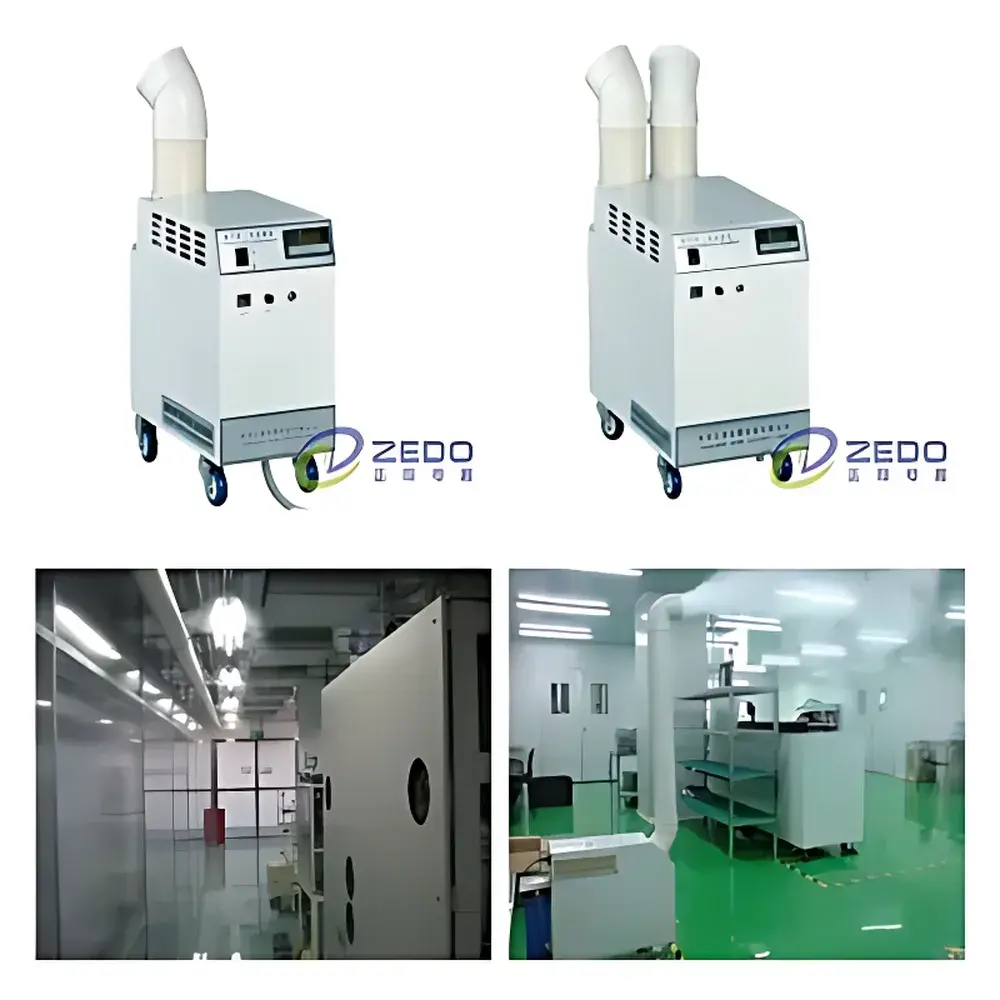
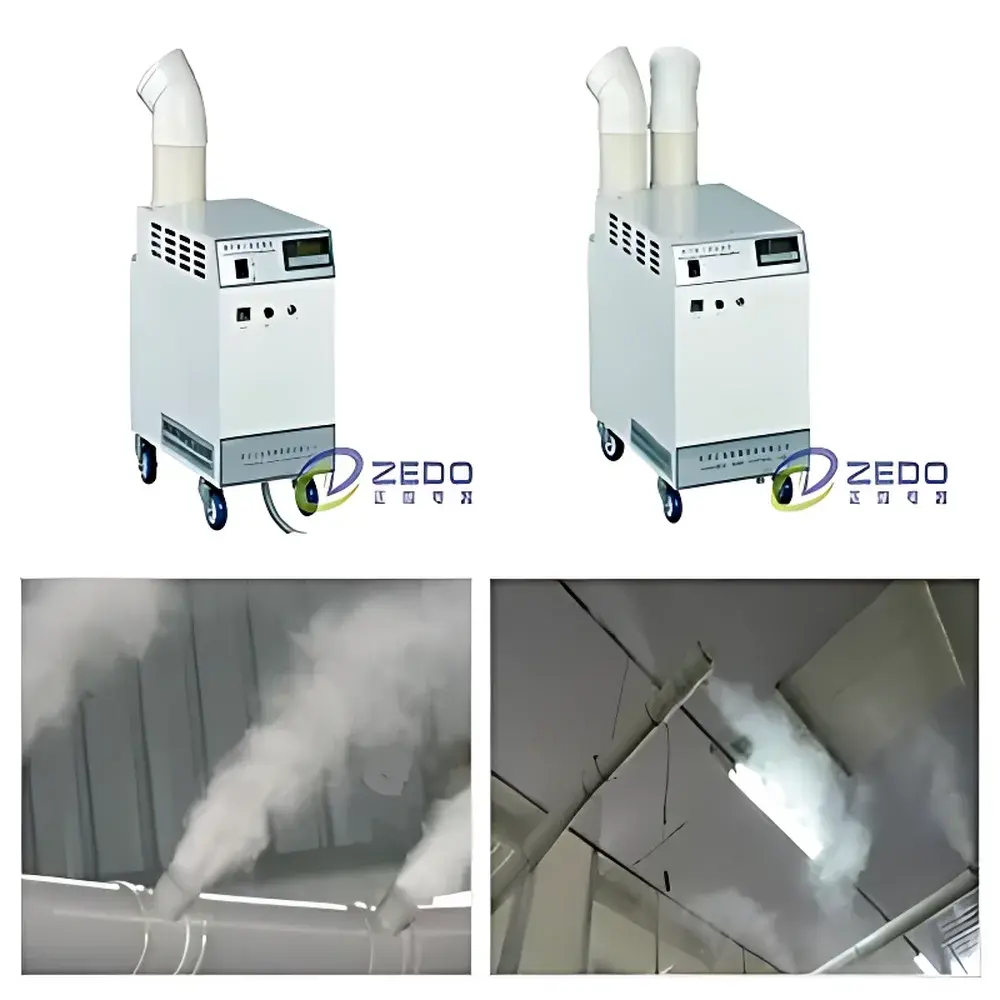
ZEDO ZS-40Z Ultrasonic Industrial Humidifier
| Brand | ZEDO |
|---|---|
| Origin | Zhejiang, China |
| Manufacturer Type | OEM/ODM Manufacturer |
| Country of Origin | China |
| Model | ZS-40Z |
| Humidification Capacity | 12 kg/h |
| Power Consumption | 1200 W |
| 雾化颗粒直径 | ~5 µm |
| Control Mode | Automatic Humidity Control (RH Feedback) |
| Construction | Full Stainless Steel Enclosure (304 SS) |
| IP Rating | IP68 for Power Supply & Fan |
| 雾化片材质 | Alumina Ceramic (Al₂O₃), Acid/Alkali Resistant |
| Sensor | Japanese Shinyo High-Accuracy Capacitive RH Sensor (±2% RH, 10–90% RH range) |
| Safety Features | Auto Water-Level Detection, Overflow Protection, Dry-Run Prevention |
| Mobility | Integrated Swivel Casters with Locks |
| Compliance | CE-marked per EN 60335-1, RoHS 2011/65/EU, ISO 9001:2015 Certified Manufacturing |
Overview
The ZEDO ZS-40Z Ultrasonic Industrial Humidifier is a precision-engineered environmental control system designed for stable, repeatable humidity maintenance in controlled industrial and laboratory settings. It operates on the principle of high-frequency ultrasonic transduction—where piezoelectric ceramic transducers vibrate at >1.7 MHz to atomize deionized or softened water into sub-10 µm droplets without thermal energy input. This cold-mist process ensures minimal energy consumption (1200 W for 12 kg/h output), avoids mineral deposition on sensitive equipment, and eliminates condensation risk in ducted or open-space applications. Unlike steam or evaporative systems, the ZS-40Z delivers rapid, uniform moisture distribution across large-volume environments—critical for electrostatic-sensitive manufacturing (e.g., semiconductor assembly, PCB handling), hygroscopic material storage (textiles, paper, pharmaceutical excipients), and climate-stabilized calibration labs where RH drift directly impacts measurement traceability.
Key Features
- Full 304 stainless steel enclosure and internal tank—resistant to corrosion, microbial growth, and chemical exposure during operation with treated water or low-conductivity additives.
- Integrated ultrasonic atomizing module with alumina ceramic transducers rated for 3,000–5,000 operating hours under continuous duty; field-replaceable without tools.
- IP68-rated sealed variable-frequency power supply and 36 V DC waterproof blower—capable of submerged operation and certified for high-humidity, washdown-prone zones (e.g., cleanroom perimeter corridors).
- Microprocessor-based controller with Shinyo capacitive RH sensor (±2% RH accuracy, 10–90% RH range) enabling closed-loop feedback control within ±3% RH setpoint tolerance.
- Dual-level water management: float-switch-driven auto-fill + redundant ultrasonic water-level detection, plus overflow shutoff and dry-run lockout.
- Modular mounting design—compatible with ceiling suspension, wall bracketing, or floor-standing deployment; optional duct adapter kit available for integration into HVAC air-handling units.
Sample Compatibility & Compliance
The ZS-40Z is validated for use with deionized water (conductivity 120 ppm CaCO₃) without pretreatment, as scale accumulation compromises transducer longevity and aerosol purity. The unit complies with IEC 61000-6-3 (EMC emissions), EN 60335-1 (household and similar electrical appliance safety), and RoHS 2011/65/EU. While not classified as medical or GMP-grade equipment per FDA 21 CFR Part 11, its logging-capable controller supports GLP-aligned operational records when paired with external data acquisition systems.
Software & Data Management
The onboard controller provides real-time RH%, runtime hours, fault codes (e.g., “Low Water”, “Transducer Fault”, “Sensor Drift Alert”), and setpoint history via a backlit LCD interface with tactile membrane keys. Optional RS-485 Modbus RTU output enables integration into SCADA or BMS platforms (e.g., Siemens Desigo, Honeywell Experion) for centralized monitoring, alarm escalation, and audit-trail generation. Firmware updates are performed via USB port; configuration parameters—including hysteresis band, delay timers, and sensor calibration offset—are password-protected to ensure procedural integrity.
Applications
- Electronics manufacturing: Maintaining 40–60% RH in SMT lines to suppress ESD events (>10⁶ Ω surface resistance) and prevent solder paste slump or component warpage.
- Textile and nonwovens processing: Stabilizing fiber tensile strength and weaving efficiency in spinning, knitting, and finishing rooms.
- Pharmaceutical packaging: Preventing static-induced powder segregation in blister-pack filling stations and maintaining capsule brittleness specifications.
- Archival and metrology labs: Preserving dimensional stability of reference standards (e.g., gauge blocks, optical flats) and preventing hygroscopic drift in mass calibration workflows.
- Printing and converting facilities: Eliminating paper curl, ink misting, and registration errors caused by RH fluctuations below 45% RH.
FAQ
What water quality is required for optimal performance and transducer life?
Deionized or reverse-osmosis water (conductivity ≤10 µS/cm) is mandatory. Tap water usage requires inline softening (≤17 ppm hardness) and particulate filtration (≤5 µm). Failure to meet these specifications voids the 12-month transducer warranty.
Can the ZS-40Z be integrated into an existing building automation system?
Yes—via standard RS-485 Modbus RTU communication. Configuration files and register maps are provided in the technical manual; no proprietary software license is required.
Is the unit suitable for Class C or higher cleanrooms?
It meets ISO 14644-1 Class 8 (100,000) particle emission limits when operated with filtered water and installed with HEPA-grade mist dispersion nozzles (optional accessory). Not certified for ISO Class 5 or tighter environments without third-party aerosol testing.
How often does the ceramic transducer require replacement?
Under continuous operation with compliant water, expected service life is 3,000–5,000 hours. Visual inspection every 500 hours is recommended; reduced mist output or audible frequency shift indicates end-of-life.
Does the controller support data logging for regulatory audits?
Local display logs only last 72 hours of operational history. For long-term compliance (e.g., FDA 21 CFR Part 11, EU Annex 11), external Modbus-scraping software or PLC-based historian integration is required.



