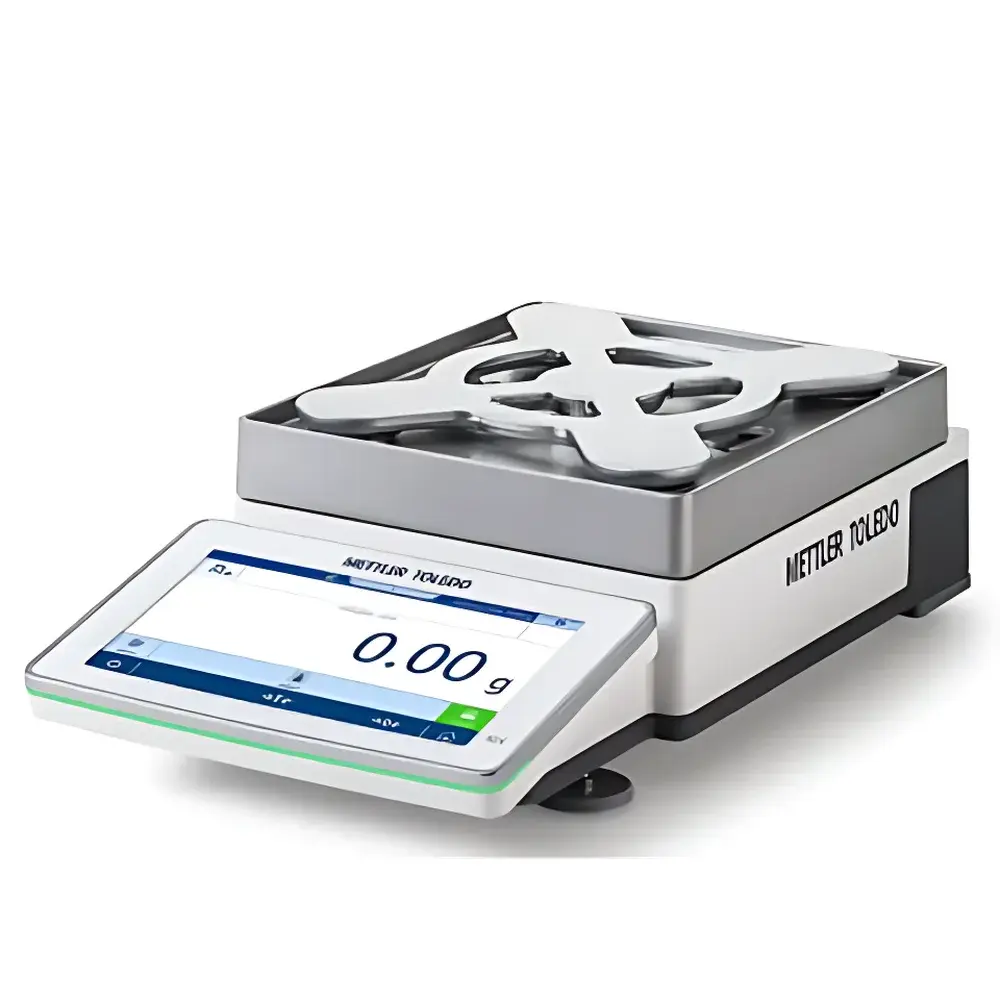
METTLER TOLEDO MX1203N Precision Balance
| Brand | METTLER TOLEDO |
|---|---|
| Origin | Shanghai, China |
| Model | MX1203N Precision Balance |
| Maximum Capacity | 32 kg |
| Readability | 1 mg |
| Protection Class | IP54 |
| Compliance | GxP-ready, FDA 21 CFR Part 11 compatible (with optional software), GLP/GMP audit trail capable |
Overview
The METTLER TOLEDO MX1203N Precision Balance is an industrial-grade analytical and semi-micro weighing instrument engineered for laboratories and production environments requiring high repeatability, traceable accuracy, and regulatory compliance. Utilizing electromagnetic force compensation (EMFC) technology, the MX1203N delivers stable, drift-free measurements with a readability of 1 mg across its full 32 kg capacity range. Its core transducer architecture—designed and calibrated in accordance with ISO/IEC 17025 metrological principles—ensures long-term stability under variable ambient conditions, including minor air currents or floor vibrations. The balance integrates seamlessly into quality-critical workflows where documentation integrity, user accountability, and process consistency are mandated by internal SOPs or external regulatory frameworks such as ISO 9001, ISO 13485, and pharmaceutical GMP.
Key Features
- SmartPan™ anti-vibration weighing pan: A patented dual-chamber damping system that reduces settling time by up to 50% in non-ideal lab environments—enabling rapid stabilization even on shared workbenches or near HVAC vents.
- ProActive Calibration & Maintenance Manager: Configurable internal test schedule based on usage frequency, environmental risk assessment, and process tolerance thresholds; automatic alerts trigger before calibration or performance verification deadlines expire.
- StatusLight™ visual status indicator: A three-color LED ring providing at-a-glance confirmation of operational readiness (green), pending action (amber), or error condition (red)—reducing operator dependency on display interpretation.
- Energy-Saving Mode with Adaptive Wake-Up: Automatically enters low-power state after programmable idle duration; resumes full functionality within 70% versus conventional designs.
- IP54-rated enclosure: Dust-protected housing with splash-resistant front panel and sealed key membrane—validated per IEC 60529 for operation in humid or particulate-prone manufacturing and QC labs.
Sample Compatibility & Compliance
The MX1203N accommodates a wide range of sample forms—including powders, granules, liquids in tared containers, and irregular solid components—via its large 220 mm × 220 mm stainless-steel pan and optional draft shield compatibility (sold separately). It supports routine verification using standard weights traceable to NIST, BIPM, or national metrology institutes. All internal diagnostics—including linearity, eccentricity, repeatability, and sensitivity tests—are executable directly from the touchscreen interface and logged with timestamp, operator ID, and result pass/fail status. Data export formats include CSV, XML, and PDF—structured to support ALCOA+ data integrity principles (Attributable, Legible, Contemporaneous, Original, Accurate, Complete, Consistent, Enduring, Available).
Software & Data Management
The MX1203N operates natively with METTLER TOLEDO’s LabX® software platform (optional license required), enabling centralized method management, electronic signature enforcement, and full 21 CFR Part 11 compliance—including role-based access control, audit trail generation, and secure data archiving. Local data storage retains ≥10,000 weighing records with metadata (date/time, user, method, environment log). USB host port supports direct printing to thermal or dot-matrix printers; Ethernet and RS232 interfaces enable integration with LIMS, MES, or ERP systems via standardized protocols (e.g., TCP/IP, Modbus RTU). All firmware updates are digitally signed and validated prior to installation.
Applications
- Pharmaceutical formulation: Precise active pharmaceutical ingredient (API) dispensing and blend uniformity testing per USP <905>.
- Chemical R&D: Stoichiometric reagent preparation and reaction mass balancing.
- Food & beverage QA: Net weight verification, moisture loss tracking, and raw material receipt inspection.
- Materials science: Density determination of metal alloys, polymer pellets, and composite preforms.
- Environmental testing labs: Sample preparation for ICP-MS, GC-MS, and gravimetric analysis of filter residues (e.g., EPA Method 1631).
FAQ
What is the recommended recalibration interval for the MX1203N in a regulated environment?
Recalibration frequency must be determined through a documented risk-based assessment aligned with your quality system—typically ranging from daily zero checks to quarterly full calibration, depending on usage intensity and criticality of measurement outcomes.
Does the MX1203N support direct connection to a laboratory information management system (LIMS)?
Yes—via Ethernet or RS232 using ASCII or custom protocol mapping; LabX software provides certified LIMS connectors for major vendors including Thermo Fisher SampleManager, LabWare LIMS, and Agilent OpenLab.
Can the balance operate without LabX software while maintaining GxP compliance?
Basic GxP functions—including user login, audit trail logging, and password-protected settings—are embedded in the instrument firmware; however, electronic signatures and advanced reporting require LabX or third-party compliant middleware.
Is the MX1203N suitable for use in cleanroom environments classified ISO 5 or higher?
While the IP54 rating permits operation in ISO 8 environments, cleanroom deployment requires additional validation of static charge dissipation, surface smoothness, and material compatibility—consult METTLER TOLEDO’s Cleanroom Suitability Report (CSR-024) prior to installation.
How does SmartPan improve measurement robustness compared to conventional pans?
SmartPan utilizes asymmetric mass distribution and tuned mechanical resonance damping to suppress transient oscillations induced by air turbulence or mechanical shock—reducing standard deviation in repeated weighings by up to 35% under ISO 17025-relevant test conditions.