
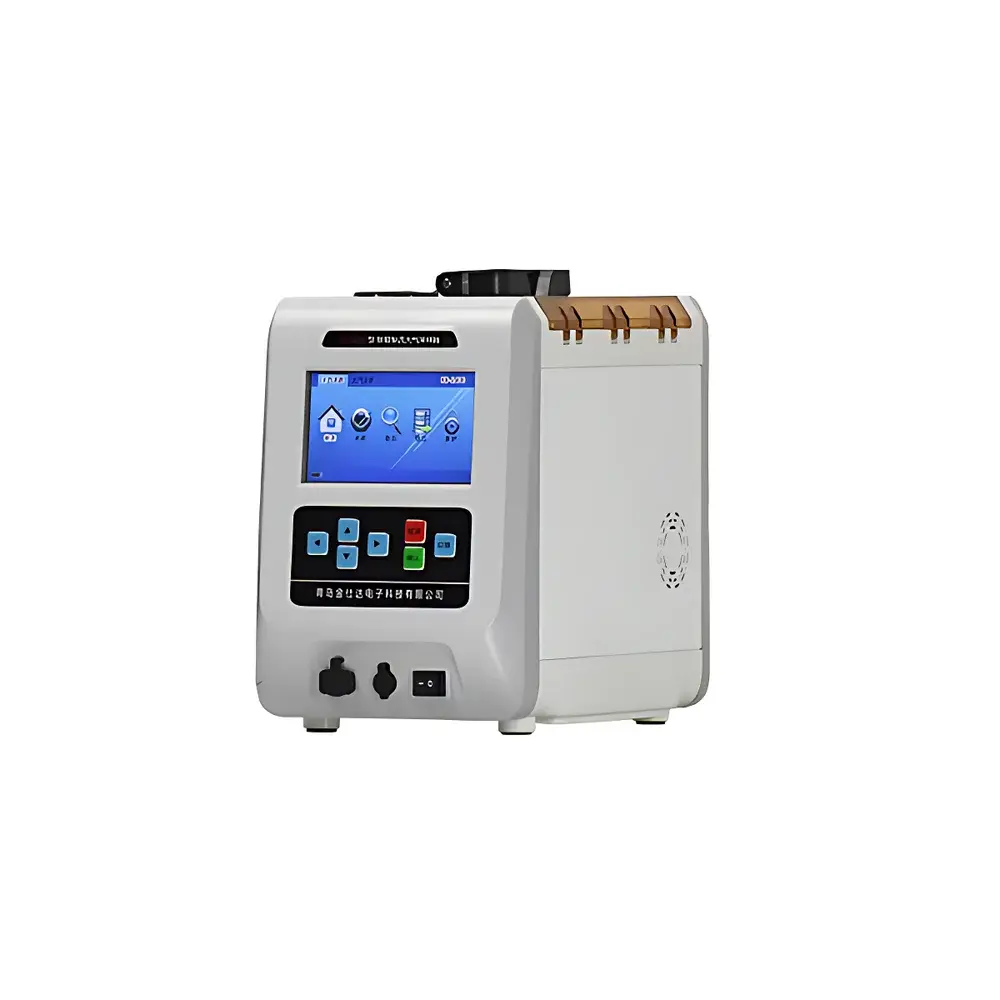
Genetec KB-2400(A) Dual-Channel Constant-Temperature Constant-Flow Automatic Continuous Air Sampler
| Brand | Genetec |
|---|---|
| Model | KB-2400(A) |
| Origin | Shandong, China |
| Manufacturer Type | Manufacturer |
| Instrument Type | 24-Hour Constant-Temperature Constant-Flow Gas Sampler |
| Configuration | Dual-Channel Sampling System |
| Flow Range | Dual independent channels, each 0.001–1.000 L/min |
| Maximum Vacuum Pressure | 50–130 kPa |
| Flow Stability | ≤ ±2.0% |
| Flowmeter Accuracy | ≤ ±2.0% |
| Service Life under Max Flow & Backpressure | ≤ 5,000 hours |
| Programmable Sampling Duration | Up to 99 h 59 min per channel |
| Compliance | HJ 479–2009, HJ 482–2009, JJG 956–2013, HJ/T 376–2007 |
Overview
The Genetec KB-2400(A) is a dual-channel, constant-temperature constant-flow automatic continuous air sampler engineered for regulatory-grade ambient and indoor air monitoring. It operates on the principle of solution absorption sampling—drawing gaseous pollutants (e.g., NOx, SO2) through absorbent solutions at precisely controlled temperature and volumetric flow conditions. Unlike conventional samplers with external cooling lines or passive thermal management, the KB-2400(A) integrates a thermoelectric (Peltier) cooling module and long-life resistive heating film within a fully enclosed, single-unit housing. This architecture eliminates condensation-induced ice formation in sampling lines—a critical failure mode during low-temperature field deployments—and ensures uninterrupted operation across seasonal extremes (–20 °C to +40 °C ambient). Its design conforms to the metrological and functional requirements specified in HJ/T 376–2007 for 24-hour automated environmental air samplers, supporting trace-level quantification in compliance with HJ 479–2009 (NOx) and HJ 482–2009 (SO2).
Key Features
- Dual independent sampling channels, each equipped with high-stability digital mass flow sensors and real-time closed-loop flow control;
- Integrated constant-temperature chamber (15–30 °C adjustable, ±0.5 °C stability) with brown-tinted transparent lid for UV-shielded secondary light protection—critical for photolabile analytes;
- Brushless DC sampling pump delivering ≥130 kPa vacuum pressure and maintaining ≤±2.0% flow deviation under variable backpressure (up to 10 kPa resistance);
- Onboard environmental parameter measurement: ambient temperature, atmospheric pressure, inlet temperature, and inlet pressure—automatically correcting sampled volume to standard conditions (273.15 K, 101.325 kPa);
- Intelligent fault recovery: if target flow is not achieved within user-defined timeout (e.g., due to filter clogging or tubing obstruction), the system enters protective standby and logs the event;
- Full-parameter in-field calibration via password-protected keyboard interface, with role-based access control (operator vs. technician levels) aligned with GLP audit requirements;
- Large-capacity non-volatile memory storing >10,000 timestamped sampling records, including flow profiles, temperature/pressure traces, and error flags;
- Ergonomic front-panel arc design, compact footprint (≤380 × 280 × 220 mm), and lightweight aluminum chassis (<6.5 kg) optimized for mobile lab and rooftop station deployment.
Sample Compatibility & Compliance
The KB-2400(A) is validated for solution-phase collection of water-soluble inorganic gases—including nitrogen oxides (NO, NO2), sulfur dioxide (SO2), hydrogen sulfide (H2S), and ammonia (NH3)—using impingers, bubblers, or coated denuders. Its dual-channel architecture supports parallel sampling for method validation, blank subtraction, or multi-analyte workflows. All internal wetted surfaces are chemically inert (PTFE-lined tubing, borosilicate glass impingers), minimizing adsorption artifacts. The instrument meets mandatory verification criteria in JJG 956–2013 (Verification Regulation for Atmospheric Samplers) and satisfies data integrity prerequisites for regulatory submissions under China’s Ministry of Ecology and Environment (MEE) guidelines. While not certified to ISO/IEC 17025, its metrological traceability path—via factory-calibrated flow sensors and NIST-traceable pressure/temperature transducers—supports laboratory-developed method validation per ISO 5725 and US EPA Compendium Method TO-11A.
Software & Data Management
Data acquisition and configuration are managed entirely via the onboard embedded system with a high-contrast wide-temperature LCD (–20 °C to +60 °C operating range) and intuitive Chinese/English bilingual menu navigation. Sample metadata—including start/stop time, cumulative standard-volume, real-time flow deviation, and thermal chamber status—is automatically logged with millisecond timestamp resolution. Export options include direct thermal printing (via integrated mini-printer) or USB mass-storage mode for U-disk transfer. Raw data files follow ASCII-delimited format (.csv), compatible with LIMS integration and post-processing in MATLAB, Python (pandas), or EPA-approved QA/QC tools such as ProUCL. Audit trails record all parameter changes, calibrations, and error events with operator ID and timestamp—supporting 21 CFR Part 11–aligned electronic record retention when paired with institutional signature policies.
Applications
- Ambient air quality monitoring networks (AQMN) conducting routine NOx/SO2 compliance measurements per national ambient air quality standards;
- Indoor air quality (IAQ) assessments in schools, hospitals, and office buildings under GB/T 18883–2022;
- Method development and inter-laboratory comparison studies requiring high inter-channel reproducibility (CV <3% across 24-h runs);
- Mobile source emission plume characterization using trailer-mounted or vehicle-integrated configurations;
- Research on gas-phase reaction kinetics where precise residence time and temperature control are essential;
- Emergency response screening during chemical spills or industrial accidents involving volatile acidic or reducing gases.
FAQ
What is the minimum detectable flow rate per channel, and how is low-flow stability ensured?
The KB-2400(A) achieves stable operation down to 0.001 L/min using differential-pressure-based digital flow sensors with active thermal compensation—enabling accurate collection of ultra-low-concentration analytes over extended durations.
Can the instrument operate unattended for 99+ hours while maintaining temperature and flow accuracy?
Yes. With external AC power or optional high-capacity LiFePO4 battery pack (not included), the unit sustains ±0.5 °C chamber temperature and ≤±2.0% flow accuracy continuously for up to 99 h 59 min, with auto-restart capability after brief power interruption.
How does the integrated thermal chamber prevent ice formation without external refrigerant lines?
The sealed semiconductor cooling module and uniform-heating film eliminate thermal gradients along the sample path; no external tubing means no surface for frost nucleation—even at –15 °C ambient and 85% RH.
Is firmware upgrade supported in the field, and what documentation accompanies calibration?
Firmware updates are performed via USB; each unit ships with a factory calibration certificate listing sensor serial numbers, as-found/as-left values, and uncertainty budgets per JJG 956–2013 Annex B.
Does the device support remote monitoring or network connectivity?
The base model lacks Ethernet or cellular modules; however, RS-232 output enables integration with SCADA systems or third-party data loggers using Modbus RTU protocol (custom configuration required).







