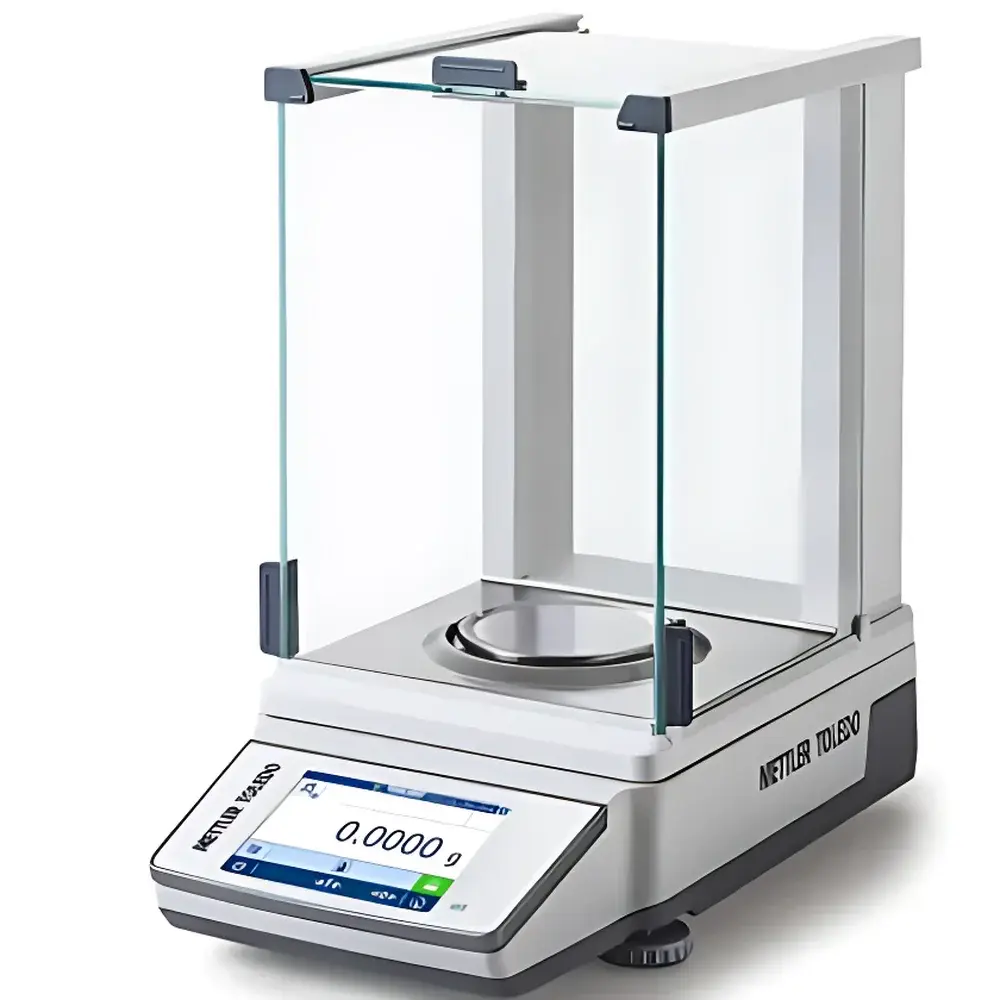
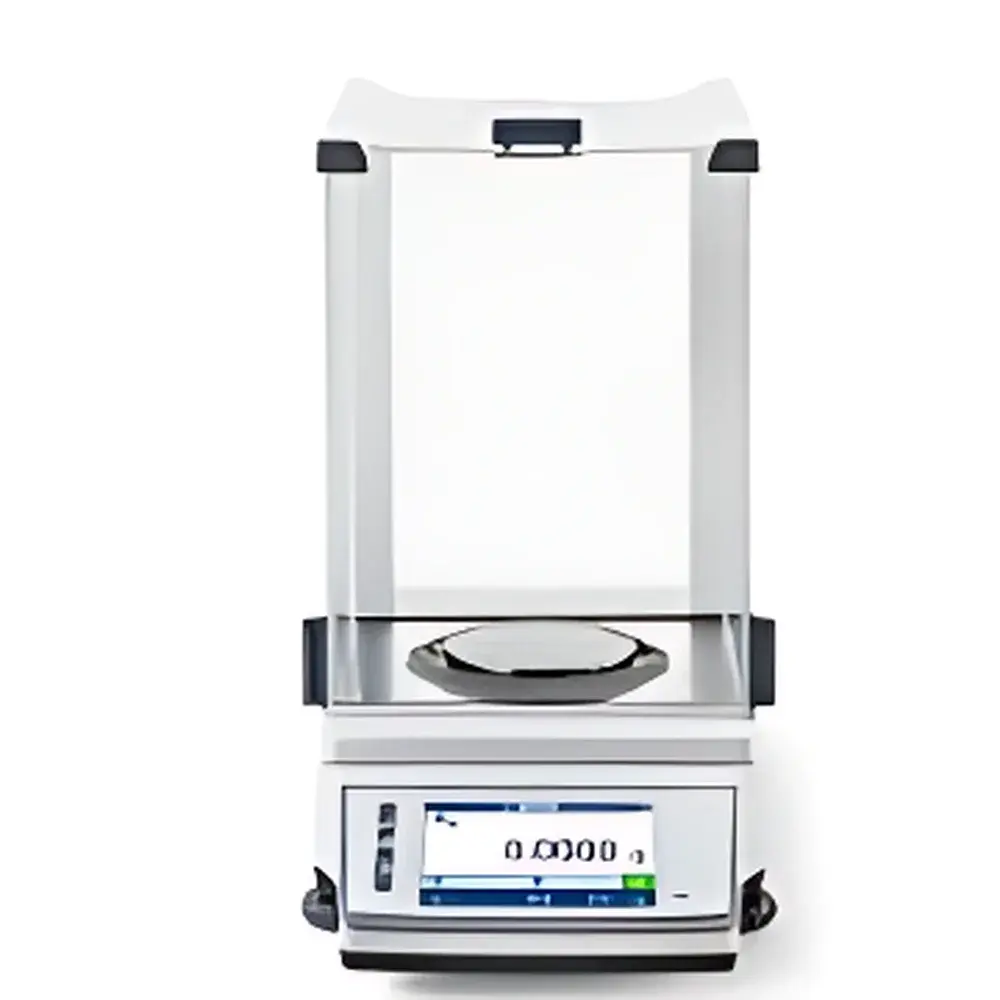
METTLER TOLEDO MR204 Analytical Balance
| Brand | METTLER TOLEDO |
|---|---|
| Origin | Germany |
| Model | MR204 Analytical Balance |
| Maximum Capacity | 220 g |
| Readability | 0.1 mg |
| Repeatability (sd) | ≤ 0.1 mg |
| Calibration | Internal automatic calibration with FACT (Fully Automatic Calibration Technology) |
| Weighing Pan Size | 90 mm diameter |
| Environmental Protection | IP54-rated housing |
| Interface Options | RS232, USB, Ethernet, optional Bluetooth |
| Software Compliance | MT-SICS v2.0, supports FDA 21 CFR Part 11 audit trail and user access control |
Overview
The METTLER TOLEDO MR204 Analytical Balance is a high-precision mass measurement instrument engineered for reproducible, traceable weighing in regulated and non-regulated laboratory and industrial environments. Based on electromagnetic force compensation (EMFC) technology, the MR204 delivers stable, drift-free measurements with 0.1 mg readability across its 220 g capacity range. Its robust monolithic metal housing—tested under ISO 17025-compliant environmental stress protocols—ensures mechanical stability against vibration, thermal gradients, and air currents. Designed for continuous operation in demanding settings—including QC labs, production floors, and GLP-compliant R&D facilities—the balance integrates seamlessly into automated workflows while maintaining full metrological integrity under variable ambient conditions.
Key Features
- FACT (Fully Automatic Calibration Technology) with internal motor-driven calibration weights: enables temperature-triggered and time-scheduled recalibration without manual intervention, ensuring long-term accuracy compliance per ISO 9001 and ISO/IEC 17025.
- Guided leveling system with integrated bubble level and real-time tilt feedback: eliminates setup errors and reduces commissioning time by >60% compared to traditional manual leveling procedures.
- IP54-rated enclosure with sealed electronics and corrosion-resistant stainless-steel pan: provides protection against dust ingress and accidental splashes of common solvents (e.g., ethanol, acetone, diluted acids).
- Overload protection mechanism: safeguards the precision load cell from mechanical shock up to 5× rated capacity; includes audible and visual overload alerts with immediate sensor disengagement.
- QuickLock draft shield: tool-free removal in <3 seconds; all transparent acrylic components are dishwasher-safe (top-rack cycle, max 65°C), supporting rapid turnaround between GMP batch weighings.
- Modular connectivity architecture: native support for RS232, USB Device/Host, Ethernet (TCP/IP), and optional Bluetooth 5.0—enabling direct integration with LIMS, MES, PLCs, and electronic notebooks via standard MT-SICS v2.0 command protocol.
Sample Compatibility & Compliance
The MR204 accommodates standard analytical sample containers—including weighing boats, vials, crucibles, and filter papers—within its 90 mm diameter weighing pan. Its low-profile pan geometry minimizes air turbulence effects during micro-weighing of hygroscopic or volatile substances. The balance meets international regulatory requirements for analytical instrumentation: it supports ALCOA+ data integrity principles, generates electronic records with embedded timestamps and operator IDs, and maintains full audit trail functionality compliant with FDA 21 CFR Part 11, EU Annex 11, and WHO TRS 996. All firmware and calibration certificates are traceable to national metrology institutes (e.g., PTB, NIST) through METTLER TOLEDO’s certified calibration chain.
Software & Data Management
MT-SICS (METTLER TOLEDO Standard Interface Command Set) v2.0 provides deterministic ASCII-based communication for bidirectional data exchange with host systems. The MR204 supports configurable user roles (Administrator, Supervisor, Operator) with granular permission sets—restricting access to calibration functions, method editing, or report generation based on GxP-defined responsibilities. Built-in data logging stores ≥10,000 weighing events with metadata (date/time, user ID, application mode, environmental status). Export formats include CSV, XML, and PDF (with digital signature option). Optional LabX® Lite software enables remote monitoring, statistical process control (SPC) charting, and automated SOP enforcement across multi-balance networks.
Applications
- Pharmaceutical formulation: active pharmaceutical ingredient (API) dispensing, excipient ratio verification, and blend uniformity testing per USP <905>.
- Chemical synthesis: stoichiometric reagent weighing, catalyst dosing, and reaction yield quantification under inert atmosphere gloveboxes.
- Materials science: powder density determination (tap/untapped), coating thickness validation via mass-thickness correlation, and nanoparticle suspension concentration calibration.
- Food & beverage QA: nutritional labeling compliance (FDA 21 CFR 101), moisture content analysis (ASTM D445), and allergen cross-contamination screening.
- Environmental testing: filter weighing for PM2.5/PM10 gravimetric analysis (EPA Method IO-4.3), and soil organic carbon quantification per ISO 14235.
FAQ
What is the recommended calibration frequency for the MR204 in a GLP environment?
Calibration should follow a risk-based schedule aligned with usage intensity, environmental stability, and regulatory expectations—typically daily zero-checks, weekly internal calibration, and annual external verification by an ISO/IEC 17025-accredited provider.
Can the MR204 be integrated into a Siemens S7 PLC system?
Yes, via RS232 or Ethernet using MT-SICS commands; preconfigured function blocks are available in TIA Portal for seamless data acquisition and status monitoring.
Does the balance support weight recording under dynamic conditions (e.g., vibrating tables)?
The MR204 includes adjustable damping algorithms and anti-vibration filtering modes optimized for installations on non-isolated surfaces; performance validation per ISO 14413 is recommended prior to deployment.
Is the QuickLock draft shield compatible with Class A volumetric glassware handling?
Yes—the shield’s removable base plate allows unobstructed access to the pan while maintaining ISO 17025-compliant airflow control; maximum clearance height is 210 mm.
How is user authentication enforced when multiple operators share one MR204 unit?
Each login requires unique PIN or RFID card authentication; session-specific activity logs capture all critical actions—including tare, print, and calibration—with immutable timestamps and role-based visibility constraints.