
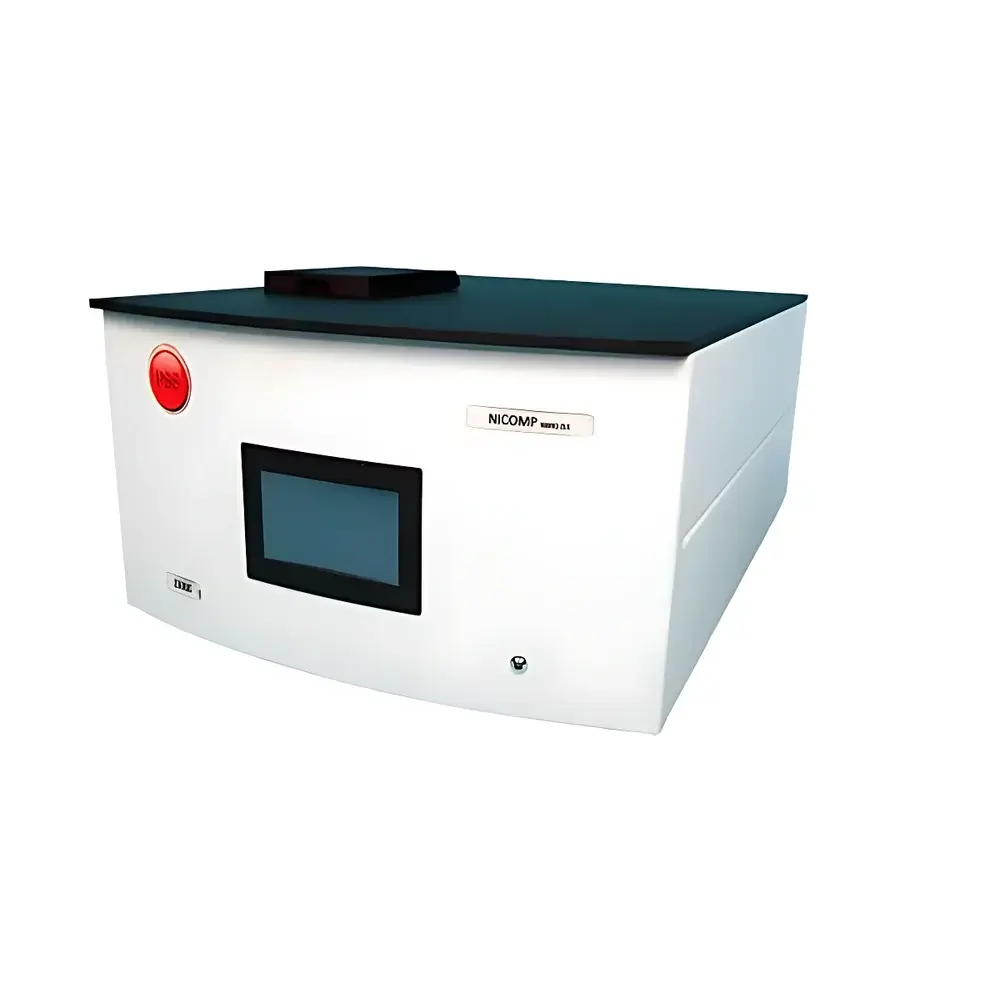
PSS Nicomp ZLS Laser Light Scattering Analyzer
| Brand | Particle Sizing Systems (PSS), USA |
|---|---|
| Origin | USA |
| Model | Nicomp ZLS |
| Zeta Potential Range | ±500 mV |
| pH Range | 1–14 |
| Temperature Range | 0–90 °C |
| pH Resolution | 0.1 |
| Temperature Resolution | 0.1 °C |
| Accuracy | 99% |
| Repeatability | 99% |
Overview
The PSS Nicomp ZLS Laser Light Scattering Analyzer is a dual-mode, research-grade instrument engineered for simultaneous and independent measurement of particle size distribution (PSD) and zeta potential in colloidal and macromolecular systems. It integrates two complementary optical techniques: Dynamic Light Scattering (DLS) for hydrodynamic diameter determination (0.3 nm – 10 µm), and Laser Doppler Electrophoresis (LDE) for electrophoretic mobility and surface charge quantification. Unlike conventional single-angle DLS systems, the Nicomp ZLS employs a modular multi-angle detection architecture (10°–175°, 0.7° step resolution) to resolve complex, polydisperse samples with high fidelity—particularly critical for biologics, nanomedicines, CMP slurries, and polymer dispersions where sample heterogeneity is intrinsic. Its core analytical engine combines classical Gaussian distribution modeling with the proprietary Nicomp multimodal algorithm, enabling deconvolution of overlapping populations without prior assumptions—a capability validated against certified reference materials and peer-reviewed biological standards (e.g., HDL/LDL/VLDL lipoprotein fractions). The system operates under strict thermal control (±0.1 °C stability across 0–90 °C), ensuring compliance with ISO 22412 and ASTM E2490 for reproducible DLS measurements.
Key Features
- APD-LDC (Avalanche Photodiode–Low-Noise Detection Circuit) detector delivering 7–10× higher signal-to-noise ratio than standard PMTs—essential for low-concentration proteins, surfactant micelles, and sub-5 nm nanoparticles.
- Multi-angle scattering detection (10°–175°) with motorized precision goniometer; eliminates angular bias in large-particle (>100 nm) analysis and improves resolution of broad or bimodal distributions.
- Modular high-power laser options: 35–100 mW at 635 nm (red) or 514.4 nm (green), optimized for low-scattering samples (e.g., dextrans, silica, low-refractive-index polymers).
- Integrated temperature-controlled cuvette holder with active condensation suppression—enables stable operation from 0 °C to 90 °C without dew formation on optical windows.
- Automated dilution module capable of handling initial concentrations up to 40% w/v, reducing manual error and improving inter-operator reproducibility (<1% RSD).
- Compliant with FDA 21 CFR Part 11 requirements via audit-trail-enabled software, electronic signatures, and role-based access control.
Sample Compatibility & Compliance
The Nicomp ZLS accommodates aqueous and organic solvents—including water, ethanol, THF, chloroform, and DMF—using interchangeable quartz or high-transmission plastic cuvettes (1 mL and 4 mL formats). It supports microvolume analysis down to 10 µL using precision glass capillaries. All measurements adhere to internationally recognized standards: ISO 22412 (DLS), ISO 13099 (zeta potential), USP <729> (submicron emulsions), and EP 2.9.33 (nanoparticle characterization). For regulated environments, the system includes IQ/OQ documentation packages and supports GLP/GMP workflows through configurable reporting templates, raw data archiving, and full metadata capture (pH, temperature, viscosity, refractive index, solvent dielectric constant).
Software & Data Management
The Nicomp Analysis Software v4.x provides dual-mode operation: Gaussian monomodal fitting for routine QC and the Nicomp multimodal algorithm for advanced R&D. The latter performs iterative baseline correction and non-negative least-squares deconvolution to resolve peaks differing in size by as little as 1:2 intensity ratio—demonstrated with 93 nm/150 nm polystyrene standards. Data export supports CSV, PDF, XML, and .ncl binary formats. All processing parameters—including correlation time windowing, regularization strength, and scattering angle weighting—are fully user-definable and logged. The software maintains complete electronic records compliant with 21 CFR Part 11, including operator logins, parameter changes, and result approvals—with immutable timestamps and digital signature integration.
Applications
The Nicomp ZLS serves critical roles across pharmaceutical development (nanocarrier sizing and stability profiling per ICH Q5C), semiconductor manufacturing (CMP slurry particle uniformity and agglomeration monitoring), biomaterials research (liposome, exosome, and protein aggregate characterization), and industrial quality control (paint pigment dispersion, inkjet ink stability, cosmetic emulsion homogeneity). Its ability to quantify both size and surface charge under identical experimental conditions enables direct correlation between colloidal stability (via DLVO theory) and formulation performance—supporting rational design of injectables, topical suspensions, and functional nanocomposites.
FAQ
Does the Nicomp ZLS require calibration with traceable standards?
No. The system is factory-calibrated using NIST-traceable polystyrene latex standards and requires no routine recalibration. Instrument performance verification is conducted via daily automated alignment checks and reference material runs.
Can it measure zeta potential in high-ionic-strength buffers?
Yes. The integrated electrophoretic cell uses patented electrode geometry and pulse-field inversion to minimize electrode polarization effects, enabling reliable measurements in buffers up to 1 M NaCl.
Is the multimodal algorithm validated for regulatory submissions?
Yes. The Nicomp distribution model has been cited in >120 peer-reviewed publications and is accepted by major regulatory agencies for nanoparticle characterization dossiers, including FDA IND/BLA filings and EMA scientific advice responses.
What sample volume is required for zeta potential measurement?
Minimum volume is 1 mL for standard cells; optional micro-electrophoretic cells support volumes as low as 300 µL.
How does temperature control impact DLS accuracy?
Precise thermal regulation (±0.1 °C) is mandatory for accurate Stokes-Einstein radius calculation, as diffusion coefficient (D) varies exponentially with temperature and solvent viscosity—both rigorously modeled in real time by the software.



