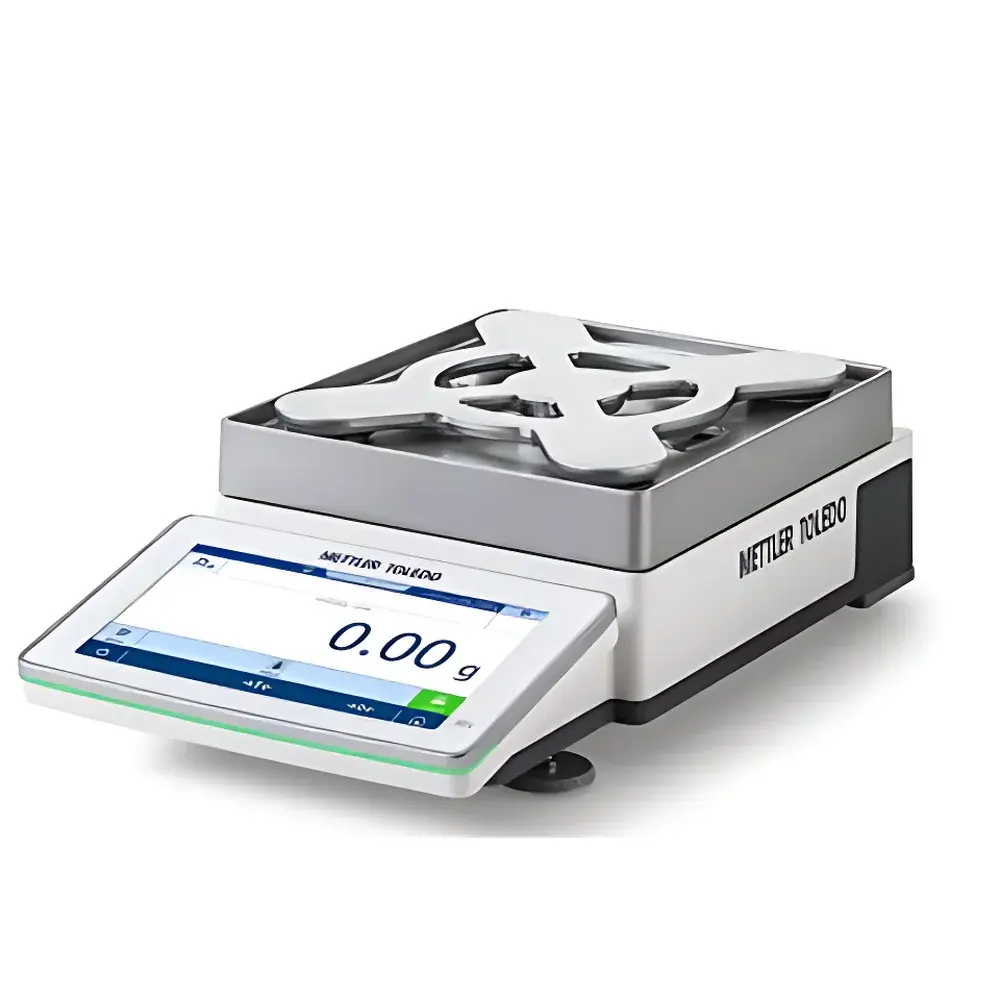
METTLER TOLEDO MX1203 Precision Balance
| Brand | METTLER TOLEDO |
|---|---|
| Origin | Shanghai, China |
| Model | MX1203 Precision Balance |
| Max Capacity | 32 kg |
| Readability | 1 mg |
| IP Rating | IP54 |
| Compliance | GxP-ready, FDA 21 CFR Part 11 compatible (with optional software), GLP/GMP audit trail support |
Overview
The METTLER TOLEDO MX1203 Precision Balance is an industrial-grade analytical and semi-micro weighing instrument engineered for laboratories and production environments requiring high repeatability, traceable accuracy, and regulatory compliance. Utilizing a high-stability electromagnetic force compensation (EMFC) sensor architecture, the MX1203 delivers consistent 1 mg readability across its full 32 kg capacity range—optimized for applications demanding both broad dynamic range and fine resolution, such as formulation batching, raw material verification, and quality control release testing. Its core design integrates metrological integrity with operational robustness: the balance conforms to OIML R76-1 (2021) and ISO/IEC 17025:2017 requirements for calibration traceability, while its internal self-diagnostic routines continuously monitor sensor linearity, temperature drift, and mechanical stability. Unlike entry-level platforms, the MX1203 employs a dual-compensation system—combining real-time thermal drift correction and active vibration damping via SmartPan™—to maintain measurement integrity in non-ideal lab conditions, including proximity to HVAC vents or shared benchtops.
Key Features
- SmartPan™ weighing pan technology: Reduces settling time by up to 40% in low-frequency ambient vibrations (e.g., footfall, nearby centrifuges) through adaptive mass compensation and optimized resonance damping.
- Integrated StatusLight™ indicator: A three-color LED ring provides at-a-glance verification of operational readiness (green), calibration due (amber), or error condition (red), minimizing operator interpretation errors.
- Configurable energy management: Programmable auto-sleep mode reduces standby power consumption to <1.5 W; wake-on-weigh activation ensures immediate responsiveness without manual reactivation.
- Internal daily verification protocol: User-defined test schedules trigger automated internal weight checks against factory-certified reference masses; overdue tests generate auditable alerts logged in the internal event history.
- IP54-rated enclosure: Dust-protected housing with splash-resistant front panel meets ISO 14644-1 Class 8 cleanroom compatibility standards for controlled manufacturing environments.
Sample Compatibility & Compliance
The MX1203 accommodates diverse sample forms—including powders, granules, liquids in tared containers, and irregularly shaped solids—via its 220 mm diameter stainless-steel pan and optional draft shield (sold separately). It supports direct connection to METTLER TOLEDO’s LabX® software for full 21 CFR Part 11 compliance, including electronic signatures, role-based access control, and immutable audit trails. All calibration and verification events are timestamped, user-identified, and exportable in CSV or PDF format. The balance complies with ISO 9001:2015 clause 7.1.5 (monitoring and measuring resources) and supports GMP Annex 11 validation documentation packages. Routine calibration intervals align with ASTM E898-22 guidance for precision balances used in pharmaceutical QC workflows.
Software & Data Management
Data capture is natively supported via RS232, USB device, and Ethernet interfaces. When paired with LabX®, the MX1203 enables centralized method deployment, real-time data streaming to LIMS or ERP systems, and automated report generation compliant with ALCOA+ principles (Attributable, Legible, Contemporaneous, Original, Accurate, Complete, Consistent, Enduring, Available). All weighing events—including tare, net, gross, and statistical batch summaries—are stored locally with SHA-256 hashing for data integrity verification. Optional barcode scanner integration allows sample ID auto-population, eliminating manual transcription errors during high-throughput operations.
Applications
- Pharmaceutical: Active pharmaceutical ingredient (API) dispensing, excipient blending verification, and stability study sample preparation per ICH Q5C guidelines.
- Chemical manufacturing: Catalyst dosage control, polymer batch consistency checks, and hazardous material handling under OSHA 1910.1200 compliance.
- Food & beverage: Nutritional labeling compliance (FDA 21 CFR 101.9), allergen cross-contamination monitoring, and HACCP critical control point documentation.
- Academic research: Gravimetric analysis in materials science labs, catalyst synthesis yield quantification, and standard solution preparation for ICP-MS calibration.
FAQ
What is the recommended calibration frequency for the MX1203 in a GMP environment?
Calibration should be performed before first use, after relocation, following any impact or environmental shift, and at intervals defined by risk-based assessment—typically daily verification with internal weights and external calibration every 3–6 months using NIST-traceable standards.
Does the MX1203 support direct printing to thermal label printers?
Yes, via RS232 or USB printer emulation mode; compatible with Zebra ZD420, SATO CL4NX, and Brady BMP51 label printers for GHS-compliant container labeling.
Can multiple users be assigned distinct permission levels?
Yes—when connected to LabX®, administrators can assign roles (e.g., Operator, Supervisor, QA Reviewer) with granular controls over method editing, calibration execution, and data export rights.
Is the SmartPan™ function hardware-based or firmware-dependent?
It is a patented mechanical-electronic hybrid system: the pan mount incorporates tuned mass dampers and piezoelectric feedback sensors, processed by dedicated onboard ASICs—no PC or software dependency required.
How does the MX1203 handle electrostatic interference in dry environments?
The balance includes integrated ionization detection circuitry and optional anti-static kit (part no. 11127143) featuring grounded carbon-fiber brushes and humidity-sensing feedback to suppress charge accumulation on samples and containers.