
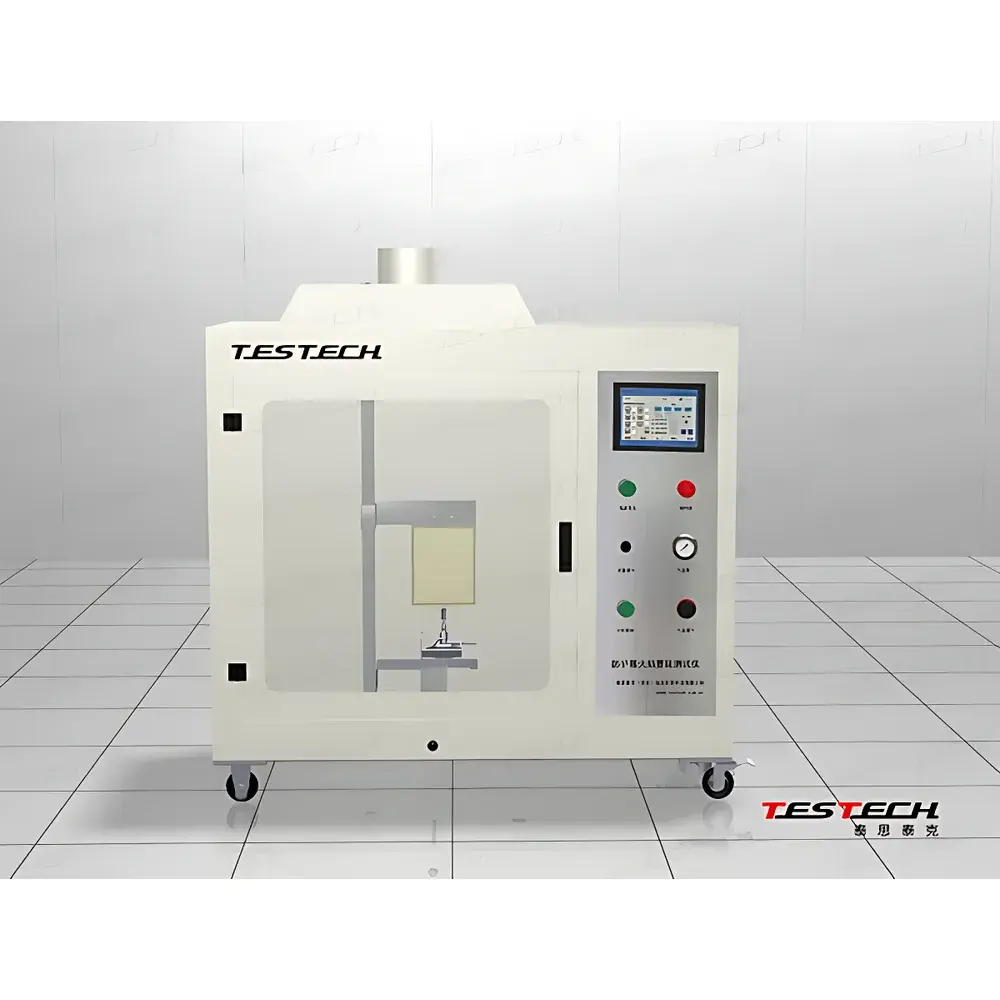
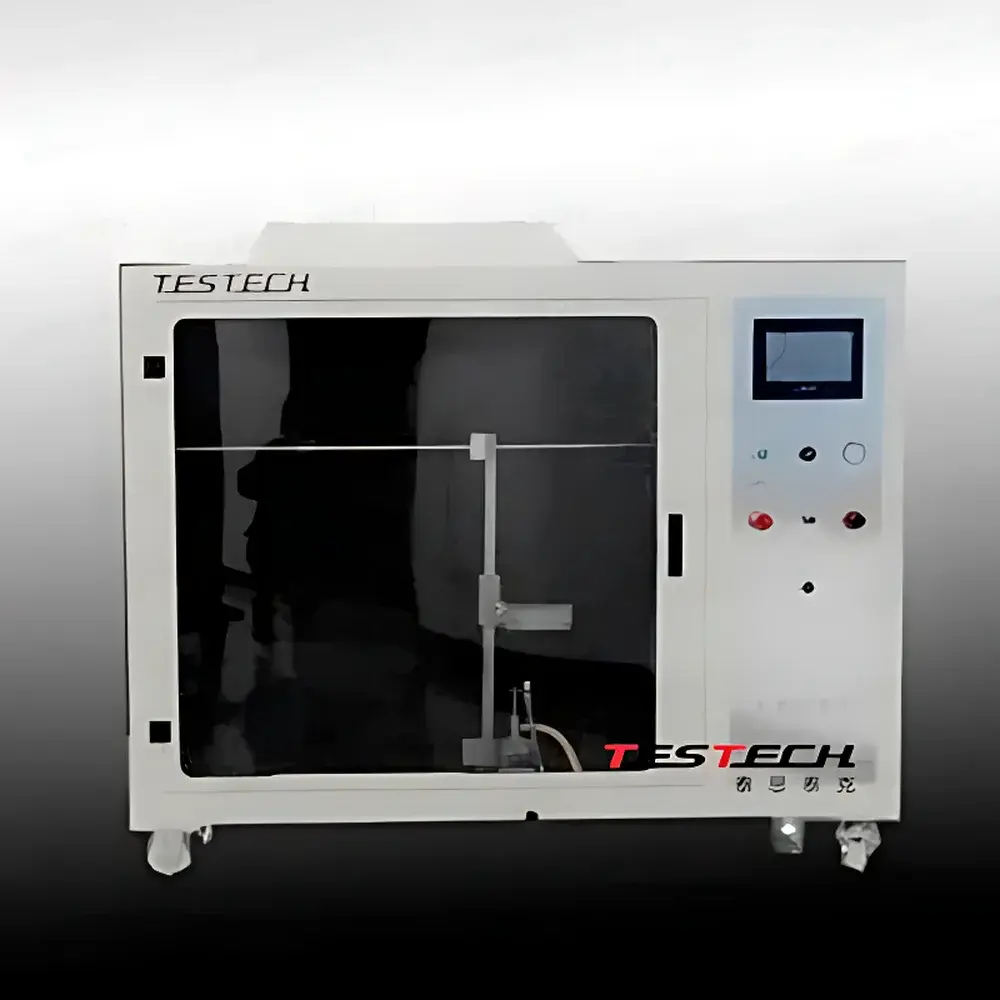
TESTech TTech-ISO15025 Flame Spread Tester for Protective Clothing (Compliant with ISO 15025:2016 & BS EN ISO 15025:2022)
| Brand | TESTech |
|---|---|
| Model | TTech-ISO15025 |
| Construction | Stainless Steel (AISI 304) |
| Chamber Dimensions | 1200 × 600 × 1200 mm (W × D × H) |
| Flame Height | Horizontal 25 ± 2 mm, Vertical 40 ± 2 mm |
| Nozzle Orifice | 0.19 mm |
| Timing Resolution | 0.1 s |
| Ignition | Pulse High-Voltage Electronic Auto-Ignition |
| Gas Control | Imported Precision Needle Valve & Pressure Regulator |
| Control System | PLC + 7″ Touchscreen HMI |
| Test Modes | Surface Ignition & Bottom Edge Ignition |
| Power Supply | 220 V AC, 50/60 Hz, Grounded |
Overview
The TESTech TTech-ISO15025 Flame Spread Tester is a precision-engineered combustion test chamber designed explicitly for evaluating the limited flame spread behavior of protective clothing and flame-resistant textiles in accordance with ISO 15025:2016 (“Protective clothing — Protection against heat and flame — Method of test for limited flame spread”) and its harmonized European counterpart, BS EN ISO 15025:2022. The instrument implements the standardized small-flame impingement method—where a defined propane or butane flame is applied to either the surface or bottom edge of a vertically mounted fabric specimen for a fixed duration (typically 10 s)—to quantitatively assess post-ignition behavior including afterflame time, afterglow time, char length, and hole formation. Its operation adheres to the fundamental principles of controlled thermal exposure and reproducible ignition geometry, ensuring compliance with regulatory frameworks governing personal protective equipment (PPE) certification under EU Regulation (EU) 2016/425 and OSHA-compliant workplace safety standards.
Key Features
- Robust all-stainless-steel construction (AISI 304) for chamber housing, specimen holders, and auxiliary fixtures—ensuring long-term corrosion resistance, dimensional stability, and compliance with laboratory hygiene requirements;
- Dual-mode specimen mounting system supporting both surface ignition and bottom-edge ignition configurations per ISO 15025 Annex A and Annex B, each with dedicated stainless-steel frames and alignment guides;
- Calibrated standard burner assembly featuring a 0.19 mm orifice nozzle, delivering stable laminar flame profiles at precisely regulated heights: 25 ± 2 mm (horizontal orientation) and 40 ± 2 mm (vertical orientation);
- Integrated high-precision gas control subsystem comprising imported needle valves and pressure regulators, enabling repeatable fuel flow and consistent flame thermodynamics across sequential tests;
- PLC-based control architecture paired with a 7-inch industrial touchscreen HMI—supporting programmable ignition duration (user-defined, typically 10 s), automatic timing start/stop triggers, and real-time status feedback;
- Pulse high-voltage electronic auto-ignition system eliminating manual torch handling and reducing operator variability;
- Automated timing module with 0.1-second resolution and non-volatile data logging—recording afterflame time, afterglow time, and total observation period directly to internal memory;
- Pre-installed flame height gauge (304 stainless steel) and calibrated gas tubing with dual hose clamps for secure, leak-free connections;
- Grounded 220 V AC power interface compliant with IEC 61000-6-3 EMC standards and laboratory electrical safety protocols.
Sample Compatibility & Compliance
The TTech-ISO15025 accommodates flat textile specimens measuring 160 mm × 50 mm, conditioned per ISO 139 (standard atmosphere: 20 °C ± 2 °C, 65 % RH ± 4 % RH) prior to testing. It supports woven, knitted, nonwoven, and laminated flame-retardant fabrics—including aramid, modacrylic, FR cotton blends, and coated technical textiles—used in firefighting turnout gear, military uniforms, and industrial arc-flash protection. The system meets mechanical and procedural requirements outlined in ISO/IEC 17025:2017 for accredited testing laboratories and supports audit-ready documentation for GLP-compliant reporting. While not itself certified to UL 94 or ASTM D6413, its test methodology is referenced in cross-standard evaluations for PPE classification under EN ISO 11612 and EN ISO 11611.
Software & Data Management
The embedded PLC firmware provides deterministic real-time control without reliance on external PCs. All test parameters—including ignition duration, mode selection (surface/bottom), operator ID, ambient temperature/humidity inputs, and pass/fail flags—are timestamped and stored locally in CSV-compatible format. Data export is supported via USB flash drive; no proprietary software installation is required. Audit trails include system event logs (e.g., ignition activation, timer reset, door interlock status) to satisfy traceability requirements under FDA 21 CFR Part 11 (when deployed in regulated quality assurance environments) and ISO 9001:2015 clause 8.5.2.
Applications
- Quality assurance testing of flame-resistant workwear during R&D and batch release;
- Comparative evaluation of fabric treatments (e.g., phosphorus-based vs. nitrogen–phosphorus synergistic FR systems);
- Validation of manufacturing consistency in coated or laminated composite PPE;
- Technical support for CE marking submissions under Module C2 or Module D conformity assessment;
- Training and demonstration of limited-flame-spread performance criteria for safety officers and procurement specialists.
FAQ
Which gas types are compatible with the TTech-ISO15025?
Propane or butane, supplied via standard LPG cylinder with CGA 770 or BS 341 No. 3 connection—gas purity ≥ 95 % recommended.
Is calibration certification included with delivery?
Yes, each unit ships with a factory-issued calibration report verifying burner alignment, flame height repeatability, and timer accuracy against NIST-traceable references.
Can the instrument be integrated into a LIMS environment?
Raw test data files (CSV) are LIMS-importable; optional RS-232 or Ethernet communication modules are available for automated data transfer upon request.
What maintenance intervals are recommended?
Burner nozzle inspection every 50 tests; stainless-steel chamber wipe-down after each session; annual verification of gas regulator linearity and timer drift per ISO/IEC 17025 Clause 6.4.6.
Does the system comply with updated ISO 15025:2016 requirements for specimen mounting tension?
Yes—the specimen frame applies ≤ 0.5 N clamping force as specified in Clause 6.2.2, verified during final factory acceptance testing.



