
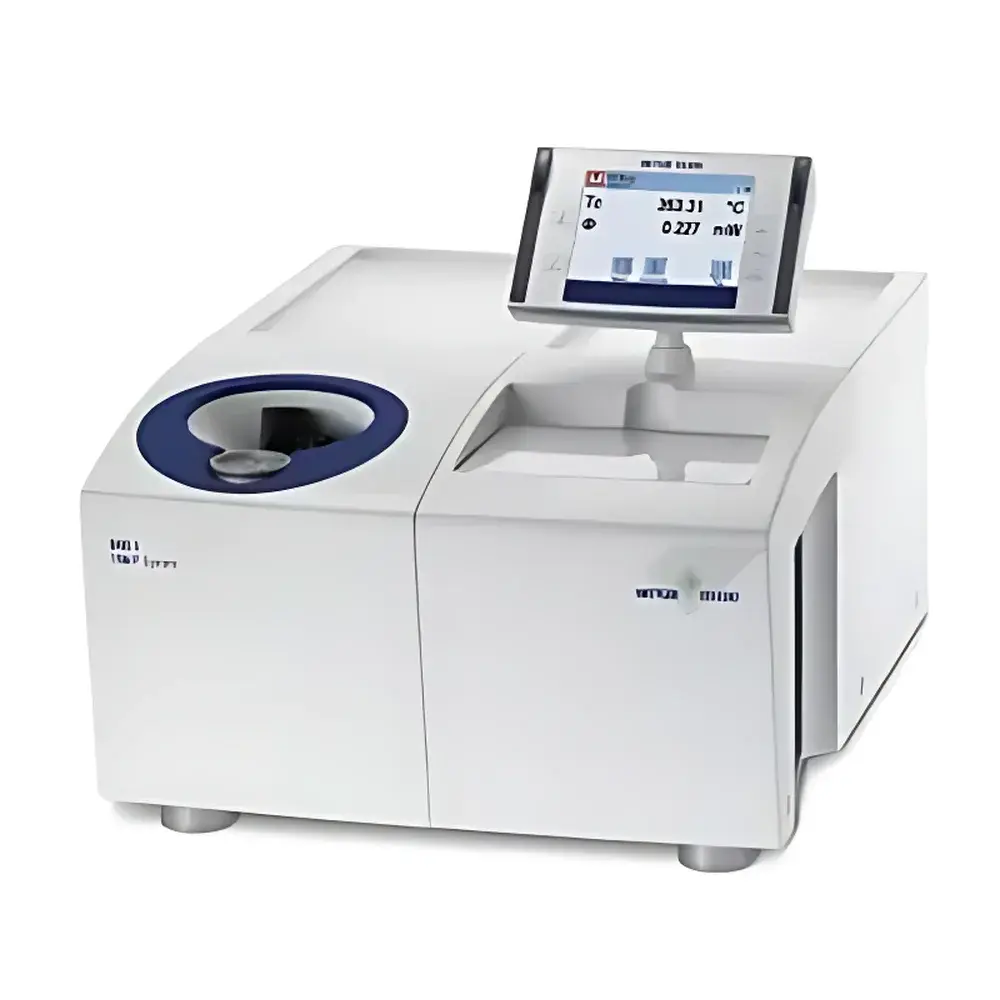
METTLER TOLEDO DSC Expansion System
| Brand | METTLER TOLEDO |
|---|---|
| Origin | Switzerland |
| Manufacturer Type | Authorized Distributor |
| Origin Category | Imported |
| Model | DSC Series (UV-DSC, Optical DSC, Microscope-DSC) |
| Pricing | Available Upon Request |
Overview
The METTLER TOLEDO DSC Expansion System is a modular thermal analysis platform designed to extend the functional scope of high-performance differential scanning calorimeters—primarily the HP DSC827e and DSC82xe series—beyond conventional heat-flow measurement. Built upon METTLER TOLEDO’s legacy in thermal instrumentation since the 1960s—including pioneering work in TGA-SDTA coupling, TGA-MS integration, and the introduction of TOPEM® Temperature-Modulated DSC—the Expansion System enables advanced, multi-modal characterization of thermally induced and light-triggered phenomena. Each expansion module operates on the principle of synchronized thermal control and external stimulus delivery (UV irradiation, optical detection, or real-time microscopy), allowing researchers to correlate enthalpic events measured by DSC with spatial, kinetic, or photochemical responses. This architecture supports rigorous investigation of structure–property relationships under controlled thermal and environmental conditions, particularly for polymer curing, stabilization kinetics, phase transitions, and degradation mechanisms.
Key Features
- UV-DSC Module: Integrates a calibrated UV light source (wavelength-selectable, typically 254–365 nm) with precise temporal control to initiate and monitor photopolymerization, photodegradation, or photocrosslinking reactions during DSC heating/cooling ramps or isothermal holds.
- Optical DSC Module: Configurable with either a photomultiplier tube (PMT) for high-sensitivity chemiluminescence (CL) detection or a scientific-grade CCD camera enabling spatially resolved CL imaging across the sample surface—critical for mapping antioxidant distribution heterogeneity in polymeric matrices.
- Microscope-DSC Integration: Couples the DSC furnace with an upright or inverted optical microscope equipped with video capture and digital photography; permits real-time visualization of morphological evolution—including crystal nucleation/growth, melting front propagation, color shifts, birefringence changes, and dimensional anisotropy—during thermal cycling.
- Hardware Synchronization: All modules interface via METTLER TOLEDO’s STARe software platform, ensuring time-aligned acquisition of thermal, optical, and image data streams with sub-second timestamp resolution.
- Thermal Integrity Preservation: Expansion components are engineered to maintain baseline stability, temperature accuracy (±0.1 °C), and repeatability (<0.1% RSD in ΔH) without compromising core DSC performance metrics.
Sample Compatibility & Compliance
The DSC Expansion System accommodates standard DSC pans (aluminum, gold-plated aluminum, hermetic lids) and supports solid, semi-crystalline, and viscous samples up to 50 mg. UV-DSC requires optically transparent or semi-transparent specimens; Optical DSC demands low-background luminescent materials; Microscope-DSC necessitates flat, optically accessible sample geometries (e.g., thin films, pellets, or microtomed sections). The system complies with ISO 11357 (Plastics — Differential Scanning Calorimetry), ASTM E794 (Melting and Crystallization Temperatures), and supports GLP/GMP workflows through audit-trail-enabled data logging, electronic signatures, and 21 CFR Part 11–compliant software configuration options within STARe.
Software & Data Management
STARe Evaluation Software (v15.x or later) serves as the unified control and analysis environment. It provides synchronized multi-channel acquisition, automated baseline correction, peak deconvolution, kinetic modeling (e.g., Ozawa-Flynn-Wall, Kissinger), and CL intensity quantification per pixel region. Image sequences from the microscope module are time-stamped and linked to corresponding DSC thermograms; CL maps can be overlaid onto thermal event markers for correlative interpretation. Raw data are stored in vendor-neutral .tdms or .csv formats, supporting third-party analysis in MATLAB, Python (via PySTARe), or commercial analytics suites. Data integrity is ensured via encrypted project files, version-controlled method templates, and configurable user access levels.
Applications
- Photocuring kinetics of dental resins, 3D-printing photopolymers, and UV-adhesives under programmable irradiation profiles.
- Spatial mapping of antioxidant depletion gradients in polyolefins using chemiluminescence imaging during oxidative induction time (OIT) tests.
- In situ observation of polymorphic transitions in pharmaceutical actives (e.g., ritonavir Form I → II) and correlation with enthalpy changes and onset temperatures.
- Real-time tracking of spherulite growth rates, lamellar thickening, and melt-recrystallization behavior in semicrystalline thermoplastics (e.g., PP, PET).
- Validation of thermal stability models for battery separator films under combined thermal–mechanical stress and UV exposure.
FAQ
Can the UV-DSC module be used with non-METTLER TOLEDO DSC instruments?
No. The UV-DSC module is mechanically and electronically integrated exclusively with METTLER TOLEDO HP DSC82xe and DSC827e platforms, requiring proprietary firmware, pan alignment fixtures, and optical path calibration.
Is the microscope-DSC system compatible with polarized light or hot-stage configurations?
Yes. Optional polarizing filters and heated stage accessories (up to 600 °C) are available for birefringence analysis and high-temperature morphological studies.
Does the Optical DSC module support time-resolved CL measurements?
Yes. PMT-based configurations achieve temporal resolution down to 10 ms; CCD-based imaging supports frame rates up to 30 fps with binning, enabling dynamic CL kinetics tracking.
Are calibration standards provided for UV irradiance and CL sensitivity?
Yes. NIST-traceable UV radiometers and certified CL reference materials (e.g., luminol solutions) are included with initial system validation kits.
How is data synchronization achieved between thermal and optical channels?
Hardware-level triggering via TTL pulses from the DSC controller ensures sub-millisecond alignment between temperature ramp initiation, UV pulse onset, and image acquisition start signals.



