
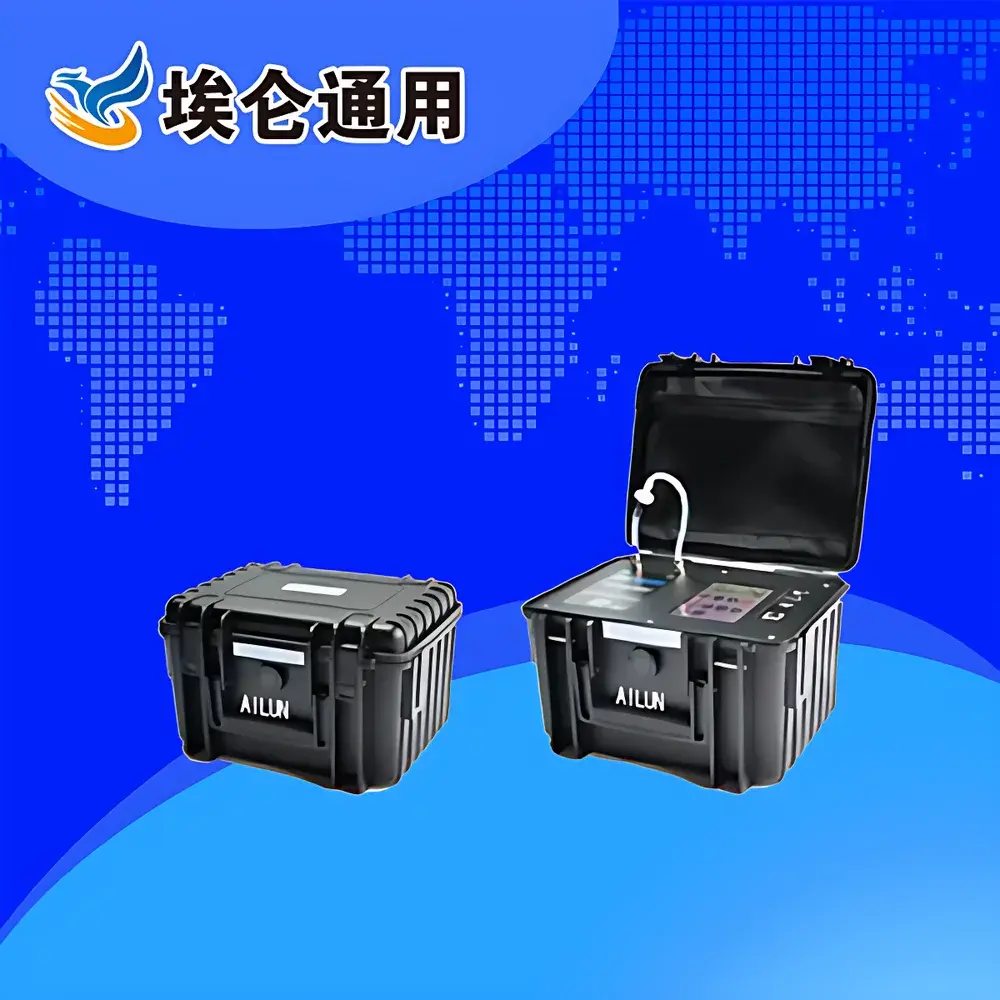
Ailun AL-HB6200 Smart Radon Monitor (Scintillation Cell Method)
| Brand | Ailun |
|---|---|
| Origin | Shandong, China |
| Manufacturer Type | Authorized Distributor |
| Origin Category | Domestic |
| Model | AL-HB6200 |
| Pricing | Upon Request |
Overview
The Ailun AL-HB6200 Smart Radon Monitor is a field-deployable, scintillation-cell-based instrument engineered for quantitative measurement of radon-222 (222Rn) activity concentration in air, soil gas, water, and radon exhalation rate from building materials and soil surfaces. It operates on the principle of alpha-particle-induced scintillation in a ZnS(Ag)-coated chamber, where radon decay progeny (primarily 218Po and 214Po) emit alpha particles that excite the phosphor layer, generating detectable light pulses. These photons are collected via an optimized cup-shaped internal light guide and converted into electrical signals by a side-window, cathode-grounded 1-inch photomultiplier tube (PMT) from Hamamatsu Photonics. The system employs active sampling—via integrated diaphragm pump—to ensure controlled, reproducible airflow through the scintillation cell, minimizing diffusion-related delays and enhancing temporal resolution. Designed to meet rigorous environmental and occupational health monitoring requirements, the AL-HB6200 supports compliance with key international and national standards including ISO 11665-2:2019 (Measurement of radon-222 — Part 2: Integrated measurement methods), ASTM D6937-22 (Standard Guide for Use of Radon Measurement Methods), and Chinese national standards GB/T 14582–1993, GB 50325–2020, and T/CECS 569–2019.
Key Features
- Compact, portable design: Dimensions 275 × 220 × 167 mm; net weight 3.0 kg—optimized for field surveys, indoor audits, and mobile laboratory deployment.
- High-efficiency optical coupling: Internally nested cup-shaped light window maximizes photon collection efficiency while maintaining absolute gas-tight integrity of the scintillation cell.
- Dual-mode sampling architecture: Supports both single-cycle (grab) and continuous accumulation modes, enabling flexible protocol selection per application (e.g., short-term screening vs. long-term trend analysis).
- Integrated ARM-based embedded platform running Android 4.4 OS: Enables real-time data visualization, touch-responsive UI, audio feedback, and local storage with timestamped event logging.
- Multi-interface connectivity: Equipped with USB host/device, Wi-Fi (IEEE 802.11 b/g/n), and Ethernet ports for remote configuration, firmware updates, and secure data export.
- Modular sensor architecture: Standard configuration includes air and soil gas measurement capability; optional modules support aqueous radon extraction (via liquid–gas equilibration) and surface exhalation rate quantification using calibrated accumulation chambers.
Sample Compatibility & Compliance
The AL-HB6200 is validated for direct measurement of 222Rn in ambient air (3–100,000 Bq/m³), soil gas (300–300,000 Bq/m³), and radon exhalation rate (0.001–10.000 Bq/[m²·s], optional). With accessory kits, it extends to aqueous samples (0.003–1000 Bq/L) following standard degassing protocols. All operational modes adhere to QA/QC requirements outlined in ISO/IEC 17025:2017 for testing laboratories. Data acquisition and storage comply with GLP principles, supporting audit-ready traceability—including user ID, GPS coordinates (when enabled), calibration history, and environmental metadata (T, RH). While not FDA 21 CFR Part 11-certified out-of-the-box, its logging architecture permits integration into validated workflows under GMP or radiation safety programs requiring electronic record integrity.
Software & Data Management
The onboard software provides intuitive graphical display of count rate vs. time, auto-calculated activity concentration with background subtraction, and configurable alarm thresholds. Raw pulse data and processed results are stored in CSV and XML formats on internal flash memory (8 GB) or microSD card. Desktop companion software (Windows/macOS compatible) enables advanced spectral analysis, uncertainty propagation per ISO 11665-4, batch report generation (PDF/Excel), and alignment with regulatory reporting templates (e.g., EPA Form 5200-1, CNIC Rn Survey Logs). Audit trails include operator login, parameter changes, and calibration events—all time-stamped and non-erasable.
Applications
- Indoor air quality assessment in residential, commercial, and institutional buildings per GB 50325–2020 and WHO reference levels.
- Soil gas mapping for uranium exploration, geothermal prospecting, and seismic precursor studies.
- Radiation protection surveys at nuclear facilities, waste repositories, and decommissioning sites.
- Radon exhalation characterization of construction materials (concrete, granite, fly ash brick) per T/CECS 569–2019.
- Educational use in nuclear physics, health physics, and environmental science curricula—supporting hands-on experiments in radioactive decay kinetics and detector response modeling.
- Emergency response deployment during radiological incidents involving radon progeny release or groundwater contamination events.
FAQ
What detection principle does the AL-HB6200 employ?
It uses alpha-scintillation detection in a ZnS(Ag)-coated cell, coupled with a Hamamatsu PMT for high quantum efficiency and low-noise pulse discrimination.
Is calibration traceable to national standards?
Yes—factory calibration is performed against NIM (National Institute of Metrology, China) radon reference sources; users may perform field recalibration using certified check sources (e.g., 226Ra-sealed standards).
Can the instrument operate unattended for extended periods?
Yes—battery life exceeds 8 hours under continuous sampling; external 12 V DC power input enables multi-day deployments with optional solar charging.
Does it support automated reporting for regulatory submissions?
Yes—the desktop software generates compliant reports aligned with GB/T 14582–1993 Annex C and ISO 11665-6:2016 reporting structures, including uncertainty budgets and detection limit calculations.
How is moisture interference mitigated during soil gas sampling?
An integrated desiccant cartridge (replaceable silica gel) removes water vapor upstream of the scintillation cell, preventing quenching effects and preserving counting stability at RH ≤ 90%.







